

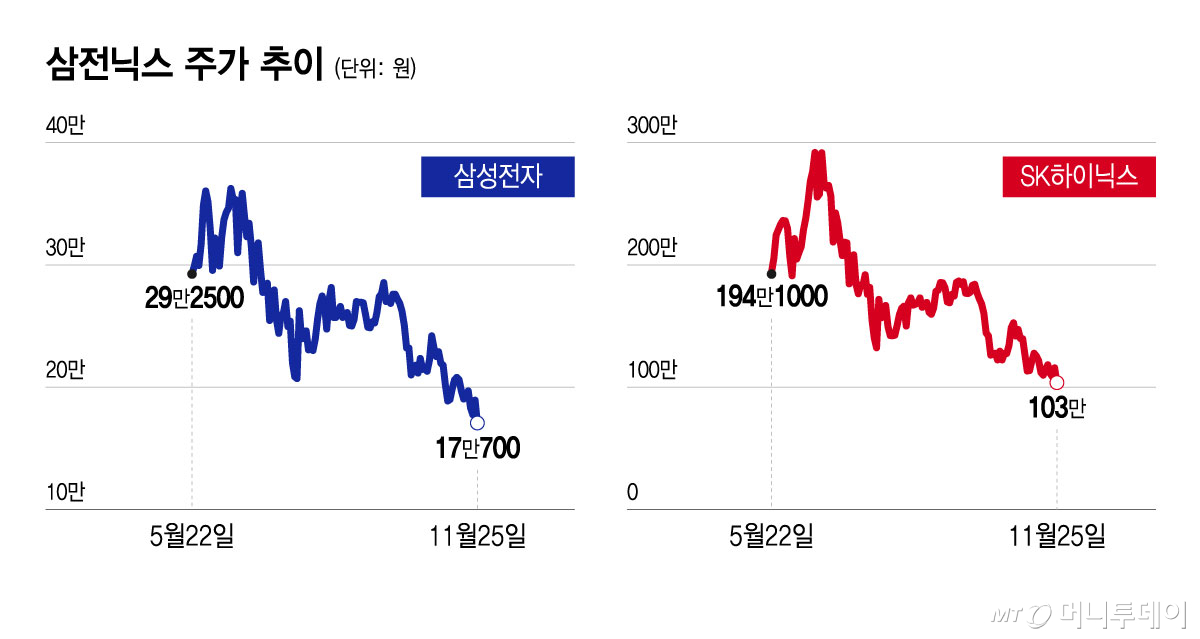
Losses are mounting for retail investors who concentrated their investments in semiconductor stocks. This is because Samsung Electronics and SK hynix have plunged by approximately 25% so far this month alone.
The impact is even greater given that the two major semiconductor leaders, along with leveraged exchange-traded funds (ETFs) that track them at twice the rate, were the most heavily purchased stocks by individuals since the KOSPI hit its all-time high in June.
On the 25th, Samsung Electronics closed trading down 9.87% from the previous session at 170,700 won, while SK hynix ended down 11.05% at 1.03 million won.
This came just one day after a rebound on the previous day. The two stocks have fallen by 24% and 27%, respectively, since the start of this month, and are down 52.9% and 64.7% from their peaks. Samsung Electronics' market capitalization fell below 1,000 trillion won due to the decline on the day. This is the first time since March 31.
Since June 22, when the KOSPI hit its closing price high of 9,114.55, SK hynix has been the most net-purchased stock by retail investors in the domestic stock market, with net purchases reaching 14.9 trillion won. Samsung Electronics follows next at 10.4295 trillion won.
In the ETF market as well, the top two individual net purchases over the past six months were the KODEX SK hynix Single Stock Leveraged ETF (4.8 trillion won) and the TIGER SK hynix Single Stock Leveraged ETF (3.4 trillion won).
The KODEX Samsung Electronics Single Stock Leveraged ETF and SOL AI Semiconductor TOP2 Plus also ranked in the top tier with net purchases of around 2 trillion won each. Leveraged ETFs, which track daily returns at twice the rate, see losses double when stock prices fall.
The KRX Semiconductor Index has dropped 24.9% since the start of this month, recording the largest decline among major sectors. Over the same period, the KOSPI fell by 18%. This is due to persistent doubts regarding AI investment.
Concerns over AI profitability and the prolonged high-interest-rate environment are compounding anxiety about AI investment. While global AI companies continue their investments and maintain solid performance, doubts about sustainability remain.
Positive factors such as major corporate earnings reports, the listing of Anthropic, and the return of Jensen Huang, CEO of NVIDIA, have been reflected in the short term only to be followed by repeated declines.
Park Sang-hyun, an analyst at iM Securities, said, "The NASDAQ, which had shown a strong upward trend riding the AI cycle, as well as the Korean and Taiwanese stock markets, are experiencing sharp declines accompanied by high volatility."
He added, "We are approaching the speed of stock price declines seen during the IT bubble, surpassing levels comparable to those of global financial regulatory bodies, while the KOSPI is showing the fastest decline rate among past crash scenarios."
In the securities industry, it is assessed that current stock prices for semiconductor stocks, including Samsung Electronics and SK hynix, are excessively low relative to fundamentals.
This is explained by continued earnings growth and still robust semiconductor demand, such as long-term contracts.
Nam Dae-jong, an analyst at Daol Investment Securities, said, "The recent correction has already reflected uncertainty regarding future profit outlooks, and supply-demand pressure will ease next year." He added, "Stock prices will gradually reflect the solid industry trend."
Advice is also emerging that one should not react hastily, as the current market is more about sentiment than numbers.
Kim Do-hyung, head of the ETF Consulting Division at Samsung Asset Management, noted, "Even if figures regarding performance or demand emerge, there is a lack of confidence, and it is an issue of investment psychology."
However, he advised, "In a situation with significant losses, selling or adjusting portfolios could result in greater future damage, and initiating purchases is also difficult, so a cautious approach is necessary."

 in STOCK
