

The duty-free industry is showing signs of recovery, buoyed by an increase in foreign tourists during the first half of the year. The rise in visitors to Korea, driven by K-beauty, food, and K-pop concerts, has boosted sales. Industry observers view the second half, extending through the summer vacation season, China's National Day (Guoqing Festival), and year-end travel, as a turning point for performance recovery.
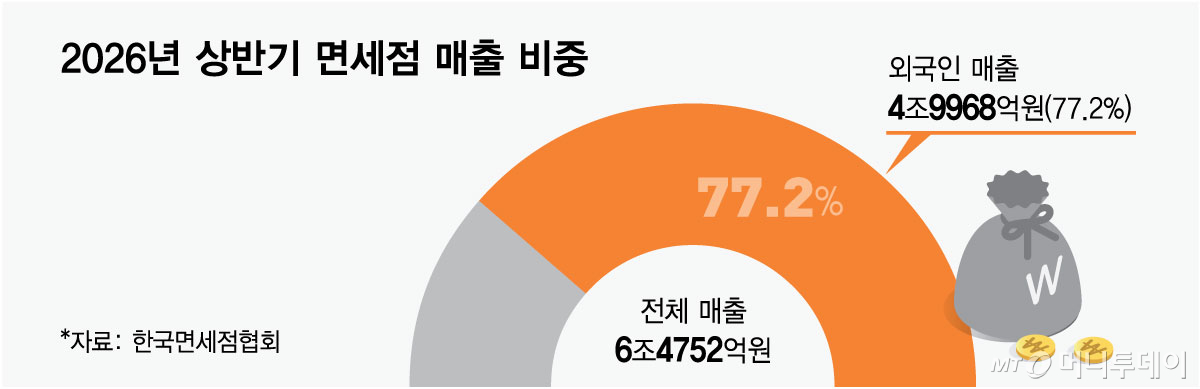
According to data from the Korea Duty-Free Shop Association released on the 29th, foreign tourist spending at duty-free shops in the first half of this year reached 4.9968 trillion won, an 11.2% increase compared to the second half of last year. Foreigner sales accounted for 77.2% of total sales of 6.4752 trillion won, effectively driving overall performance.
Additionally, the number of foreign visitors rose by 14.9% to 6.64 million. In contrast, domestic tourist spending and visitor numbers fell by 12% and 11.5%, respectively, to 1.4783 trillion won and 8.41 million during the same period. Foreign visitor numbers increased month-by-month: 1.08 million in March, 1.19 million in April, 1.22 million in May, and 1.27 million in June.
The industry analyzed that the increase in visitors to Korea is the biggest driver of duty-free shop recovery. This is due to increased price competitiveness for shopping in Korea amid a weak won, alongside sustained popularity of K-beauty and K-food. It was also noted that major K-pop events, such as BTS concerts, stimulated demand for visits to Korea and contributed to the rise in duty-free shop visitors.
In fact, according to Lotte Duty-Free, foreign beauty sales increased by 55% and food sales by 62% compared to the same period last year. The company explained that it expanded its customer base for foreign visitors by increasing the number of new brand stores, which led to higher purchases. Recently, popular beauty brands such as 'S Nature' and 'Dr. Jart+' have been added, while the company is responding to K-food demand through collaborations with BTS on food brands like 'Ari', along with ready-to-eat meals and traditional foods.
However, the increase in visitors did not lead to a rise in average transaction value. Based on first-half data, the average transaction value for foreigners decreased by 3.2% to 751,900 won, while that for domestic tourists fell by 0.5% to 175,700 won. Consequently, strengthening product competitiveness and shopping experiences to raise average transaction values has been identified as a key challenge for the duty-free industry. At the same time, analysts suggest that if dependency on foreign visitors is reduced and domestic consumption also recovers, long-term growth can be pursued.
The industry expects recovery trends to become more pronounced in the second half. With the summer vacation season in July and August, the National Day holiday in October, and the year-end shopping peak season, there is a high likelihood of increased tourist inflows. As foreign sales in the first half approached 5 trillion won, attention is also focused on whether total annual sales will reach 10 trillion won if the second-half tourism peak effect materializes.
An industry official stated, "Recently, the recovery trend in duty-free shops has been led by an increase in foreign tourists," adding, "With continued interest in K-food and K-beauty, strategies that leverage this to create differentiated shopping experiences and also boost domestic demand will become increasingly important."

 in INDUSTRY
