

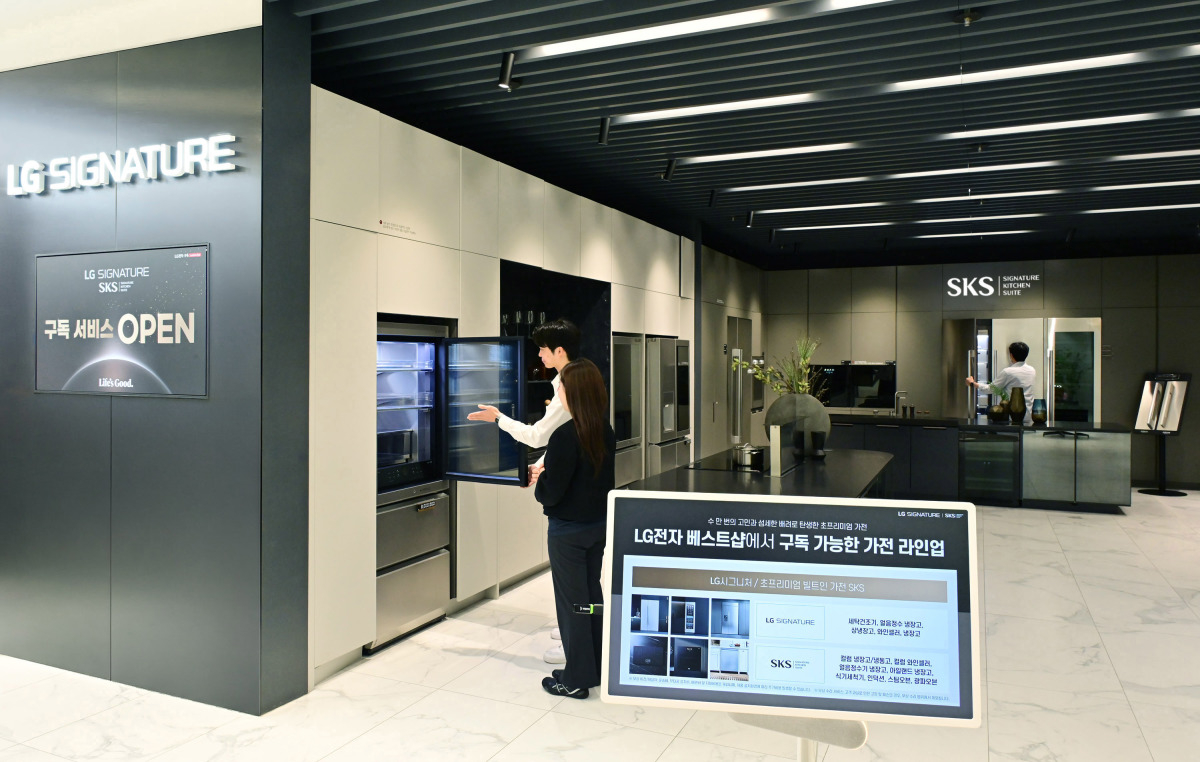
The race for leadership in the premium home appliance market is expanding beyond AI (artificial intelligence) performance to 'space utilization.' As the home appliance industry strengthens business strategies that enhance the value of living spaces beyond spec competition, the rivalry to seize the B2B (business-to-business) housing market is becoming increasingly fierce.
According to Grand View Research, a market research firm, the compound annual growth rate of built-in products in Korea's kitchen appliance market from 2023 to 2030 reached 9.8%. This is twice the level of general appliance growth rates (4–5%).
The home appliance industry believes that as AI functions spread across premium products, performance differentiation between products has become difficult. Accordingly, appliance companies are shifting their strategies toward considering space utilization from the product design stage. Built-in appliances can be installed embedded within furniture, reducing installation clearance and securing usable space even in limited areas. Especially in high-end residential areas with high space value, this effect is felt more strongly, leading to a trend of increasing preference for built-ins.
The Apgujeong Hyundai Apartment reconstruction project is a prime example. LG Electronics collaborated with Hyundai E&C to propose a built-in appliance subscription option to residents, combining convertible refrigerators, washing machines, dryers, Styler appliances, dishwashers, and combi ovens into an integrated unit. The industry estimates that such configurations can secure approximately 0.5 pyeong of space. Considering the new construction market price in Apgujeong, which is around 300 million won per pyeong, the space value gained through built-ins could be converted to hundreds of millions of won. An industry official explained, "It is highly symbolic that construction companies have begun positioning built-ins not merely as simple options but as core elements of space value proposals."
As space value emerges as a new competitive factor for premium home appliances, appliance companies' strategies are also changing. From the perspective of appliance manufacturers, built-ins allow multiple products such as refrigerators, washing machines, and dishwashers to be supplied as packages, resulting in larger sales per household compared to individual product sales. Additionally, built-in packages are easily linked to B2B orders from construction companies, making them highly valuable for business utilization from the perspective of appliance firms.
LG Electronics is utilizing built-in appliances as a means to expand its service model. In Korea, it introduced a model combining home appliance subscriptions and built-ins triggered by reconstruction projects, while overseas, it is expanding B2B touchpoints centered on the ultra-premium built-in brand SKS. Product development directions are also centering on space utilization. Examples include the 'Rony' hidden station for robot vacuums installed in the baseboard space at the bottom and the 'Fit & Max' refrigerator that can be installed with just a 4mm gap.
Samsung Electronics is pursuing an expansion strategy focused on B2B through Daiko, targeting high-end residential projects. Instead of selling individual products, it supplies built-in packages to premium housing complexes, aiming to expand brand touchpoints within the high-end residential market. All units in 'Aripeca,' a premium single-family home complex in Riviera, Florida, USA, were equipped with Daiko built-in appliances, combining them with connectivity experiences based on SmartThings to pursue differentiation. Through this, it plans to strengthen its B2B competitiveness based on collaboration with construction companies in the North American high-end residential market.
The home appliance industry expects that built-in competition will become a key variable for the premium home appliance market going forward. Another official stated, "Beyond simple product performance, interior culture emphasizing harmony between appliances and living spaces is spreading," and predicted, "Demand for built-in appliances that can maximize the economic value of space will continue to increase."

 in INDUSTRY
