

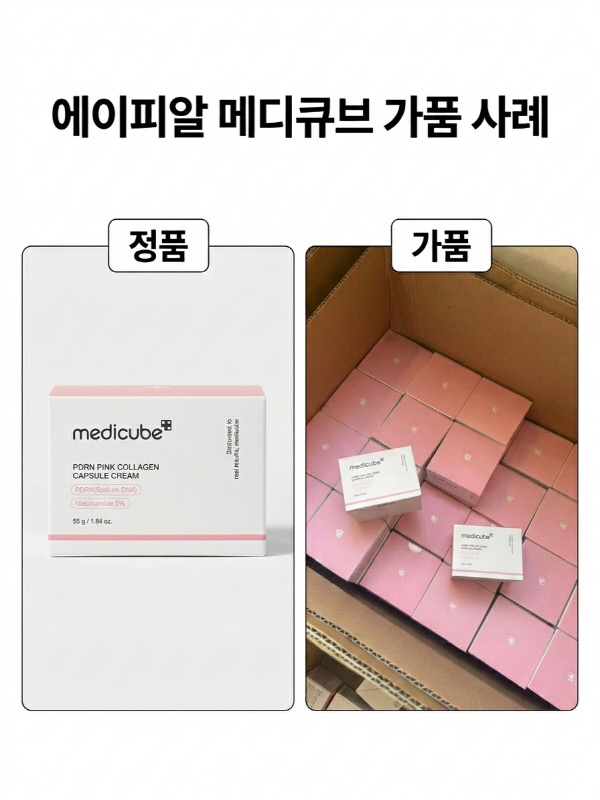
As the global popularity of 'K-beauty' rises, counterfeit and similar products imitating domestic cosmetic brands are spreading beyond Asia to Europe. Cases have emerged where not only product appearance but also product names, packaging, detailed pages, and even the brand image of K-beauty itself are being exploited, increasing the response burden on domestic companies.
According to the beauty industry on the 11th, APR confirmed that last month, over 100 suspected counterfeit items of its brand Medicube's 'PDRN Pink Collagen Capsule Cream' were seized by customs at Timișoara Airport in Romania. The seized products are said to be so similar in appearance and container design to genuine items that consumers cannot distinguish them with the naked eye. This seizure in Romania is a case showing that the distribution range of K-beauty counterfeits has expanded to Eastern Europe.
The methods of imitating products are becoming increasingly sophisticated. A Chinese cosmetic brand uses product names identical or similar to Medicube's 'Collagen Night Wrapping Mask' and 'No More Pore Pad' to sell products on Amazon and Lazada, among other platforms. The brand has applied colors used by Medicube, such as pink and light green, to its packaging, and cases have been confirmed where past model images and product detail pages were directly stolen. Notably, even though it is a Chinese brand, some cases have appeared where 'Korean Beauty' is promoted or the term 'KOREA' appears in online search results. Experts point out that counterfeit products have evolved from simply copying popular items to leveraging the reputation built by Korean brands and the image of 'Made in Korea.'
China is identified as a major production hub for counterfeit goods. In early last month, a joint crackdown by the Baiyun District Public Security Bureau and Market Supervision Administration in Guangzhou City, China, resulted in the seizure of over 6,000 suspected imitation products across six Medicube product lines. During this operation, numerous products from other well-known domestic brands with high overseas recognition, such as Skin1004 and Arensia, were also discovered. Chinese authorities had previously, in April last year, uncovered multiple Medicube counterfeit items while cracking down on a cosmetic counterfeit manufacturing site located in Guangzhou.
Online platforms serve as channels accelerating the global spread of counterfeit goods. Sellers replicate product photos and detailed descriptions from official brand stores to mimic legitimate sales outlets, then ship counterfeit products manufactured in China and other countries.
Our companies respond by coordinating with local legal representatives and law enforcement authorities to inspect production facilities or report sales posts on platforms. However, due to the nature of overseas manufacturing and distribution, it is difficult to track producers and sellers, and regulatory systems vary by country, limiting response efforts. A beauty industry official stated, "We need to strengthen cooperation between foreign customs, law enforcement authorities, and online platforms."

 in INDUSTRY
