

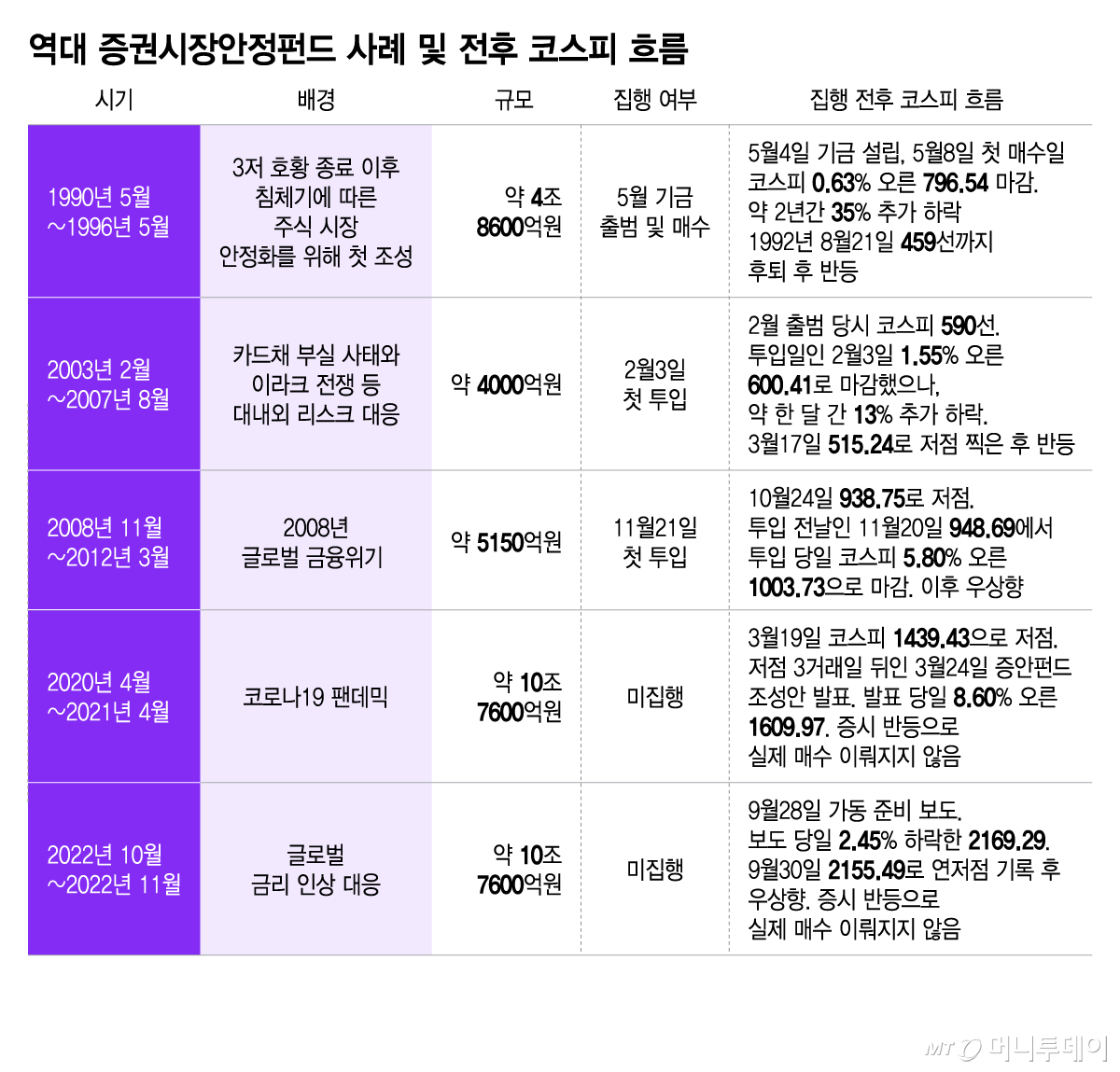
The government is preparing to activate the securities market stabilization fund for the first time in 18 years, but its track record is mixed. The fund has been included in policy responses on five occasions, three of which led to actual deployment.
Although the stock market often hit bottom around the time such measures were announced, helping stabilize investor sentiment, many analysts say it is difficult to conclude that the fund drove a sustained market rebound.
According to financial investment industry sources on Nov. 23, the government and financial authorities decided at an emergency market situation review meeting on Nov. 22 to begin preparations to ensure the fund could be activated immediately if market conditions warranted.
The fund is a mechanism financed by contributions from financial institutions and securities-related organizations. It purchases products linked to major stock indexes to absorb selling pressure during sharp market downturns.
The years in which the SMF and its predecessor, the Stock Market Stabilization Fund, appeared were 1990, 2003, 2008, 2020, and 2022. Among these, actual purchases were made in 1990, 2003, and 2008.
The first case in 1990 was close to a failure. As the "three lows" boom ended and stock market sluggishness continued, a Stock Market Stabilization Fund of approximately 4.85 trillion won was launched in May of that year. On May 8, when the fund first purchased stocks, the KOSPI rose by 0.63%, but it subsequently continued to fall, dropping to 459.07 on August 21, 1992. This level was 33.3% lower than at the end of April 1990 (688.66).
In the subsequent four instances, measures were introduced around the stock market's bottom. In 2003, as concerns over non-performing card loans grew, a 400 billion won SMF was first deployed on February 3. However, with anxieties over the Iraq War overlapping, the KOSPI continued to fall until March 17, reaching 515.24 before rebounding. In 2008, during the global financial crisis, after the KOSPI hit its annual low of 938.75 on October 24, it rose by 5.80% on November 21, when the first funds from a 515 billion won fund were deployed.
In 2020 and 2022, the market rebounded without any capital being injected. In 2020, the KOSPI hit its bottom on March 19, and the government announced a plan to raise a 10.76 trillion won fund three trading days later, on March 24. In 2022, after preparations for reactivation were revealed on September 28, the KOSPI recorded its annual low (2,155.49) two days later, on September 30, before rebounding.
Experts view the effect of the SMF as primarily stemming from psychological stabilization.
In a 2023 report analyzing SMF measures from 1990 to 2022, Senior Research Fellow Song Min-gyu at the Korea Institute for Financial Industry said, "Effects such as alleviating psychological anxiety through volatility mitigation appear relatively clearly, while trends are observed in actual stock price rebound effects and liquidity supply effects."
Kim Dae-jun, an analyst at Korea Investment & Securities, said, "In 2020 and 2022, 10.76 trillion won was raised each time, but funds were never directly injected into the stock market on either occasion; stability was restored through verbal intervention alone."
Pointers also suggest it is difficult to say that injected funds directly propped up the stock market. According to Kiwoom Securities, the KOSPI rose by 41.3% and 42.0%, respectively, in the year following the execution of the SMF in 2003 and 2008, but changes in monetary policy and the easing of external uncertainties also played a role.
Shinhan Investment Corp analyzed, "In both 2003 and 2008, when actual funds were injected, the fund size was at a level of 0.1% of the market capitalization at the time, making it difficult to view the SMF as the direct cause of the rebound." Research Fellow Song also noted, "It is dangerous to attribute even statistically significant policy effects entirely to the SMF."
Analysts say that this time, too, the key to a sustained rebound lies in resolving uncertainty surrounding AI (artificial intelligence) investment.
Han Ji-young, a researcher at Kiwoom Securities, said, "The fundamental source of anxiety that triggered the stock market correction after October—uncertainty related to AI—remains unresolved." She added, "Whether the delay in monetization by AI companies and funding burdens will lead to reduced capital expenditure, and whether this ripple effect will lower profit forecasts for domestic semiconductor companies, is crucial for a rebound."

 in STOCK
