

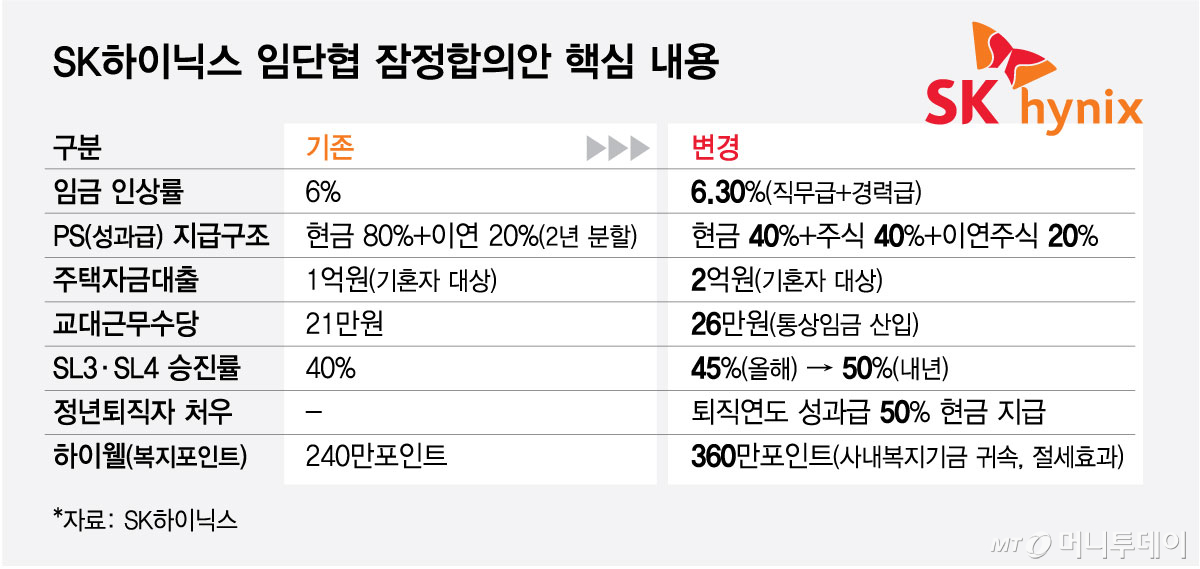
The decision by SK Hynix management and labor to pay 60% of the profit-sharing bonus (PS) in company shares reflects a compromise between the interests of the company and the union. The company secured its principle of stock-based compensation while also introducing a mechanism to protect against price declines on the 40th% of shares paid out immediately, without imposing any selling restrictions. This approach lowers the conditions for holding stocks compared to Samsung Electronics, thereby increasing the likelihood of union acceptance.
According to the electronics industry on the 20th, the tentative agreement on wages and collective bargaining for 2026 reached between SK Hynix management and labor includes provisions to pay 40% of PS in cash and 60% in company shares. Of the company shares, 40% will be paid out immediately, while the remaining 20% will be deferred and distributed at 10% each over one and two years.
SK Hynix recorded sales of 131 trillion 895 billion won and an operating profit of 98 trillion 152.9 billion won in the first half of this year, marking a record-high performance. Securities firms project that annual operating profit could reach 250 trillion won. Based on this figure, a simple calculation shows that PS funding would amount to 25 trillion won, representing 10% of operating profit. If implemented according to the tentative agreement, 20 trillion won in cash and company shares would be provided immediately, with the remaining 5 trillion won deferred over the next two years.
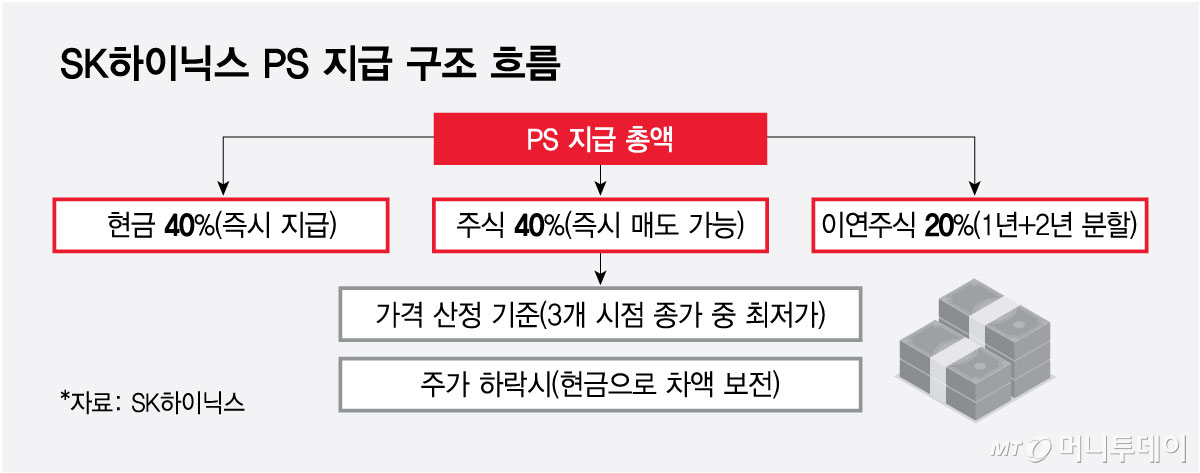
The background behind the union's acceptance of such a management proposal lies in expectations for future performance and stock prices. If the cash-centric compensation system shifts to stocks, employee compensation could become linked with corporate valuation. When stock prices rise, employees can share in the gains. Conditions have also been put in place to reduce risks associated with the shift to stocks. The 40% of company shares paid out immediately can be disposed of right away. The stock calculation price will apply the lowest closing price among the date of management performance announcement, the PS cash payment date, and the stock distribution date. If the value of the shares falls below the PS payment amount based on the closing price on the first day after share distribution, the difference will be compensated in cash.
This differs from Samsung Electronics' company share-based performance bonus established last May. Samsung Electronics paid out its entire Device Solutions (DS) division special management performance bonus in company shares, allowing only one-third of the distributed amount to be sold immediately. The remaining one-third each was subject to selling restrictions for one and two years, respectively. These standards will apply starting from payments made in 2027. This design aims not only to link compensation with stock prices over a long period but also to prevent employee turnover.
In contrast, SK Hynix imposes no selling restrictions on the 40th% of company shares distributed, making it less effective than Samsung Electronics as an incentive for long-term holding. The effect of linking stock-based compensation to long tenure to prevent talent loss is also limited. However, given that the existing cash-centric PS had to be converted into stock-based compensation, it can be seen that SK Hynix chose to increase disposal possibilities to reduce the burden on employees. Additionally, allowing employees to convert 40% of distributed company shares into cash in 2027 if they wish serves as a buffer measure during the institutional transition process.
An industry insider stated, "The company has secured the principle of linking performance bonuses with stock prices, and from the employees' perspective, sufficient room for cashing out has been ensured even when receiving compensation in stocks." The insider added, "The weaker selling restrictions compared to Samsung Electronics can be viewed as a compromise reached between management and labor to transition from an existing cash-based compensation system to a stock-based one."

 in INDUSTRY

