

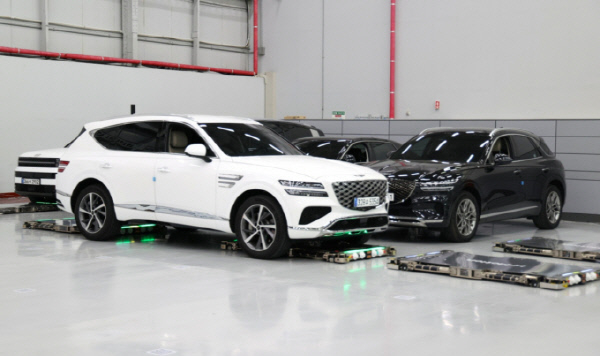
Hyundai WIA is launching a full-scale expansion of its business by presenting guidelines for introducing parking robots into multi-family housing complexes.
On the 20th, Hyundai WIA announced that it held a "Parking Solution Customer Invitation Event" over two days starting from the 19th at the Hyundai Motor Group's Uiwang Research Institute in Uiwang, Gyeonggi Province.
Approximately 800 key customers, including construction companies and contractors with high interest in applying parking robots, attended the event.
Hyundai WIA organized this event to proactively respond to market expansion following recent institutional preparations for installing parking robots in apartment complexes. The event was divided into a "parking robot demonstration" and a "seminar," allowing customers to observe actual operation methods and application plans for parking robots. The demonstration covered various scenarios, including vehicle entry/exit, perpendicular/parallel/double parking, vehicle repositioning, and responses to unexpected situations. Following the demonstration, the seminar introduced application plans for introducing parking robots. It provided guidance on architectural design considerations such as parking space layout to enhance infrastructure conditions and efficiency. Additionally, it comprehensively covered relevant laws and regulations, application plans by new construction or redevelopment project sites, and cost comparisons between conventional parking garages and parking robot-equipped facilities.
Hyundai WIA's parking robots operate in pairs per set, entering beneath vehicles to lift the wheels and transport them to vacant parking spaces or entry/exit zones. Equipped with LiDAR sensors, they recognize vehicle wheel positions and sizes, capable of transporting SUVs weighing up to 3.4 tons (multi-purpose sports vehicles). The robot's thickness is designed at 110mm to accommodate vehicles with low undercarriages. Applying parking robots reduces the space needed for opening and closing car doors and enables double or triple parking. Consequently, they can accommodate 20% to 50% more vehicles than conventional parking garages. Hyundai WIA is currently leading South Korea's first multi-family housing parking robot demonstration project at "Hillstate The Wave City" in Siheung, Gyeonggi Province, as part of a consortium with Hyundai Motor and Hyundai E&C. A Hyundai WIA representative stated, "We will continue to provide parking robot solutions optimized for diverse living spaces."

 in INDUSTRY
