

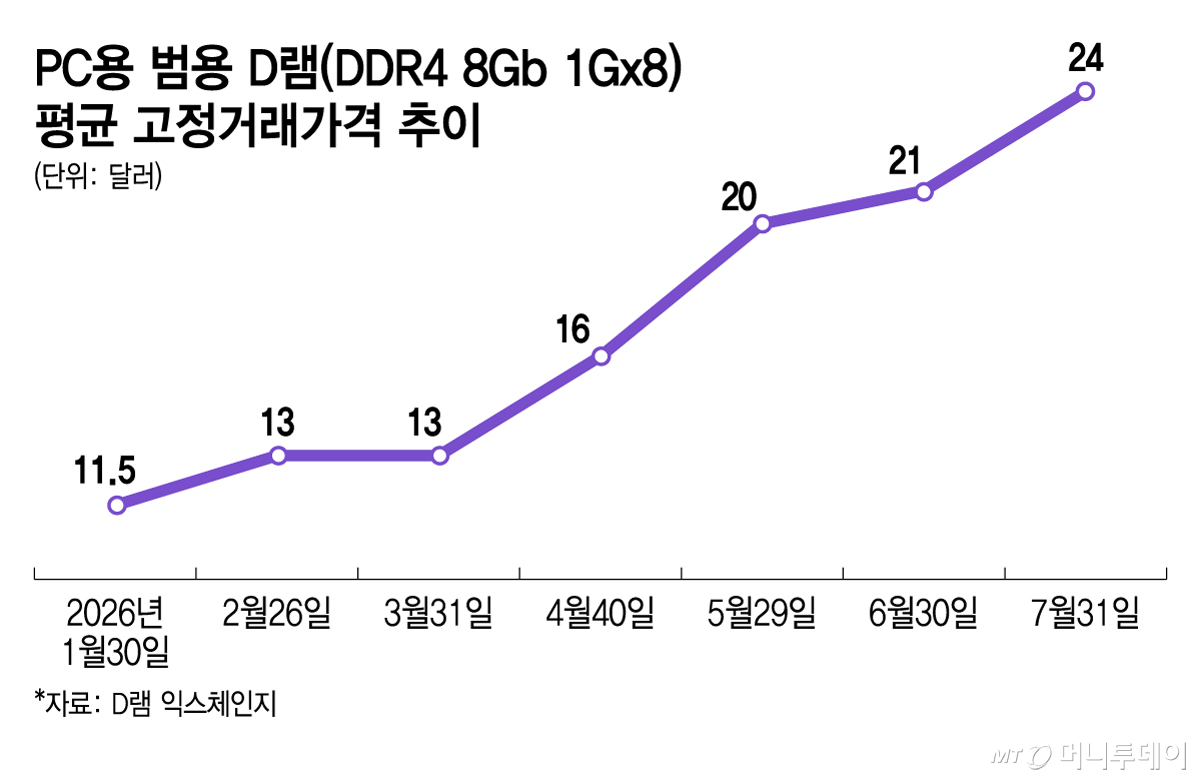
Price increases for legacy DRAM are expected to continue through the second half of this year. This is due to memory semiconductor manufacturers focusing production on HBM (High-Bandwidth Memory) and server-grade DRAM, tightening general DRAM supply. As demand for HBM continues to grow, analysts predict that shortages and rising prices for legacy DRAM will persist in the long term.
According to industry sources on the 20th, global investment bank Morgan Stanley forecasts that DDR4 (Double Data Rate 4) prices will rise by 50% in the third quarter of this year compared to the previous quarter. An additional 10% increase is expected in the fourth quarter. DDR4 is a general-purpose DRAM used in PCs and other devices, representing one generation behind the current mainstream DDR5.
DDR4 prices have already surged to record highs. According to DRAM exchange market research firm DRAMeXchange, as of last month's 31st, the average fixed transaction price for DDR4 8Gb (gigabit) 1Gx8, a general-purpose DRAM for PCs, reached $24, marking an all-time high. Compared to $2.9 in June 2016 when tracking began, this represents more than an eightfold increase over ten years.
The background of price increases lies in reduced supply of legacy DRAM. The "three major memory companies"—Samsung Electronics, SK Hynix, and Micron—have prioritized production capacity allocation for HBM and server-grade DRAM, leading to decreased production of legacy DRAM like DDR4. HBM requires significantly larger chip area and a more complex manufacturing process, needing three to four times the production capacity to produce the same volume compared to general-purpose DRAM. Considering limited production capacity, as the proportion of HBM increases, general-purpose DRAM supply must inevitably decline.
Especially with recent requests from major CSPs (Cloud Service Providers) to expand HBM supply, constraints on general-purpose DRAM are expected to worsen. In fact, key customers have repeatedly revised their medium-to-long-term demand plans upward in line with increased AI (Artificial Intelligence) investments. According to Meritz Securities, as of this month, the 2028 HBM demand plans for major customers stand at: Broadcom 35–40 billion Gb, NVIDIA 30 billion Gb, Google 20 billion Gb, and AMD 10 billion Gb. Kim Sun-woo, a researcher at Meritz Securities, stated, "In a situation where DRAM production capacity is limited in 2027–2028, competition among legacy manufacturers to secure HBM volumes will intensify," adding that "shortages of general-purpose DRAM will further deepen."
General-purpose DRAM supply disruptions are already becoming reality. Taiwanese memory module manufacturer Apacer analyzed that the volume of DRAM supplied by major DRAM manufacturers to independent memory module companies next year could decrease by more than 70% compared to this year. Apacer CEO Chang Tzu-kun expressed concern, stating, "The greatest threat facing Apacer is not paying excessively high chip prices but failing to secure supply itself." DRAM shortages are expected to continue at least until mid-2027. Earlier, Kwak No-jung, President of SK Hynix, also noted the possibility of prolonged supply shortages, saying, "From a supply perspective, 2027 will be the worst year in industry history."
This trend is inevitably favorable for the three major memory companies. As HBM sales expand while general-purpose DRAM benefits from price increases due to supply constraints, their profitability improves.
An industry source said, "The expansion of HBM demand is restricting general-purpose DRAM supply and driving up prices," adding that "a favorable environment is being created for memory manufacturers."

 in INDUSTRY
