

Expanding AI (artificial intelligence) infrastructure investments are driving up demand for eSSDs (enterprise solid-state drives). Major CSPs (large cloud service providers) are increasingly revising their demand forecasts upward, with some projections suggesting that eSSD demand in the fourth quarter of this year will exceed that of the third quarter. Samsung Electronics and SK Hynix have also launched market strategies featuring high-performance and high-capacity products.
According to market research firm TrendForce on the 22nd, CSPs have recently repeatedly revised their eSSD demand forecasts upward. This is due to the advancement of AI infrastructure, which has expanded the application of eSSDs beyond large-scale data storage to support AI computations. TrendForce stated, "Recent purchasing trends suggest that eSSD order volumes in the fourth quarter this year are likely to surpass the high levels recorded in the third quarter," and added, "The strong upward trend is expected to continue."
Demand is also growing for high-capacity QLC (Quad Level Cell) products beyond high-performance TLC (Triple Level Cell). TLC stores 3 bits per cell, while QLC stores 4 bits. QLC can store more data with the same number of cells, making it advantageous for implementing high-capacity products and reducing costs. TrendForce expects that the adoption rate of QLC eSSDs will further increase due to the spread of generative AI.
The rapid surge in data required for training and inference driven by the spread of generative AI has transformed NAND flash (hereinafter referred to as NAND) from a simple storage device into a key solution supporting AI computations. In particular, eSSDs are utilized as core devices for storing and processing large-scale data in data centers and servers. Recently, there have also been discussions about storing part of the 'KV (Key-Value) cache' generated during LLM (large language model) operations on SSDs instead of HBM (high-bandwidth memory).
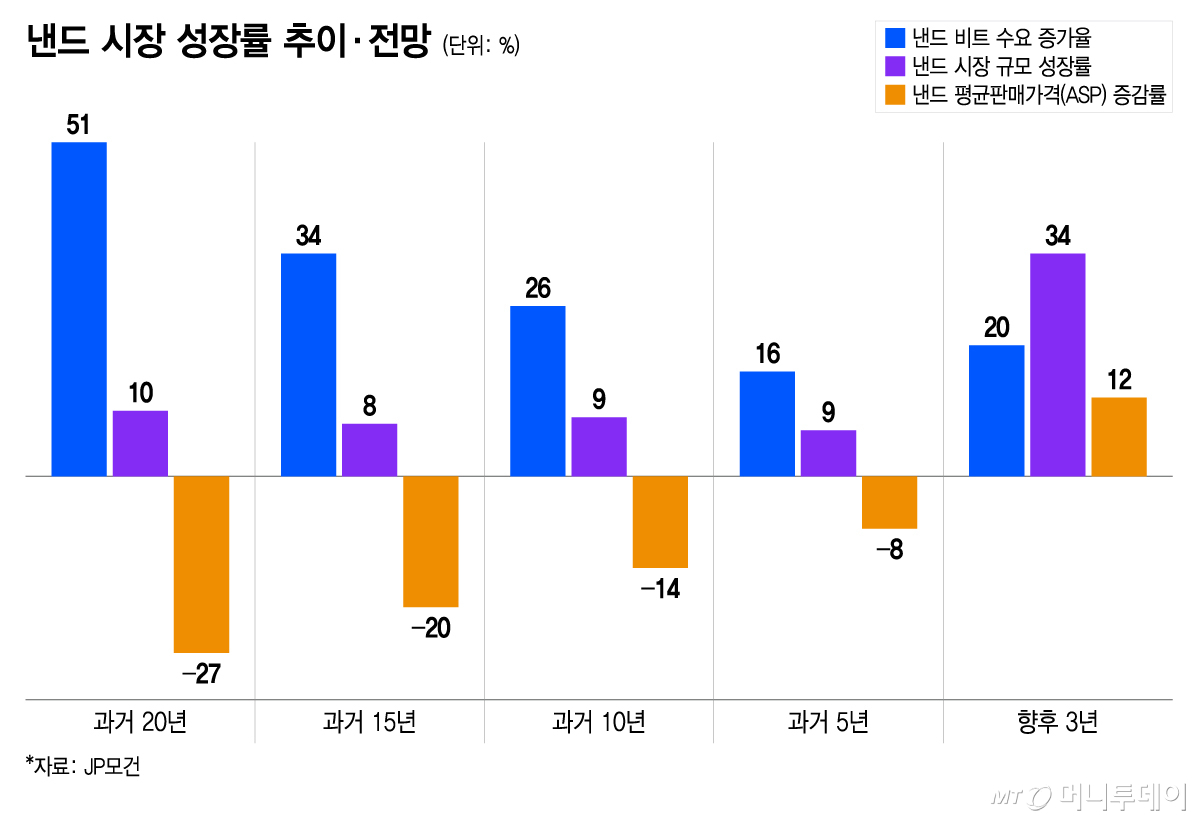
As the importance of eSSDs grows, their share within the NAND market is expected to expand rapidly. Global investment bank JP Morgan predicts that NAND bit demand will grow at an annual average rate of 20% over the next three years, while the market size will grow at an annual average rate of 34%. JP Morgan also forecasts that the average selling price (ASP) of NAND will rise by an annual average of 12% during the same period. JP Morgan analyzed, "By 2027, eSSDs will account for 48% of global NAND bit demand, surpassing smartphones (30%) and PCs (22%) to become the largest demand source."
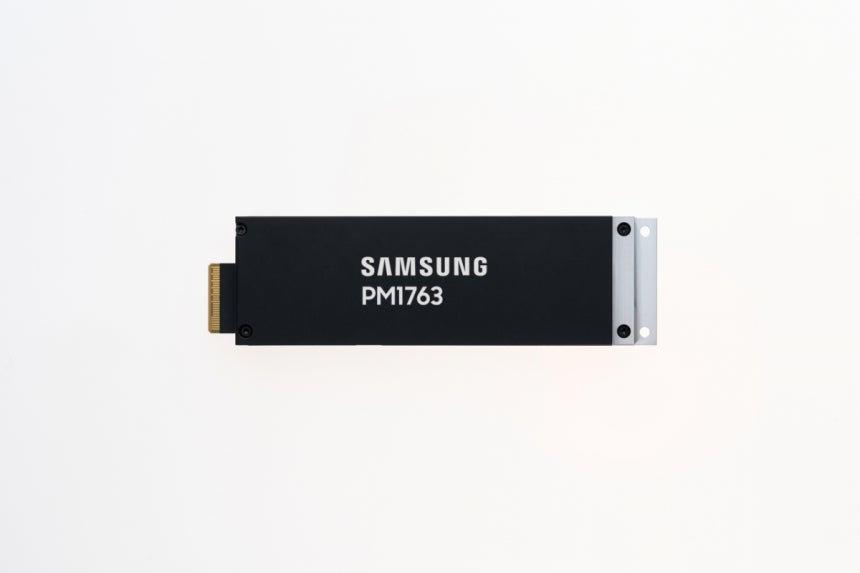
Domestic memory semiconductor companies are also expanding their product lines. Samsung Electronics began shipping the PCIe 6.0-based eSSD 'PM1763' Yangsan in July, which will be mounted on Nvidia's next-generation AI platform 'Verona Rubin'. By applying ninth-generation V-NAND and a new controller based on 4nm (1nm = one-billionth of a meter), the company has improved performance and power efficiency. In March, Samsung completed development of a 2Tb (terabit) QLC product based on ninth-generation V-NAND and expanded its product lineup to include high-capacity server SSDs such as 256TB (terabyte).
SK Hynix plans to fully enter the market with products including 'PEB210 E1.S (9.5mm)' supporting liquid cooling, high-performance 'PS1110 E3.S', and QLC-based 122TB 'PS1101 E3.S'. The strategy is to respond to AI storage demand by offering a full range of products from high-performance SLC-mode SSDs to large-capacity QLC SSDs.
An industry insider stated, "As AI infrastructure investments continue and inference demand joins in, the growth foundation for the eSSD market has broadened further," adding, "Given that data center investments will continue, the growth trend of the eSSD market is expected to persist for a considerable period."

 in INDUSTRY

