

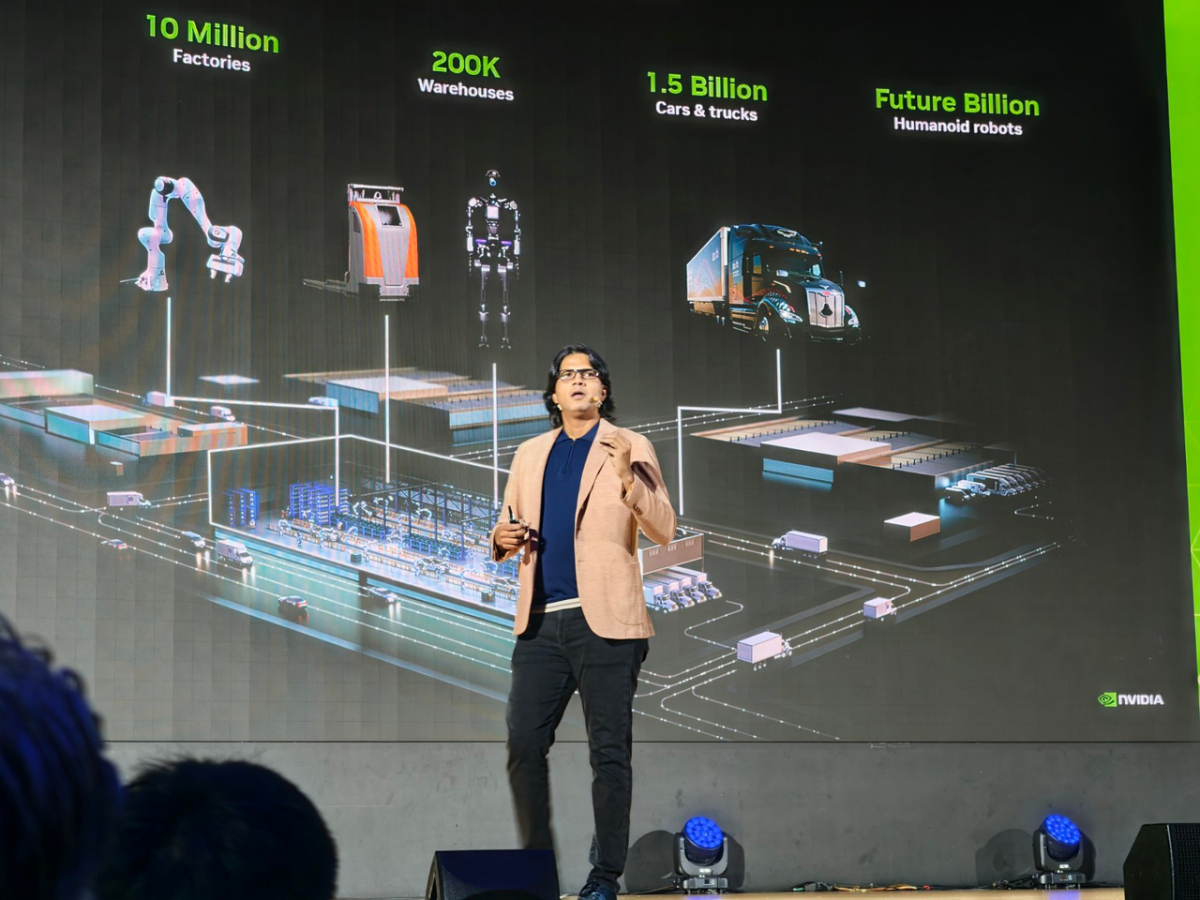
Nvidia is expanding its physical AI (artificial intelligence) collaborations with domestic companies such as the Hyundai Motor Group, Doosan, SK hynix, and LG Electronics. The company has launched technology development to apply AI to manufacturing sites, ranging from robot simulations on automotive production lines to body polishing work and digital twins of semiconductor factories.
Deepu Talla, Vice President of Nvidia's Robotics and Edge AI division, stated at the 'Nvidia AI Day Seoul 2026' held on the 9th at COEX in Gangnam-gu, Seoul, that "Korea has demonstrated outstanding capabilities for a long time in heavy industry, automotive, and electronics manufacturing," adding that "over the next 10 years, Korea will play a very important role in the development of physical AI."
In his keynote speech on "The Current State and Future of Physical AI," VP Talla emphasized that "the golden age of robotics has begun as AI models and simulation technologies matured last year."
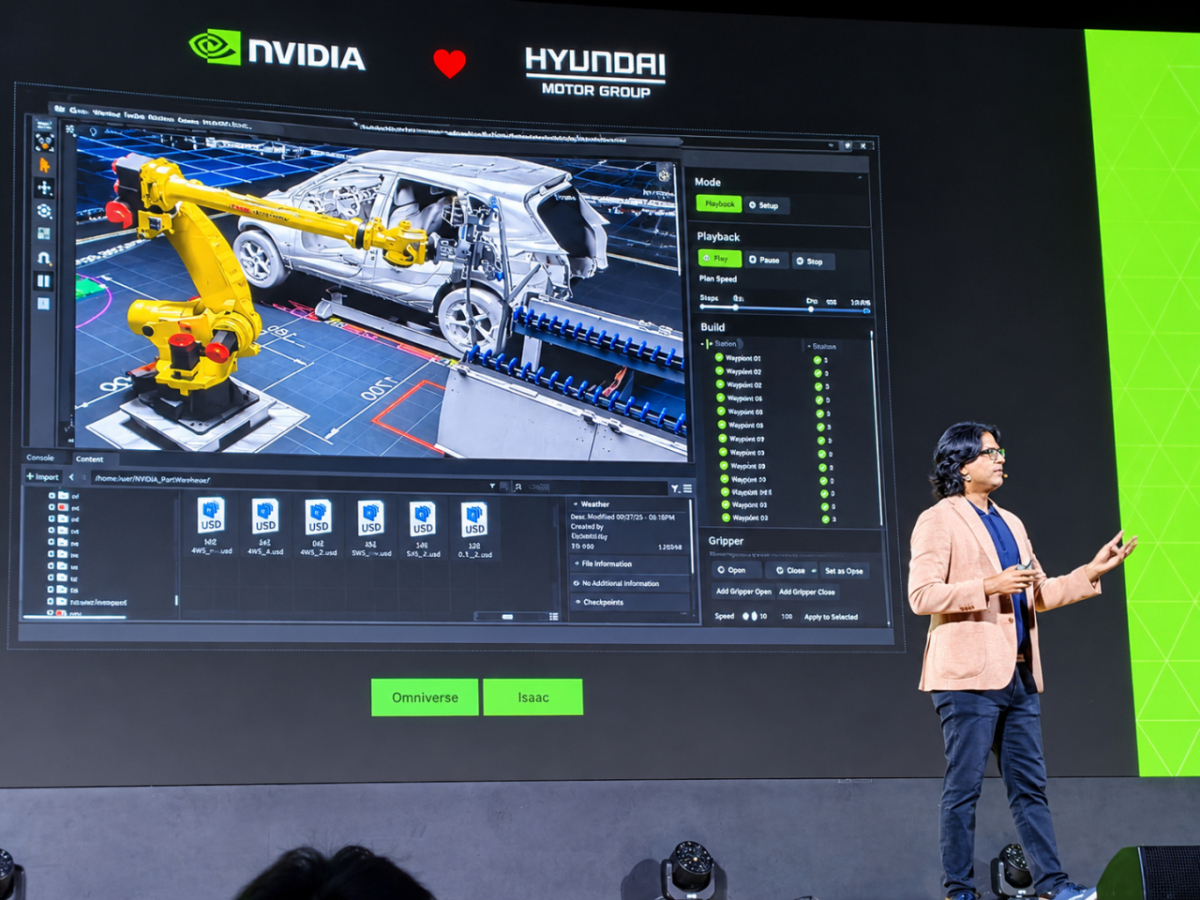
VP Talla successively revealed collaboration cases with domestic companies. With the Hyundai Motor Group, they are collaborating on robot simulation technology for automotive manufacturing processes. The displayed screen featured industrial robots handling car bodies in a virtual production line. This was an example utilizing Nvidia's virtual world implementation platform 'Omniverse' and its robotics development platform 'Isaac.'
With Doosan, they are developing robot technology to precisely polish automotive door surfaces. The simulation screen featured a scene where a robotic arm polishes an automotive door while analyzing surface roughness and the contact pressure of the polishing pad. The robotics learning platform 'Isaac Lab' and the physics simulation engine 'Newton' were used.
VP Talla explained, "While automation in automobile factories has progressed over the past 30 to 40 years, this was automation by programmed robots, not AI," adding that "in areas where the work environment is constantly changing, it is impossible to program every action."
Collaboration cases with SK hynix and SK Telecom were also revealed. The presentation screen introduced digital twin technology that implements large-scale equipment in a virtual space and allows an AI agent to analyze the causes of anomalies. With LG Electronics, they are developing simulation technology for robot learning and verification, and with domestic startup RealWorld, they are collaborating on technology to evaluate robots' object manipulation capabilities.
VP Talla emphasized that AI agents can significantly increase the speed of robotics development. He stated, "Simulation environment construction work that previously took multiple experts several months to complete can now be finished by a single engineer within one week," explaining that "Nvidia is a platform company that provides core technologies necessary for development, rather than directly manufacturing robots."
Meanwhile, Jung So-young, General Manager of Enterprise Sales at Nvidia Korea, said in her welcome speech on this day that "AI is rapidly developing from agentic AI, which makes judgments and acts autonomously, to physical AI, which performs tasks in the real world," urging exchanges among domestic companies, research institutes, startups, and developers.

 in TECH

