

Convenience stores near Seoul’s cram school districts saw a sharp surge in sales of sugary and energy drinks this summer—beverages that could impact youth health. This indicates that teenagers visiting cram schools during the summer break are consuming these drinks indiscriminately to quench their thirst.
Critics point out that while areas around schools face restrictions on high-calorie, low-nutrient products and high-caffeine beverages, neighborhoods surrounding cram schools remain in a regulatory blind spot.
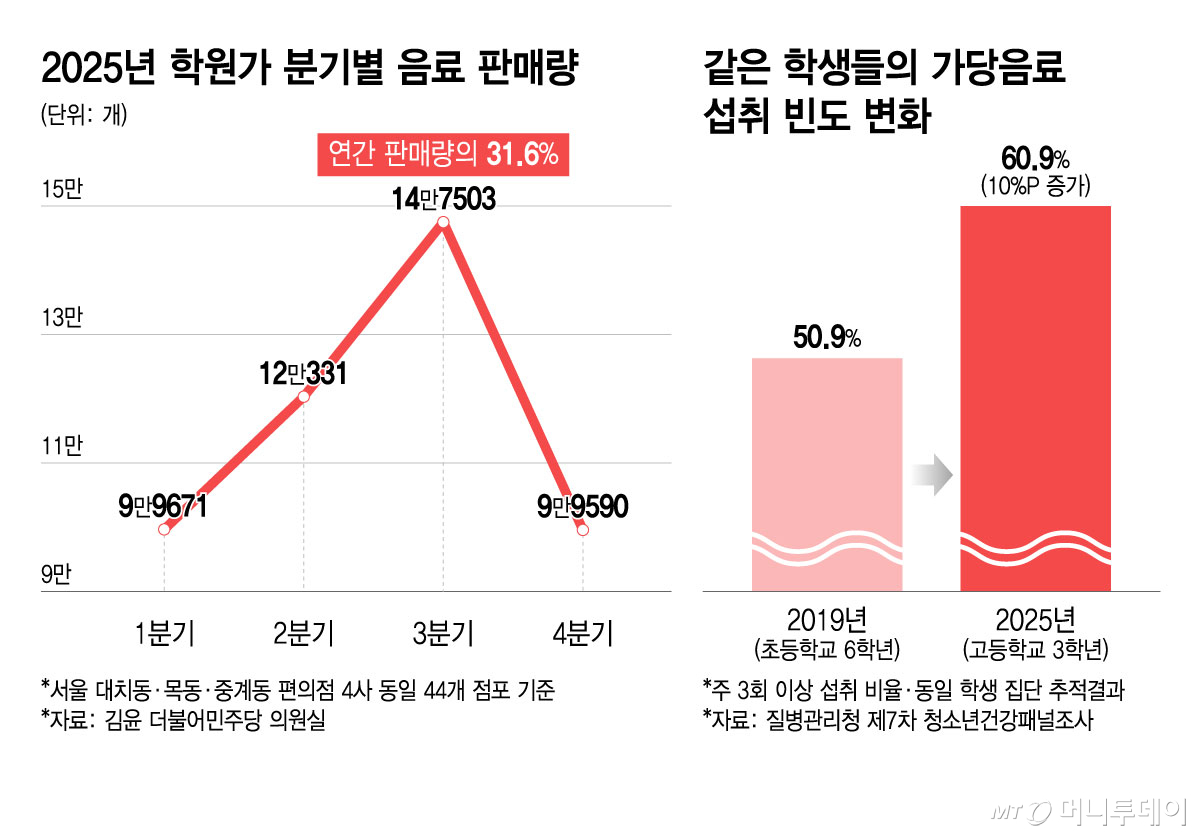
On the 22nd, Kim Yoon, a lawmaker from the Democratic Party of Korea serving on the National Assembly’s Health and Welfare Committee, analyzed beverage sales data submitted by four major convenience store chains. The analysis covered 44 stores in Seoul’s Daechi-dong, Mokdong, and Junggye-dong areas. Last year, total sugary drink sales across these stores amounted to 467,095 units, with 147,503 units (31.6%) sold during the third quarter. The analysis included only stores with sales records from 2022 through 2025.
Third-quarter sales figures were: 155,578 units in 2022, 143,308 in 2023, 149,602 in 2024, and 147,503 in 2025—exceeding sales in all other quarters across all four years. The share of annual sales accounted for by the third quarter rose from 29.5% in 2022 to 31.6% last year, an increase of 2.1 percentage points (P). This is interpreted as a sharp rise in sugary drink consumption during summer break, when demand for cram school attendance peaks among teenagers.
Current food sales regulations focus primarily on schools and their immediate surroundings. Under the "Special Act on Child Food Safety Management" (Child Food Safety Act), areas within a 200-meter straight-line radius from school boundaries may be designated as Child Food Safety Protection Zones. In these zones, sales of high-calorie, low-nutrient foods and high-caffeine products are restricted; sugary drinks also become subject to restrictions if they meet specific nutritional criteria.
However, areas densely packed with cram schools outside the immediate vicinity of schools do not qualify as protection zones simply due to the concentration of institutions. Even within designated protection zones, sales restrictions do not automatically apply to all general retail outlets; only "excellent retailers" must undergo separate designation to be subject to restrictions. Thus, expanding zone boundaries alone does not automatically increase the number of restricted outlets.
Studies also show that as students grow older, they tend to consume more sugary drinks. According to the "7th Youth Health Panel Survey" released last month by the Korea Disease Control and Prevention Agency (KDCA), the proportion of students consuming sugary drinks three or more times per week rose from 50.9% in 2019—when they were in sixth grade—to 60.9% last year, when they reached their final year of high school. This represents a 10-percentage-point increase based on tracking the same cohort of students over time.
Kim Yun (Rep.) stated, "The increase in sugary drink sales around cram schools during summer break reflects concerns that teenagers may be consuming excessive amounts of sugar. However, the current regulatory framework for sugary drinks overall remains insufficient." He added, "We will push for amendments to the 'Child Food Safety Act' to reduce excessive exposure of teenagers to sugary drinks and establish a legal foundation aligned with the national agenda goal of creating a 'safe food environment and healthy lifestyle.'"

 in INDUSTRY
