

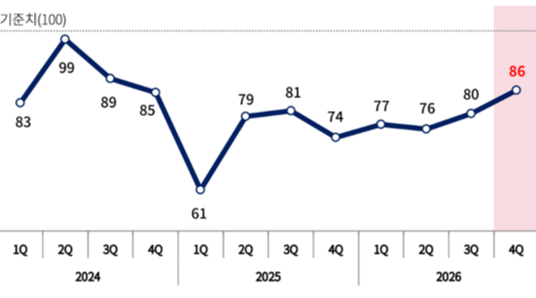
A survey revealed that the business sentiment indices for both export-oriented and domestic-focused companies rose simultaneously, indicating that the manufacturing sector has experienced recovery for two consecutive quarters.
On the 27th, the Korea Chamber of Commerce and Industry (KCCI) announced that its survey of 2,413 manufacturing firms on the 'Q4 2026 Manufacturing Business Situation Index (BSI)' showed the BSI for this year's fourth quarter reached 86, up 6 percentage points from the previous quarter's 80.
The export-oriented companies' BSI was recorded at 91, a 5-point increase from the prior quarter, driven by strong exports in key items such as semiconductors and cosmetics. Domestic-focused companies also saw a 7-point rise to 85, benefiting from reduced pressure on imported raw material prices due to exchange rate stability. This marks the first time since Q3 last year that both export and domestic indices have risen together over five consecutive quarters.
The number of industries expecting improvement in the next quarter also increased compared to the previous quarter. While only one industry—semiconductors (113)—exceeded the baseline of 100 in the prior quarter, this rose to five industries in Q4: semiconductors, cosmetics, medical and precision equipment, shipbuilding, and pharmaceuticals/biotech. Notably, semiconductors reached an all-time high of 139, surpassing the 100th baseline for four consecutive quarters since the survey began.
Cosmetics (120) and medical and precision equipment (108) rose by 20 and 28 percentage points respectively from the previous quarter, showing positive outlooks second only to semiconductors. Shipbuilding (103), which saw increased orders focused on high-value-added vessels, and pharmaceuticals/biotech (102), driven by rising exports of biosimilars, also reported improved sentiment as more companies anticipated higher production volumes compared to the prior quarter.
Non-metallic mineral products (88) had been at the lowest level among surveyed industries due to reduced construction demand during the summer heat and rainy season in the previous quarter. However, it rose by 27 points thanks to stable imported raw material prices from exchange rate stability and the onset of the autumn peak season.
In contrast, electronics and telecommunications (80) fell by 13 points from the previous quarter due to cost pressures stemming from rising prices of raw materials such as memory chips, copper-clad laminates (CCL), and copper, along with increased logistics costs.
Sixty point four percent (60.4%) of companies expected their operating profit for this year to fall short of the target. Thirty-one point seven percent (31.7%) anticipated achieving the target level. Only 7.9% projected exceeding the target, combining those expecting "partial exceedance within 10%" (6.4%) and "significant exceedance" (1.5%).
The most frequently cited major obstacle to achieving operating profit targets was "rising production costs such as raw materials and energy" (43.2%). This was followed by: deteriorated sales and order conditions (24.9%), increased labor costs and difficulties in securing personnel (11.7%), exchange rate volatility (6.8%), worsening trade environment (4.1%), and regulatory and licensing issues (1.3%).
Kang Min-jae of KCCI Gyeong Je-jeong-chaek (Team Lead) stated, "Given that rising production costs such as raw materials and energy have emerged as the biggest challenge for companies, policy support is needed to improve business conditions through stabilizing raw material supply and alleviating energy cost burdens."

 in INDUSTRY
