

Hyundai Rotem is rapidly increasing the export share of its rail business (RS division). The company's strategy is to diversify its export product lineup, which had been centered on EMUs, into high-speed rail vehicles and other categories, thereby boosting its market share in the global rail market and improving profitability.
According to industry sources on the 29th, Hyundai Rotem's outstanding order book for its rail business stood at 19.867 trillion won as of the end of the first half of this year, an increase of 1.4137 trillion won from the end of last year (18.4533 trillion won). Compared with the end of 2024 (14.0646 trillion won), the figure rose by 41.3%. The rapid growth in the order book is analyzed as being driven by consecutive wins on large overseas projects. Recently, Hyundai Rotem has restructured its order-taking structure from a domestic focus to one centered on overseas business.
In fact, the company secured Queensland's EMU project worth 1.3 trillion won in Australia in 2023 and won the Los Angeles (LA) Metro EMU project worth 900 billion won in the United States in 2024. Last year, it landed Morocco's EMU project valued at 2.2027 trillion won, the largest single rail project in history. The company is currently negotiating additional supply with Uzbekistan, where it made its first export of a Korean-style high-speed train in 2024, aiming to sign a contract by early next year. The likelihood of winning the order has increased following the signing of a "Memorandum of Understanding (MOU) for Strategic Cooperation Enhancement" between the two governments. Driven by expanded overseas orders, Hyundai Rotem's export revenue has also grown. While domestic and export sales were roughly evenly split in 2024, exports accounted for 679.1 billion won in the first half of this year, surpassing domestic sales (448.9 billion won).
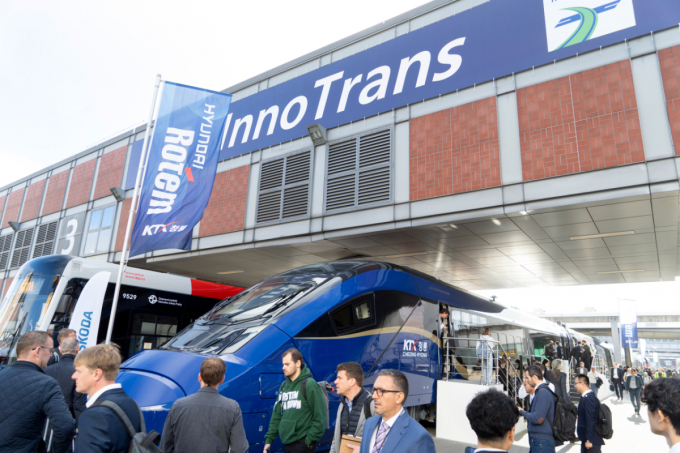
Hyundai Rotem is accelerating its push into the global rail market. As part of this strategy, the company set up its largest exhibition booth in its history at "Innotrans 2026," the world's largest biennial rail industry trade show. The booth was placed in a prominent first-floor space immediately visible from the exhibition hall entrance. Nearby were global rail companies such as France's Alstom and China's CRRC (China Railway Rolling Stock Corporation). At the outdoor real-vehicle exhibition area, the "KTX-Cheongryong" was positioned at the very front.
Currently, the project Hyundai Rotem is focusing on most overseas is the New York Metropolitan EMU replacement project in the United States, valued at up to 1 trillion won. Global rail companies such as Alstom and Germany's Siemens are also expected to enter this project. Hyundai Rotem is reportedly aiming to secure about half of the total volume.
The company is also stepping up its efforts to capture the high-speed rail market. Its goal is to expand into the Middle East, Central Asia, and other regions, using the Uzbekistan export as a springboard. It plans to actively leverage capabilities at the Hyundai Motor Group level, including design, physical AI (artificial intelligence), and hydrogen technology.
Export expansion is also expected to lead to improved profitability in the rail business. This is because the domestic rail vehicle market has a high proportion of public procurement and an bidding structure centered on price competition, which limits profit margins. The market expects that profitability will improve significantly once the Morocco project enters full-scale production next year. Forecasts also suggest that rail business revenue will grow by more than 30% next year.

 in INDUSTRY
