

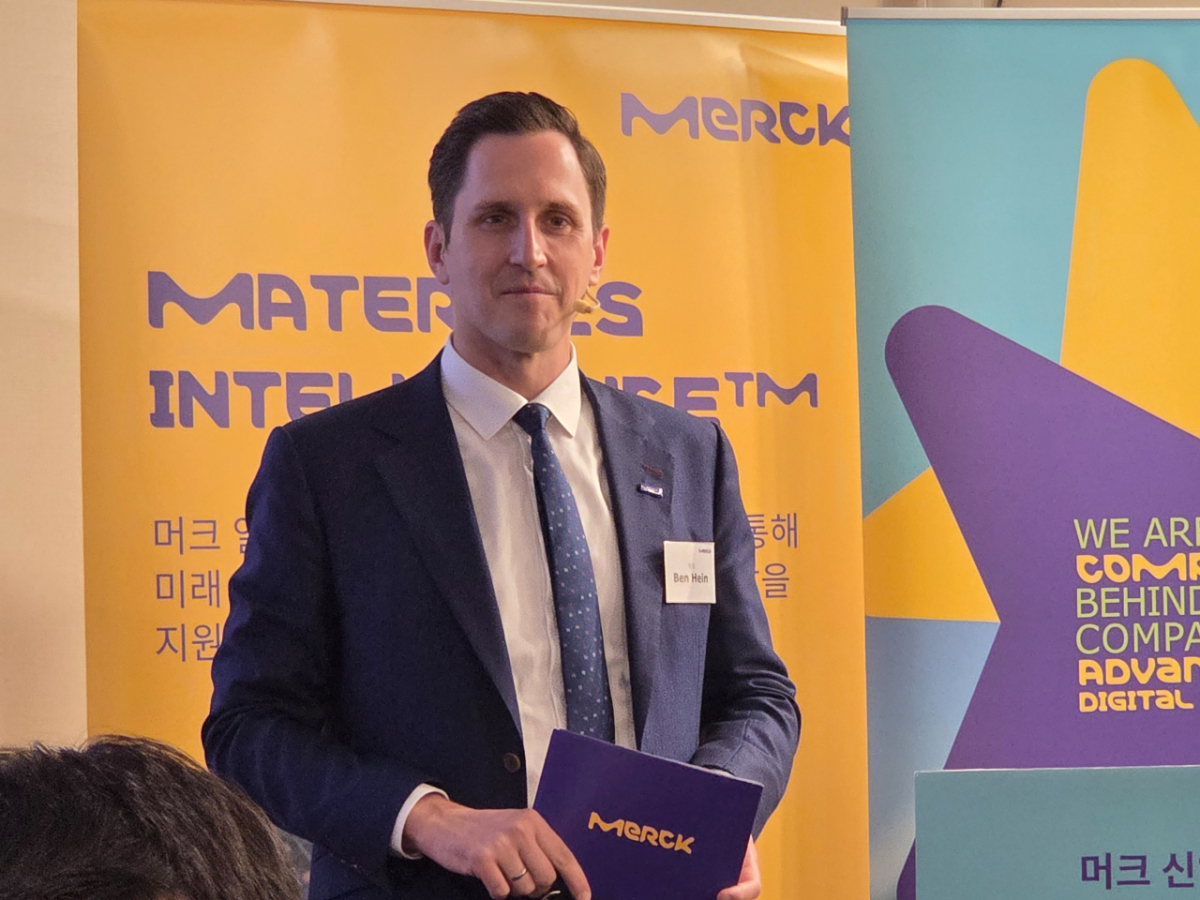
Global semiconductor materials company Merck is accelerating efforts to strengthen its production and supply system in South Korea, aligning with the expanded investments by domestic semiconductor firms such as Samsung Electronics and SK Hynix. The company’s strategy involves expanding next-generation materials production facilities and enhancing technical support capabilities in preparation for the possibility that demand for semiconductor materials and solutions will double over the next five years.
Merck held a press conference at Sonofelice Samsung in Gangnam-gu, Seoul on the 21st to announce its growth outlook and investment strategy for the South Korean semiconductor market. Benjamin Hein, CEO of Merck’s Electronics business division, stated, “South Korea is a key market from the perspective of semiconductor device manufacturing, making it an essential destination for any materials company,” adding, “It is one of the world’s top three markets and will remain a core market going forward.”
CEO Hein cited the medium- to long-term business plans of domestic semiconductor manufacturers as grounds for growth. He said, “Even if only half of what South Korean semiconductor manufacturers aim to achieve over the next five years is realized, it would represent tremendous growth,” adding, “Demand for semiconductor materials and solutions could double within the next five years.”
In preparation for this demand increase, Merck is expanding its domestic production facilities for next-generation semiconductor materials. On the 22nd, the company held an opening ceremony for a molybdenum oxychloride (MoO₂Cl₂) production facility in Eumseong, Chungcheongbuk-do. As semiconductor circuits become finer, wiring widths narrow, leading to increased resistance and potential declines in performance and power efficiency; molybdenum is gaining attention as a next-generation material that can improve these issues. The molybdenum oxychloride produced by Merck serves as a precursor used for forming molybdenum thin films, with applications not only in 3D NAND flash but also in future DRAM and system semiconductor manufacturing processes.
Merck plans to supply customers in South Korea and Asia by combining the molybdenum precursors produced in Eumseong with a supply system currently being manufactured in Ansan. This system is a device that vaporizes precursors to stably supply them into semiconductor manufacturing processes. Merck aims to enhance supply stability by producing both materials and supply equipment domestically, while also increasing material usage efficiency to over 99% to reduce customers’ process operation costs.
Merck has invested over €600 million in South Korea in recent years to expand domestic production facilities and strengthen technical support capabilities. The company has expanded thin-film materials and specialty gas production facilities, while also opening a Spin-On Dielectric (SOD) Application Research Institute in Anseong. Because semiconductor materials require separate verification before application in Yangsan due to varying process conditions and performance requirements among customers, Merck uses this institute to support customers in testing new materials domestically and adjusting process conditions. Through these efforts, the company has broadened its foundation for handling everything from material production to supply and process verification within South Korea.
CEO Hein stated, “Customers expect us to be present locally,” adding, “We cannot meet customer demands by responding only from other regions such as the United States or Japan. We must be able to execute on-site.”

 in INDUSTRY
