

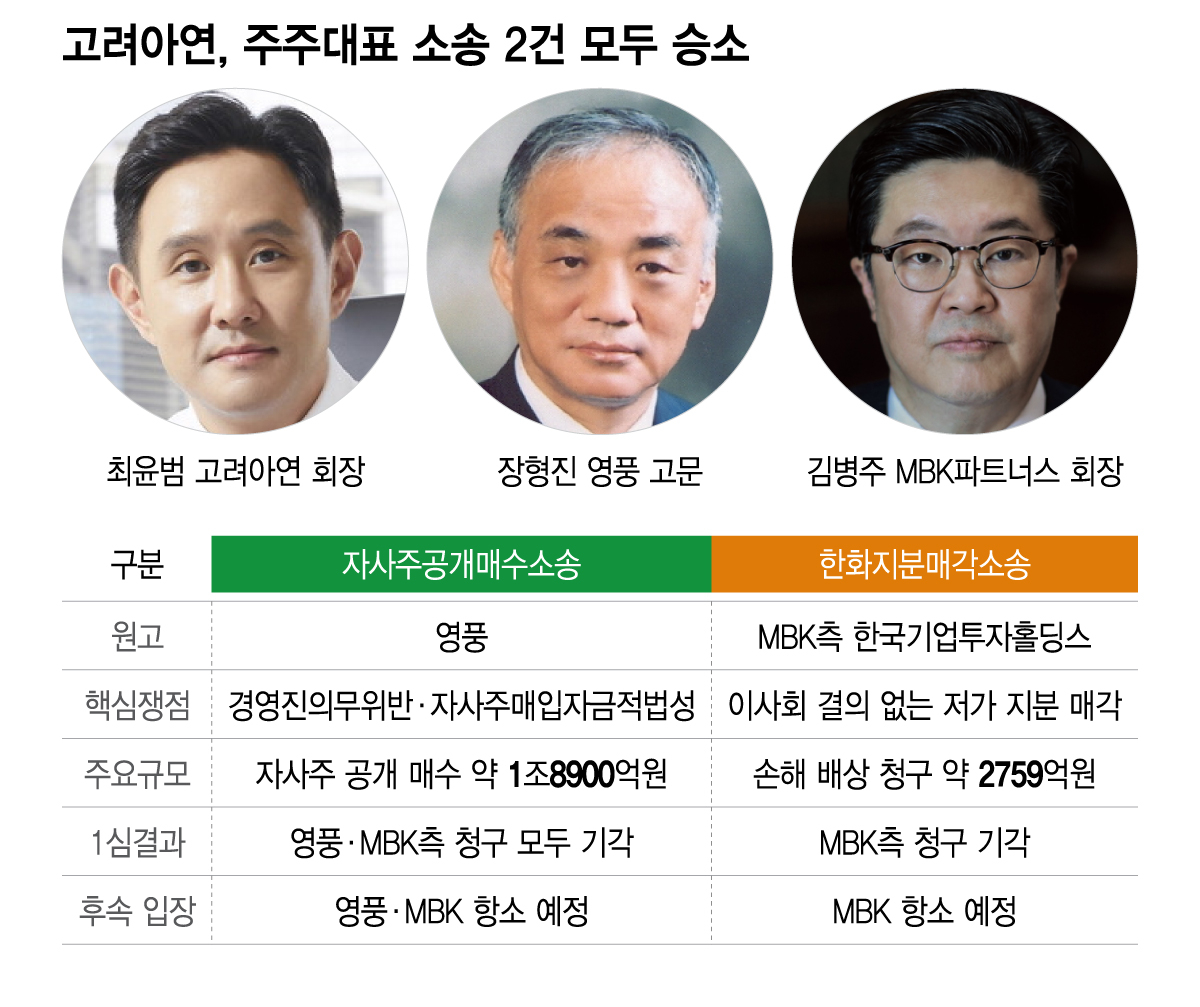
Korea Zinc has won two shareholder derivative suits filed by Young Poong and MBK Partners. The court dismissed claims seeking damages over the company's tender offer for its own shares and the sale of its stake in Hanwha Corp. Young Poong and MBK expressed regret over the ruling on the tender offer and said they would immediately appeal.
On Oct. 22, Korea Zinc said it had won a shareholder derivative suit filed by Young Poong against Chairman Choi Yun-beom and nine other directors. The 30th Civil Division of the Seoul Central District Court, presided over by Judge Kim Seok-beom, dismissed all of the plaintiff's claims. Young Poong was also ordered to pay the legal costs.
The lawsuit challenged the legality of Korea Zinc's tender offer for its own shares, launched during a management control dispute in 2024. Young Poong and MBK began a tender offer for Korea Zinc shares on Sept. 13 that year, prompting Korea Zinc's board to approve a counteroffer for its own shares on Oct. 2. The two offers were valued at approximately 1.83 trillion won and 1.89 trillion won, respectively.
Young Poong argued that the tender offer was intended to help Choi and other executives retain their positions, violating the directors' duties of care and loyalty. It also argued that using discretionary reserves set aside for specific purposes to finance the share buyback violated the Commercial Act and the company's articles of incorporation. Such reserves are funds a company sets aside from its profits for designated purposes.
The court, however, found that Korea Zinc's board had recognized Young Poong's tender offer as a business threat and considered external legal advice, court injunction rulings, the tender offer price and financing arrangements. It concluded that the board's decision fell within the scope of reasonable business judgment. Even if the tender offer ultimately affected the management control dispute, the directors could not be deemed to have breached their duties of care or loyalty, the court said.
The court also ruled that the use of funds was lawful. It explained that the Commercial Act limits the overall amount a company can spend on acquiring its own shares but does not restrict the source of the funds. The court also found that a provision in Korea Zinc's articles of incorporation restricting the use of discretionary reserves applied to interim dividends, not share buybacks.
Korea Zinc's management also prevailed in a separate lawsuit over the sale of its stake in Hanwha Corp. The 21st Civil Division of the Seoul Central District Court, presided over by Judge Jung Yong-shin, dismissed both a damages claim of approximately 275.9 billion won and an alternative claim of about 30.4 billion won filed by Korea Enterprise Investment Holdings, an investment vehicle of MBK Partners, against Choi and CEO Park Ki-duk.
The dispute arose after Korea Zinc sold its 7.25 percent stake in Hanwha Corp. to Hanwha Energy. MBK argued that the executives had disposed of the stake at an undervalued price without a board resolution, causing losses to the company. The court rejected the claims.
Korea Zinc said the consecutive victories confirmed the legality of its tender offer for its own shares and the legitimacy of management decisions surrounding the Hanwha stake sale. A company official said, "Young Poong and MBK must stop filing indiscriminate lawsuits that obstruct our normal business activities and undermine corporate value in pursuit of a hostile merger and acquisition."
Young Poong and MBK, meanwhile, expressed regret over both rulings and said they would appeal. They maintain that Korea Zinc's board borrowed more than 1.6 trillion won to finance the tender offer in an effort to preserve Choi's control, causing the company losses of more than 830 billion won.
"We will seek to establish the illegality of the tender offer and the board's breach of its duty of care in a higher court," Young Poong and MBK said, adding that they would also appeal the ruling in the Hanwha stake sale case.

 in INDUSTRY
