

Rising "European-Made Barriers" Present Localization Homework for Hyundai Motor and Kia
As the European Union (EU) accelerates the introduction of regulations favoring intra-regional production to counter the offensive from Chinese electric vehicles, the burden on Hyundai Motor and Kia is growing. For the Hyundai Motor Group, which operates production facilities in Europe, a strategy that localizes not only EV production but also component sourcing has become critical.
The core of the Industrial Acceleration Act (IAA), currently being pushed by the EU, is applying European-made preference criteria to public procurement and certain vehicle purchase support programs. France and Germany have already agreed on the 16th to a plan to source 70% of automotive component value, excluding batteries, from Europe.
They also intend to apply separate intra-regional production standards for batteries. Although this is not yet a finalized EU-wide regulation, the direction has become clear: regulating not only finished vehicle production but also the component supply chain.
The scope of countries recognized as "European-made" is also a point of contention. France and Germany proposed granting preferential benefits to some European countries, including EU member states and the United Kingdom, but South Korea and Turkey were excluded from this scope. Previously, in last month's European Parliament session, discussions took place arguing that EU status should not be recognized solely on the basis of being a Free Trade Agreement (FTA) partner country. While final legislative outcomes remain pending, eligibility for support for vehicles exported from South Korea could change.
In particular, Hyundai Motor has been producing the compact electric vehicle IONIQ 3 at its Izmit plant in Turkey since August last year. Although the plant received an investment of 250 million euros to supply the European market, if Turkey is excluded from the recognized scope, vehicles produced there may also face difficulties receiving certain support benefits.
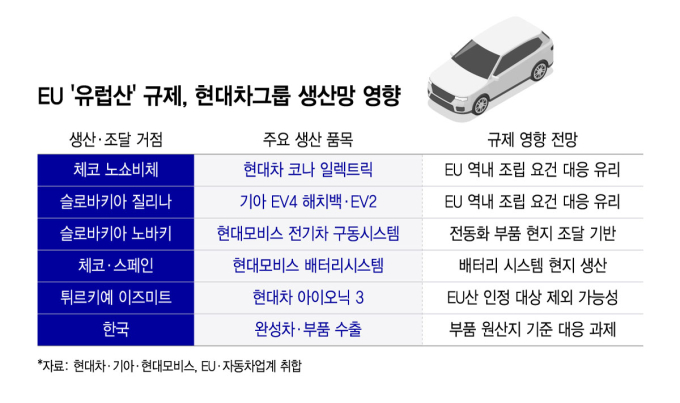
The Hyundai Motor Group is leveraging its already established production networks in EU member states as a foundation for attacking the European market. Hyundai Motor produces the Kona Electric in Nošovice, Czech Republic, and Kia has begun producing the EV2 this year in Žilina, Slovakia, following the launch of the EV4 hatchback last year. Electric vehicles manufactured at intra-regional plants are better positioned to meet assembly location requirements.
Alongside finished vehicle production, the group is also expanding its electric component production base within Europe. Hyundai Mobis began operating an electric vehicle drive system plant in Nova Ki, Slovakia, last month, with an investment of approximately 250 billion won and an annual capacity of 280,000 units.
Combined with battery system plants operated in the Czech Republic and Spain, this has expanded local production hubs for electrification components. While these facilities provide a foundation for supplying components to European finished vehicle manufacturers, challenges remain in separately meeting origin criteria for individual parts such as battery cells.
Hyundai Motor plans to increase its European electric vehicle sales from 116,000 units last year to over 420,000 units by 2030. Kia also aims to expand the share of electric vehicles in its total European sales from 23% last year to 66% by 2030. As both companies intensify their efforts to capture the European EV market, their production hub operations and component sourcing strategies are expected to be influenced by the EU's "European-made" recognition criteria.
EV "Subsidies" Have Limits… "Production Support" Such as Tax Credits Is Urgently Needed
As the domestic penetration of Chinese electric vehicles spreads rapidly, voices are rising that the government must strengthen support for domestic models. There is also criticism that this is an opportunity to transition the current "purchase subsidy" system to a "production support" model.
The United States, China, the EU (European Union), and Japan, among others, view automobiles as strategic industries with significant impacts on national economies and are trending toward strengthening protection for domestic brands. While the South Korean government is supporting domestic products, criticism persists that its measures are relatively weak in intensity and lack sophistication in structure.
South Korea's Jeong Bu-ui (CEO) support measure is the purchase subsidy system. For electric passenger cars, it provides up to 6.5 million won in national funds and up to 3 million to 6.5 million won in local funds (varying by local government) to reduce the burden on buyers. While this contributed to the popularization of EVs, imported vehicles, including Chinese models, receive the same benefits, limiting its effectiveness as a "domestic support measure."
The government decided in July last year to consider factors such as "contribution to the domestic supply chain" when selecting operators for the EV distribution program, but Tesla remained included in the support targets. Although BYD was excluded from the targets, it is defending against performance declines with its originally high price competitiveness and self-implemented discounts.
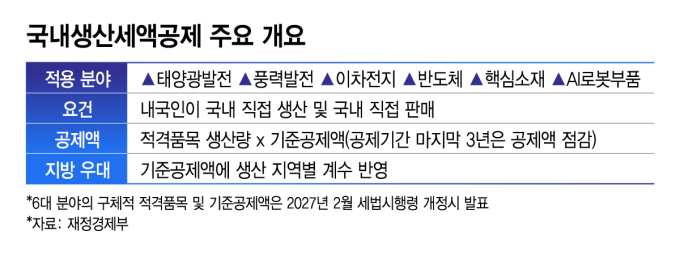
The automotive industry is strongly demanding the application of a "Domestic Production Tax Credit" that reduces taxes based on domestic production volume. The government announced plans to introduce this system in its tax reform proposal released in August, but excluded electric vehicles from the scope of application, which included solar and wind power generation, secondary batteries, and semiconductors. The reason cited was that EVs would receive "duplicate support" alongside purchase subsidies.
The industry pushed back, stating that "the government's response is too complacent," and lawmakers from both ruling and opposition parties also took action. Rep. Yoon Han-hong of the People Power Party and Rep. Lee Eon-ju of the Democratic Party of Korea each introduced representative bills to amend the Special Tax Restriction Act to include electric vehicles in tax credit targets. Recently, Rep. Yun Hu-deok (Democratic Party) jointly re-introduced a bill with Yoon Han-hong (Rep.), adding momentum to the effort.
There are also opinions that the current support system centered on purchase subsidies needs improvement. According to National Assembly meeting minutes, Lee Eon-ju (Rep.) recently argued in the National Assembly Committee on Economy and Finance for including electric vehicles in tax credit targets, stating bluntly, "The US and China provide only production support without purchase subsidies, yet our government continues to invest a massive budget in EV purchase subsidy support regardless of which country produces the electric vehicle."
She added, "Policies centered solely on purchase subsidies, which were necessary for expanding the distribution of eco-friendly vehicles, are no longer sufficient to protect domestic EV production bases and jobs," and "I question whether it is rational to continue this program."
[MT Report] K-EVs Become a "Glass Ceiling" (Part 1)
"Low-Priced Chinese EVs: Aren't We Blocking Them?"… South Korea Lets Go, Market Share "50% Wall" Crumbles

 in INDUSTRY


