

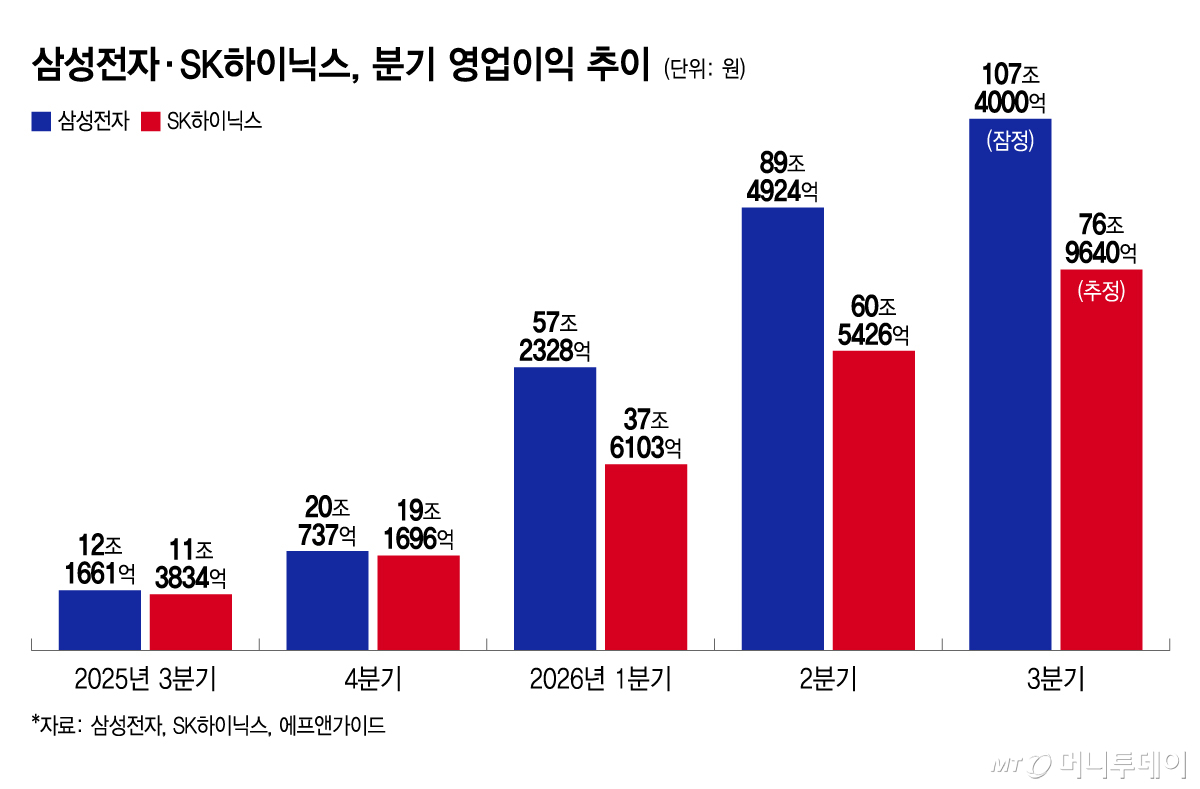
The sharp decline in the stock prices of Samsung Electronics and SK Hynix, despite record-high earnings, stems from concerns that the memory semiconductor boom has reached its peak. However, the semiconductor industry and securities firms place greater weight on forecasts that earnings growth will continue as the memory supply shortage persists long-term. Additionally, there is expectation that additional shareholder return policies announced by both companies could serve as a catalyst for a stock price rebound.
According to financial information provider FnGuide on the 26th, the average operating profit forecast by securities firms for Samsung Electronics and SK Hynix next year reaches approximately 560 trillion won and 400 trillion won, respectively. This represents an increase of more than 50% compared to this year's forecasts. The combined operating profit outlook for both companies for this year and next year is a staggering approximately 1,600 trillion won, expected to exceed twice the cumulative operating profit (748 trillion won) earned over the 26th years from 2000 through last year.
The industry sees a high likelihood that the earnings growth trend will continue through next year. It is estimated that approximately 70–80% of Samsung Electronics' and SK Hynix's memory production volume for next year has been secured through long-term supply agreements (LTAs) with global big tech companies. Competition among major customers to secure the remaining volume is also ongoing.
Furthermore, expectations are growing that the upward earnings trend will be maintained as average selling prices rise, centered on HBM (High Bandwidth Memory), and NAND flash prices have recently surged sharply. Daishin Securities forecasts that the global memory semiconductor market size next year will reach $1,518.8 billion, a 60% growth from this year.
The possibility of the memory supply shortage persisting until 2028 has also been raised. Sanjay Mehrotra, CEO of Micron, which announced its earnings ahead of Samsung Electronics and SK Hynix, stated, "Memory and storage supply and demand will be much tighter next year and in 2028 than this year." Even if semiconductor companies invest in new plants, it takes considerable time for actual production volumes to increase, and the expansion of HBM production is limiting the supply capacity for general-purpose DRAM.
The key to a stock price rebound is 'shareholder returns'… Eyes focused on earnings announcements
Despite unprecedented earnings, stock prices are held back by concerns over a slowdown in the memory industry cycle. The impact includes an unverified next-generation DRAM new technology development plan by Chinese CXMT (ChangXin Memory Technologies) and slowing revenue growth among AI companies, which have excessively dampened investor sentiment. The PER (price-to-earnings ratio) of Samsung Electronics and SK Hynix has fallen to around 3x, entering a level of historical undervaluation.
Securities firms cite shareholder return policies as one variable for a stock price rebound. A signal is needed showing that the increased cash generation capability from the memory boom translates into actual enhanced shareholder value. Consequently, attention is focused on the messages regarding shareholder returns that both companies will present in this third-quarter earnings announcement.
Samsung Electronics has presented a return plan of 90 trillion to 110 trillion won for this year, in accordance with its existing shareholder return policy. The company plans to finalize the third-quarter cash dividend, which was previewed at approximately 30 trillion won at the end of this month, and will decide on the remaining return methods and scale in January next year. The industry estimates that the remaining return funds will amount to approximately 80 trillion won.
The possibility of disclosing plans for utilizing the remaining funds, such as additional dividends or share buybacks and cancellations, is also being discussed in this earnings announcement. In particular, attention is concentrated on share buybacks and cancellations, which have a significant immediate effect on boosting stock prices. Some activist funds are demanding the cancellation of preferred shares.
Attention is also focused on the possibility of additional shareholder returns from SK Hynix, which disclosed a 40 trillion won share buyback plan in August. Market expectations for measures to enhance shareholder value have grown after the company recently halted its consideration of listing its U.S. grandchild company Solidigm on NASDAQ.
SK Hynix expressed its commitment to shareholder returns by revising its existing policy of returning 50% of cumulative FCF (free cash flow) for the period from 2025 to 2027 to "more than 50%." Securities firms are discussing the possibility of additional shareholder returns of approximately 40 trillion won. The company is also considering utilizing profits from the sale of its stake in Japan's Kioxia for shareholder returns.
However, it is difficult to utilize all increased profits for shareholder returns. This is because enormous funds are required for expanding production capacity for HBM and next-generation DRAM, as well as constructing new plants. Ultimately, the key to a stock price rebound is expected to be the sustainability of the memory market boom and the balance between capital expenditure and shareholder returns.
Ryu Hyeong-geun, a researcher at Daishin Securities, analyzed, "It is an environment where we can simultaneously pursue strengthening financial health amid massive cash inflows and expanding the absolute scale of shareholder returns," adding, "The possibility of early execution of shareholder returns has also increased as stock undervaluation persists."

 in INDUSTRY
