

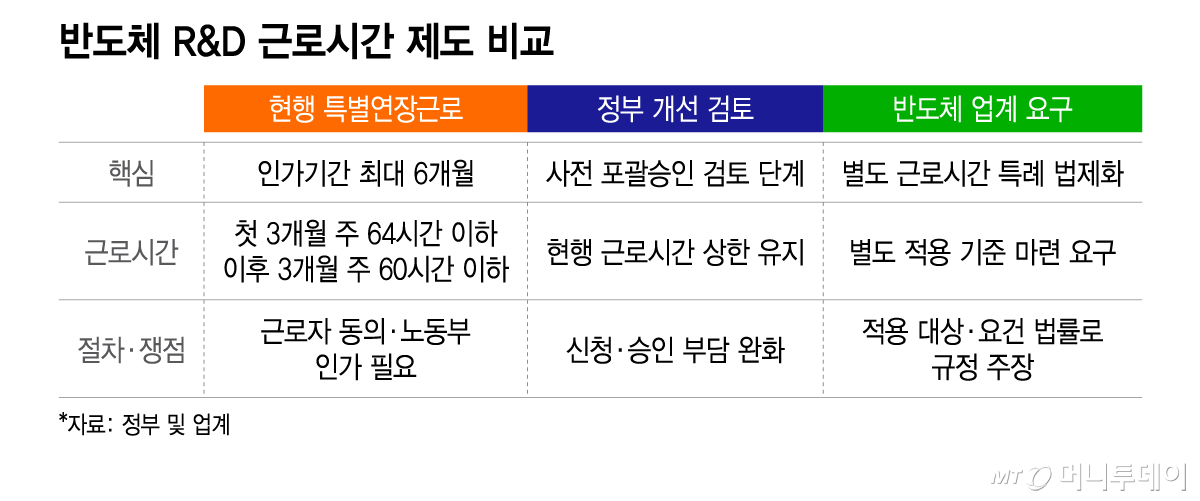
Although the government has taken successive measures to improve the working hours system, the semiconductor industry continues to demand the enactment of separate legal special provisions for research and development (R&D) personnel. The reason is that due to the nature of sudden variables arising during chip development and work being concentrated in specific periods, it is difficult to flexibly manage R&D personnel under the current special extended working hours system alone.
According to industry sources on the 27th, although President Lee Jae-myung requested improvements to the system, including prior comprehensive approval for special extended working hours, on the 23rd, the industry maintains that merely supplementing the current system is insufficient to resolve working hour management issues in R&D fields.
Last year, the government expanded the approval period for special extended working hours in the semiconductor R&D sector from a maximum of three months to six months. With a six-month approval, employees can work up to 64 hours per week for the first three months and up to 60 hours for the subsequent three months. The requirements that employee consent and Ministry of Employment and Labor approval are necessary remain unchanged.
The problem is that even if the approval period is extended, it remains difficult to predict periods of concentrated work in semiconductor R&D fields. When errors are discovered during chip design and verification processes, repeated cause analysis, correction, and re-verification are required, and responses must also be made to sudden demands from clients. In this process, the work of personnel who understand development history and process conditions inevitably becomes concentrated in specific periods. Previously, semiconductor companies had experience utilizing extended working hours during the development of high-bandwidth memory (HBM).
Although workload fluctuates rapidly depending on actual development situations, the necessity must be separately justified to utilize special extended working hours. Even if approval is granted relatively quickly, the burden remains of explaining the background for the need for extended work and the progress of development during the application process. There are also concerns that specifically justifying the development stage or work content during the application process could lead to such information becoming known externally, providing clues for competitors to infer development trends.
The prior comprehensive approval under government review is a measure to reduce such application burdens. However, even if the approval procedure is simplified, the upper limit on working hours applied to special extended working hours by the Bank of Korea remains in place. Industry points out that constraints remain requiring responses within permitted working hours even if development schedules extend longer than expected or sudden variables occur during verification processes.
Consequently, they argue that legal standards for applying working hours different from the current special extended working hours should be established for semiconductor R&D personnel meeting certain requirements. Unlike the current system where approval periods and review methods are adjusted according to government guidelines, this aims to ensure the sustainability of the system by stipulating applicable targets and requirements in law.
However, discussions on legalization are slow. The 52-hour workweek exception clause excluded from the Semiconductor Special Act is being re-pushed through the Ultra-Regional Special Zone Act, but labor-management-government social dialogue remains at the stage of agenda adjustment despite several practical consultations. The labor sector's concerns about infringement of health rights due to long working hours are also a task that must be resolved in the legalization process.
An industry official urged, "In the R&D field, concentration and continuity are important, but there are significant limitations in responding to critical moments such as the final stages of development or just before Yangsan under the current working hour system by the Bank of Korea," adding, "Since expanding approval periods or simplifying approval procedures alone have limitations, effective legal special provisions reflecting the characteristics of R&D fields must be established promptly."

 in INDUSTRY
