

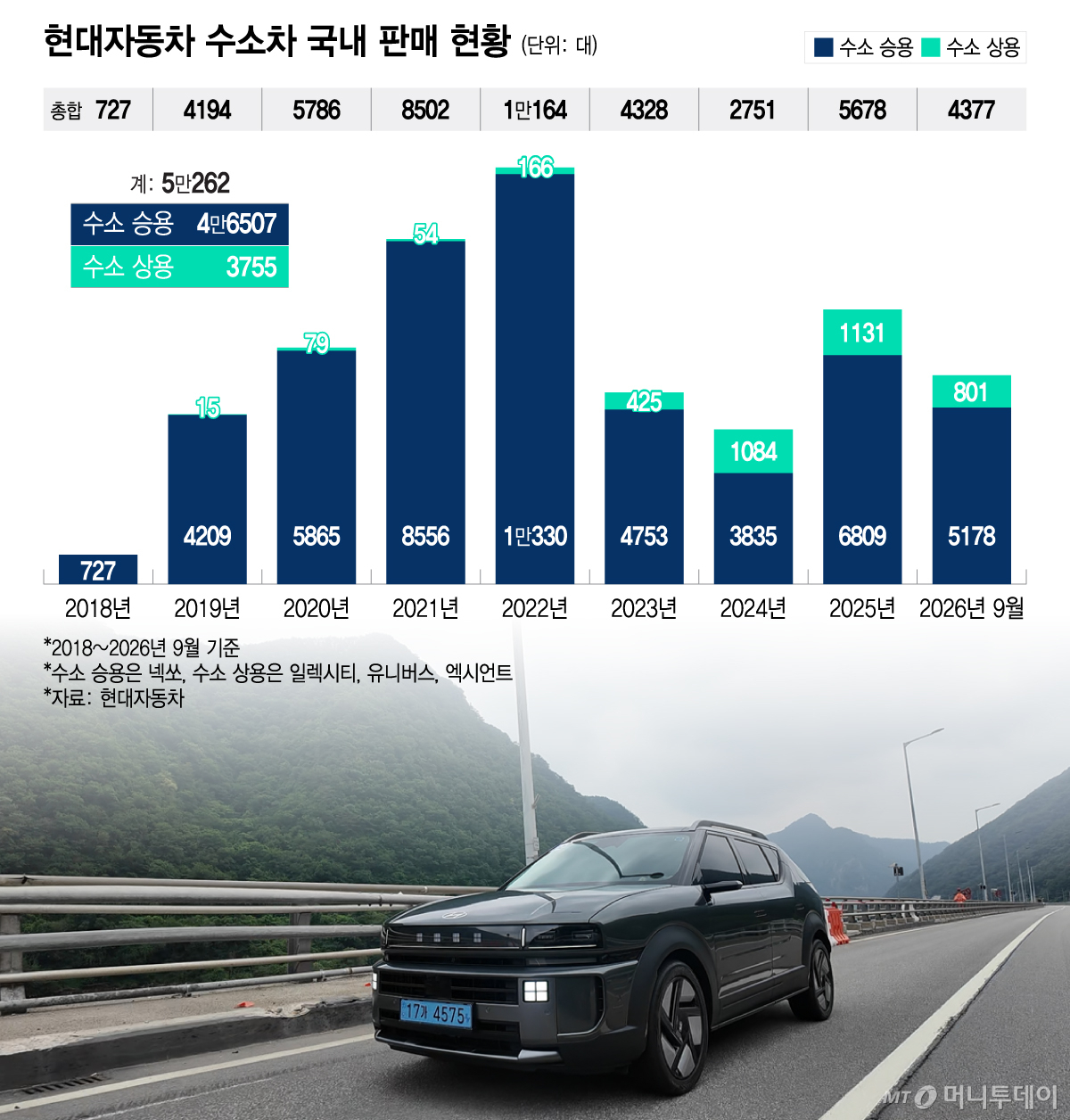
Hyundai Motor's hydrogen fuel cell vehicles have surpassed 50,000 units in cumulative domestic sales, while Kia is pursuing mass production of a hydrogen-powered Carnival in 2029.
Calls are growing for improvements to the subsidy system and an expansion of refueling infrastructure to accelerate the Hyundai Motor Group's efforts to build a hydrogen mobility ecosystem.
According to the automotive industry on Tuesday, Hyundai Motor sold a total of 50,262 hydrogen vehicles domestically in Korea through September this year. Specifically, 46,507 passenger vehicles (Nexo) and 3,755 commercial vehicles (Elec City, Universe, XCIENT) were sold, respectively.
Hyundai Motor began its hydrogen fuel cell research in 1998 and unveiled the world's first Yangsan-type hydrogen vehicle, the 'Tucson ix FCEV,' in 2013.
The company laid the foundation for the passenger vehicle sector centered on individual consumers by launching the 'Nexo' in 2018, and led the commercialization of hydrogen mobility across all areas by Yangsan-ing the large commercial hydrogen truck 'XCIENT' in 2020.
According to market research firm SNE Research, Hyundai Motor accounted for approximately 70% of global hydrogen vehicle sales as of the first half of this year, solidifying its unparalleled position not only in the domestic market but also globally.
The influence of Hyundai Motor Group is expected to continue expanding. Recently, Kia's management and labor held an employment stability committee meeting and agreed on the production schedules for major new vehicles from 2027 to 2029 and production plans by domestic factory, which included the development of a Carnival hydrogen vehicle.
Kia plans to add a model equipped with the next-generation hydrogen fuel cell system to the successor model of the Carnival, which will be produced at its Gwangmyung Plant No. 1 in Gyeonggi Province in 2029. If launched as planned, it will become the first hydrogen vehicle Yangsan-ed by Kia since its founding in 1944.
Hyundai Motor Group's hydrogen vehicle business is significant in that it contributes to securing a leading position in the global market and, furthermore, to the growth of the domestic materials, components and equipment industry and job creation.
For example, the localization rate of core components for the Nexo exceeds 90%, and the company has established a supply chain with approximately 60 partner companies.
According to the Korea Hydrogen Alliance, as of 2024, there were approximately 37,000 employees in domestic hydrogen businesses and about 3,000 related companies, forming the employment base for the hydrogen industry.
While concerns are emerging that policy support and infrastructure rollout limitations could hinder efforts to continuously enhance hydrogen mobility competitiveness, the imbalance between national and local government funding is first pointed out.
Even if the central government secures national funds for hydrogen vehicle subsidies, vehicle distribution can be delayed if Local Governments do not allocate sufficient local funds.
If the local fund matching rate is low, national funds cannot be used in a timely manner, resulting in a structure where the execution rate of national funds also drops. In fact, out of the 6,000 units allocated for national funding for hydrogen passenger vehicles this year, the local fund matching volume was 5,093 units (84.9%) as of the end of September.
For commercial vehicles such as hydrogen buses, the secured local fund volume was only about 1,270 units (70.6%) compared to the allocated national fund volume of 1,800 units.
A bigger problem is that this lowered execution rate leads to budget cuts in the following year, thereby shrinking the market's capacity for distribution itself. In fact, citing poor execution rates and other reasons, the government cut the hydrogen vehicle subsidy budget by 23%, from 576.2 billion won this year to 445.7 billion won next year.
An industry official said, "We must create an effective policy environment where allocated budgets can be executed without on-site constraints, so that the growth of the hydrogen ecosystem can lead to the cultivation of strong domestic small and medium-sized enterprises and job creation."

 in INDUSTRY
