

It has been confirmed that the Defense Acquisition Program Administration (DAPA) has launched an investigation into allegations that a subcontractor supplying Infrared Signature Suppression Systems (IRSS) for Navy vessels to major domestic shipbuilders inflated costs by approximately 6 billion won.
The company is suspected of preparing cost calculation documents as if it had directly manufactured some of the equipment imported from overseas, thereby double-counting both import prices and manufacturing costs.
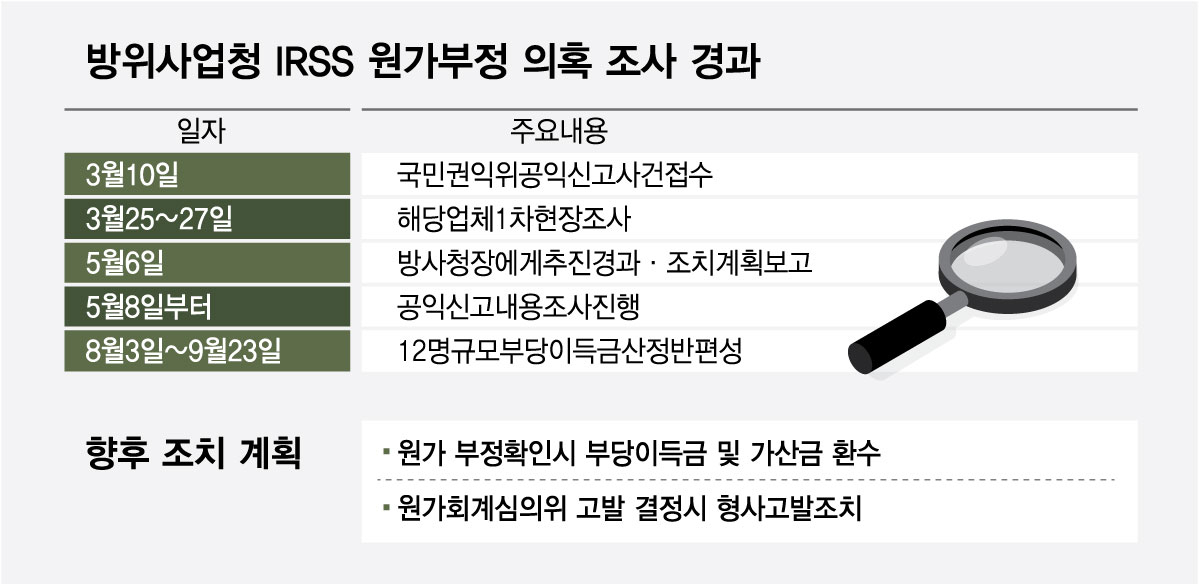
According to documents submitted by DAPA to Rep. Cheon Ha-ram of the Reform Party on the 23rd, DAPA received a public interest report case regarding suspected defense cost inflation by an IRSS supplier for Navy vessels from the Anti-Corruption and Civil Rights Commission (ACRC) on March 10.
It conducted its first on-site investigation of the company from the 25th to the 27th of the same month, and reported the progress and action plan to the Commissioner on May 6. Since then, it has been conducting an investigation into the contents of the public interest report starting May 8.
Subsequently, DAPA formed a "Calculation Team for Unjust Gains" consisting of 12 members from August 3 to September 23. DAPA stated, "Based on the results of the investigation by the Calculation Team for Unjust Gains and Surcharges, if the company is found to have committed cost irregularities, we will recover unjust gains and surcharges in accordance with Article 58 of the Defense Acquisition Act and Article 69 of its Enforcement Decree." It added, "If the Cost Accounting Review Committee decides to file a criminal complaint, we plan to take criminal prosecution measures."
The subject of the investigation is the IRSS installed on Navy destroyers (KDX), frigates (FFX), and guided missile fast attack craft (PKX). The IRSS is a device that mixes cold outside air with high-temperature exhaust gas emitted from ship or helicopter engines to lower the heat. It is a type of stealth technology that reduces infrared (heat) signals and lowers the likelihood of being detected by enemy detection equipment.
According to the report, Company A is suspected of preparing cost calculation documents as if it had directly manufactured "lower uptakes," which are part of the core IRSS equipment imported from overseas. The gist of the allegation is that the company obtained approximately 5.92 billion won in unjust gains by double-counting both the price of imported materials and direct manufacturing costs for parts purchased abroad. This amount is an estimate calculated based on a total of 16 vessels, comprising eight each of FFX-II and FFX-III.
The report also stated that Company A signed IRSS subcontract supply contracts with shipbuilding companies such as Hanwha Ocean, HD Hyundai Heavy Industries, HJ Heavy Industries, and SK Oceanplant. It is expected to become a point of contention whether the cost calculation documents subject to these false allegations were properly verified during the verification process by these shipbuilders. The fact that the shipbuilders procured the equipment through negotiated contracts with specific companies rather than open general competition has been identified as one of the causes of the incident.
Most importantly, DAPA currently mandates the submission of cost data and verifies its appropriateness for subcontract items exceeding 1 billion won per item. Pointing out that the method of calculating costs differs between imported equipment and domestically manufactured products, there are calls to strengthen verification of imported equipment in light of this suspicion. This is because the cost of domestically manufactured products is calculated based on actual manufacturing costs such as material and labor expenses, whereas the cost of imported equipment is calculated based on import prices.
Rep. Cheon Ha-ram of the Reform Party said, "Just like in the LIG D&A bribery case, the subcontracting structure is being used as a means of concealment and a shield for defense corruption in the suspected IRSS cost inflation case."
He pointed out, "DAPA must thoroughly determine whether cost irregularities occurred and take measures to ensure that defense corruption using subcontracts as a shield cannot take root by recovering not only unjust gains but also surcharges up to the maximum limit prescribed by law." He further urged, "At the same time, the costs of all subcontract items that have been supplied through negotiated contracts without competition must be comprehensively re-examined."

 in INDUSTRY
