

The Army reaffirmed that energy transition is a security challenge for future battlefields.
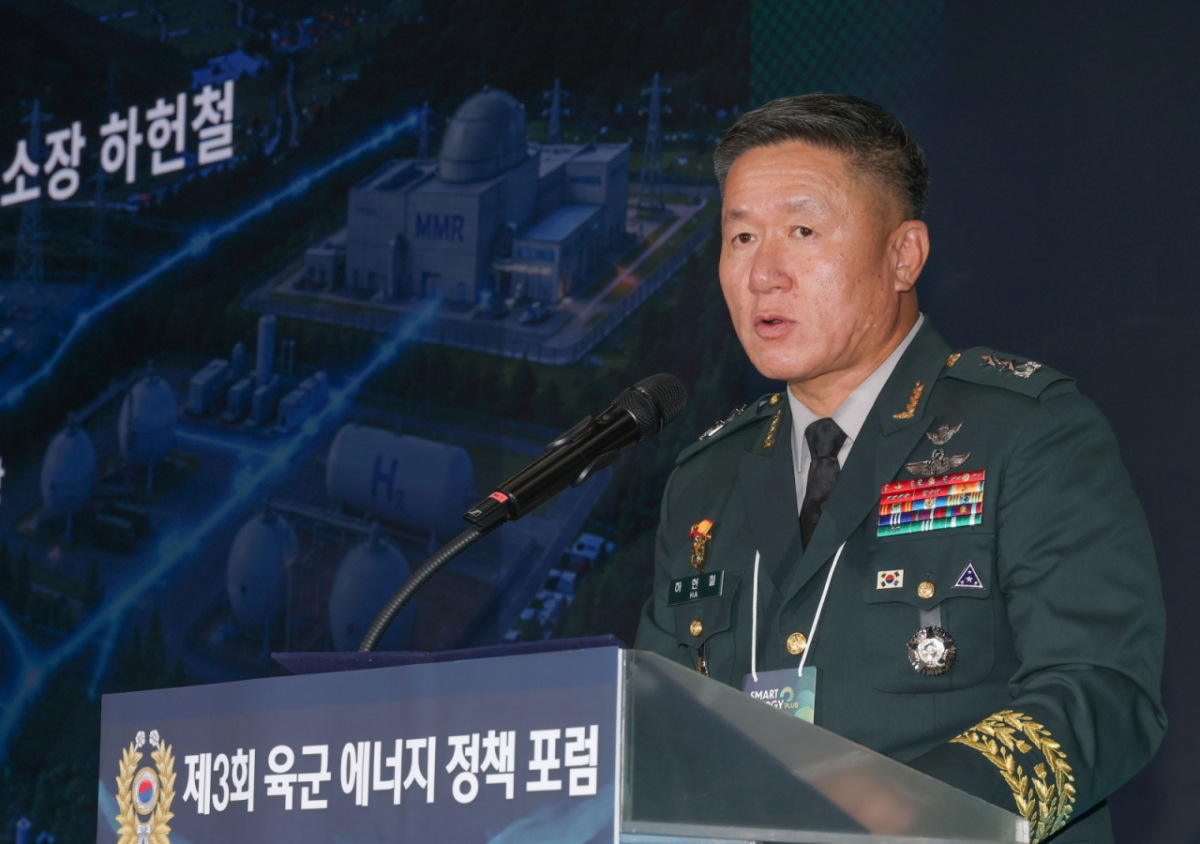
On the 28th, the Army held the "3rd Army Energy Policy Forum" alongside "Smart Energy Plus (SEP) 2026," which was conducted in Hall B of COEX in Seoul.
In his greeting, Ha Heon-cheol, Director of the Logistics Staff Department at the Army Headquarters, stated, "Preparing for energy security is preparing for the future battlefield." He added, "The Army is promoting the diversification of energy sources and the construction of self-sufficient energy systems by introducing solar power in the short term and hydrogen and nuclear power in the medium to long term."
On that day, the Army announced its direction for advancing next-generation energy policies, led by the HYBRID (fixed and mobile) microgrid pilot project currently being implemented at the Changseong Military Academy in South Jeolla Province.
A microgrid refers to a small-scale power grid that can independently supply and store electricity using its own generation sources and Energy Storage Systems (ESS). In the case of a mobile microgrid, which is configured with solar and diesel generators and an ESS installed on a vehicle, it is capable of maneuvering in rough terrain and can deploy the power grid rapidly within 100 minutes.
Yang Deok-jun, Head of the Energy Policy Division at the Logistics Staff Department of the Army Headquarters, explained, "Microgrids are operated in conjunction with external power grids under normal circumstances, but they switch to independent operation rapidly in crisis situations." He added, "Through this, we maintain core unit functions such as command and control, communications, medical maintenance, and ammunition facilities."
Figures participating in the forum that day also mentioned the necessity of microgrids in modern warfare, citing examples such as the war in Ukraine. Yoon Soon-jin, Dean of the Graduate School of Environmental Studies at Seoul National University, opened his keynote speech by stating, "Energy security is part of military security," and added, "The most certain way to safeguard security is a proper energy transition."
In particular, he emphasized that the modern military is a digital army with high energy utilization. This is because command and communications, surveillance and reconnaissance, drones, and precision weapons all run on electricity; if the energy supply is cut off, combat power is also severed. Dean Yoon stated, "Fuel supply lines are the vital points of the battlefield," adding, "As a lesson from actual battlefields rather than theory, every time a fuel convoy moved 24 times in Afghanistan, one casualty occurred."
He then proposed microgrids as a solution to this. He noted that not only the Ukrainian military, which suffered strikes on energy facilities, but also the U.S. military has begun utilizing microgrids. He said, "The encouraging point is that the Army has already embarked on this path," and added, "The easiest energy to protect is dispersed energy."
The importance of energy security was also highlighted in subsequent speeches. Moon Chae-ju, Director of the Military Energy Transition Research Center at the Korea University of Technology and Education, pointed out, "Looking at the war in Ukraine, transmission facilities are attacked first," calling them "the easiest targets." He then advised regarding our military's microgrids that they should be "mission-centric, (energy sources) must be dispersed, and must be diversified."
Sim Hyeon-seop, Head of the Energy Solution Business Center at Hanwha Aerospace, which is participating in the Army's microgrid pilot project, stated, "At battalion-level operational sites, a reduction in fuel costs of approximately 40% is expected through the introduction of microgrids." He added, "This translates to savings of 311 liters per month and 1.7 billion won per year," expressing confidence that they would successfully demonstrate this through the pilot project.

 in INDUSTRY
