

By opening the era of 100 trillion won quarterly operating profit, Samsung Electronics once again shattered its all-time high performance. Earning over 106 trillion won from its semiconductor business alone, it set a new record for highest-ever results for four consecutive quarters.
Along with SK hynix, which announced an operating profit of 83 trillion won the previous day, surpassing market expectations, 'K-semiconductors' appear to be dismissing the so-called "semiconductor peak theory" raised by some sectors.
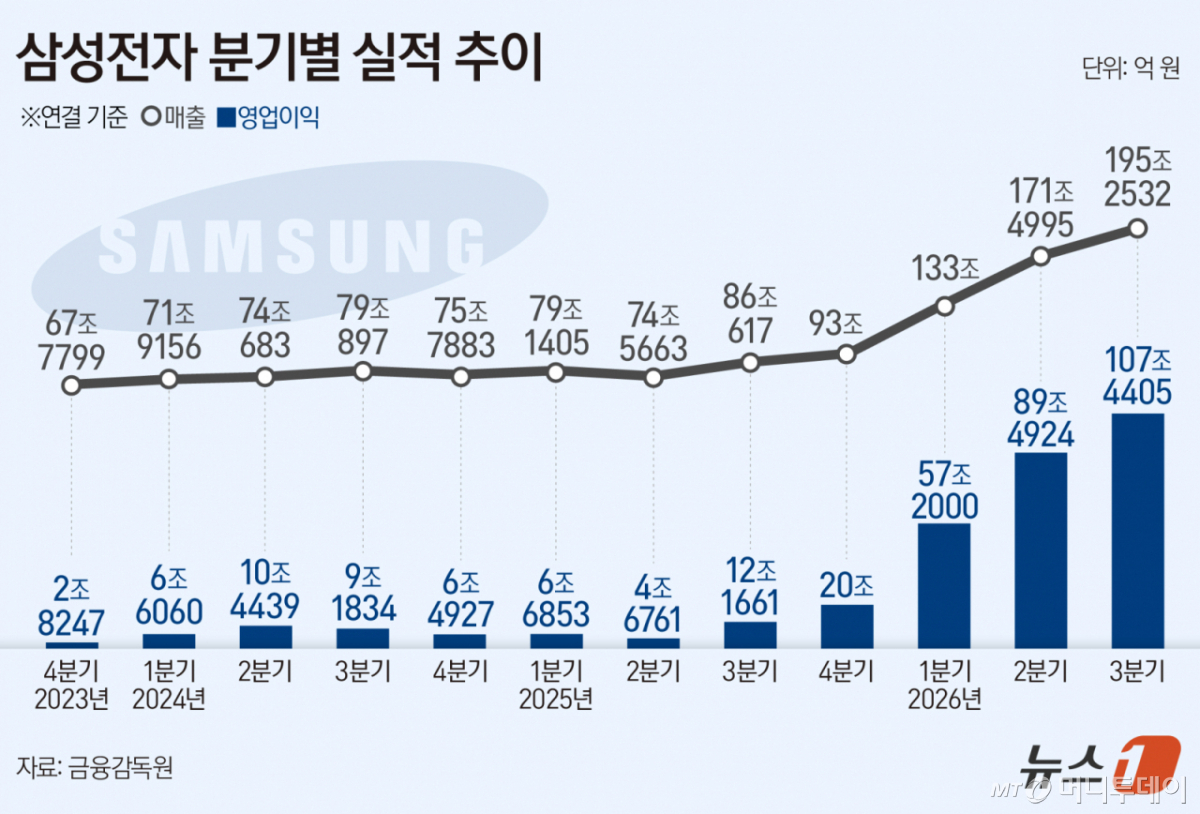
Samsung Electronics announced its finalized Q3 results on the 29th, reporting consolidated revenue of 195.2532 trillion won and operating profit of 107.4405 trillion won for this year. Revenue increased by approximately 127% and operating profit surged by approximately 783% compared to the same period last year.
Samsung Electronics is the first tech company in the world to surpass 100 trillion won in quarterly operating profit in history. As astronomical amounts of cash accumulate, net cash as of the end of Q3, excluding borrowings from cash and cash equivalents, increased by 30 trillion won in three months to 197.6 trillion won.
The semiconductor (DS) division alone generated revenue of 147.1 trillion won and operating profit of 106.5 trillion won. In Q3 alone, the semiconductor business of 'Samjun-Nix' (Samsung Electronics + SK hynix) achieved approximately 190 trillion won in operating profit. The operating margin of Samsung Electronics' DS division is 72.4%. Considering that the foundry (semiconductor contract manufacturing) and System LSI divisions are still in the red, the operating margin of the memory division is estimated to be around 77%. This is a world-class operating margin alongside SK hynix, which recorded 80%.
Sales of 6th-generation HBM (High Bandwidth Memory) 4 were significantly expanded, and it actively responded to increased demand for server SSDs (Solid State Drives). System LSI saw quarterly revenue growth by equipping new second-half models with SoCs (System on Chip) and image sensors, while the foundry (semiconductor contract manufacturing) improved performance due to revenue growth in HBM base dies and expanded sales of advanced processes to global customers.
On the other hand, the finished product (DX) division struggled to escape poor performance due to rising costs and intensified global competition. It recorded a loss for two consecutive quarters with revenue of 52.1 trillion won and an operating loss of 800 billion won.
The MX division, which manufactures smartphones, saw revenue growth compared to the previous quarter and the same period last year due to the launch of flagship new models such as the Galaxy Z Fold 8. Despite increased cost burdens such as rising memory prices, performance improved compared to the previous quarter due to an increase in ASP (Average Selling Price) resulting from a higher proportion of premium product sales. Network performance declined due to decreased revenue in the North American market and software.
The VD division, which produces TVs, saw revenue decrease due to reduced demand following the end of global sports events, but limited the decline in profitability by expanding premium product sales and streamlining costs. Home appliances saw profits decrease due to rising raw material and logistics costs.
In addition, subsidiary Harman improved its performance due to the impact of U.S. tariff refunds, recording revenue of 4.3 trillion won and operating profit of 600 billion won. The display division achieved revenue of 8 trillion won and operating profit of 1.1 trillion won through expanded sales centered on high-end products and cost reduction.
The performance outlook centered on semiconductors remains bright. Samsung Electronics expects the industry boom to continue next year due to strong overall semiconductor demand driven by the accelerated adoption of agentic AI (Artificial Intelligence). In memory, it plans to maintain a sales focus on high-value-added products such as expanded HBM4 sales based on advanced technology, mass production of 7th-generation HBM4E in the first half of next year, and high-performance DDR5.
System LSI will focus on stable mass production and sales of flagship SoCs and 200-megapixel sensors while also pursuing the acquisition of new customers for custom SoCs. The foundry aims to turn a profit by expanding mass production of 4nm and 2nm advanced processes, and is set to fully launch mass production of 2nm AI High-Performance Computing (HPC) at its Taylor fab (factory) in the U.S.
Annual capital investment this year is planned to be executed at a scale of 84.4 trillion won, with the DS division accounting for the majority at 76.8 trillion won and display at approximately 3.9 trillion won.
The DX division's strategy is to focus on securing profitability by expanding premium product sales in line with the year-end peak season. MX will push for expanded sales centered on the S26 series, foldable, and wearable new products. VD and home appliances also plan to boost profitability by increasing the proportion of premium product sales.
Meanwhile, it was revealed that a negative effect of approximately 10 trillion won compared to the previous quarter occurred in company-wide operating profit, centered on the component business, due to declines in major exchange rates such as the dollar and euro. Q3 research and development expenses were 14.4 trillion won, an increase of 63% from the previous year.
The shareholder return policy has also been detailed. The cash dividend for Q3 this year is 4,601 won per common share and 4,601 won per preferred share, totaling 30 trillion won, scheduled to be paid on November 27. Subtracting the 35th trillion won already executed or confirmed from the total shareholder return scale of 90 to 110 trillion won this year, remaining resources are at a level of 55 to 75 trillion won. This will be used to implement substantial share buybacks and cancellations along with cash dividends.
It said, "The company is aware of market interest in the price difference between common and preferred shares, and plans to actively consider and adjust the proportion of preferred share purchases by reflecting market conditions when conducting share buybacks and cancellations."
It plans to finalize and announce the next shareholder return policy, the final shareholder return scale for remaining resources in 2026, and specific execution measures at the board of directors meeting at the end of January 2027.

 in INDUSTRY

