

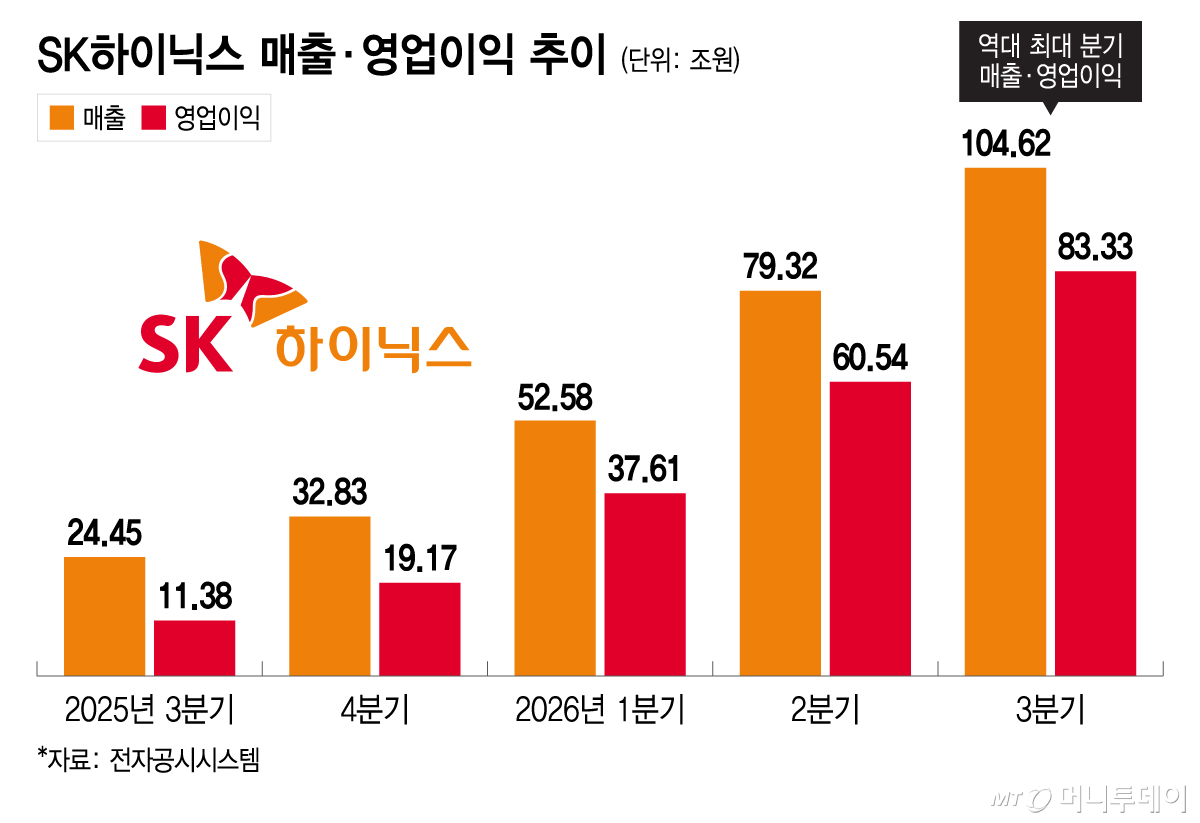
SK hynix has once again set a new record for its highest-ever results, surpassing 80 trillion won in quarterly operating profit and 100 trillion won in revenue.
The performance exceeded market expectations, proving the robust growth of the memory semiconductor industry, contrary to some concerns. Based on solid results, the company is also pushing for a shareholder return policy of approximately 100 trillion won.
SK hynix said Wednesday that it recorded revenue of 104.6155 trillion won, operating profit of 83.3338 trillion won, and net income of 39.7756 trillion won in the third quarter of this year.
The operating profit margin is 80%, and the net profit margin reaches 38%. Revenue surpassed 100 trillion won for the first time in history, with revenue and operating profit increasing by 32% and 38%, respectively, compared to the previous quarter.
The company showed an "earnings surprise" due to an explosion in memory semiconductor demand driven by expanding global AI (artificial intelligence) investment. The average expected operating profit from securities firms was around 77 trillion won.
By product, DRAM performance growth was driven by a significant increase in sales of server DDR (Double Data Rate) 5, amid the full-scale shipment of 6th-generation HBM (High Bandwidth Memory) 4. In NAND as well, high-value-added products for data centers continued to grow, with expanded sales of 321-layer TLC (Triple-Level Cell) eSSD (Enterprise Solid State Drive).
The financial structure has also become more solid. Cash and cash equivalents at the end of the third quarter were 114.5 trillion won, an increase of 26.5 trillion won from the end of the previous quarter in just one quarter. Borrowings decreased by 2.8 trillion won to 15.8 trillion won. Net cash increased to 98.7 trillion won.
The outlook ahead is also bright. Memory supply shortages are expected to continue through 2030, making it inevitable that results will improve further.
The company said, "AI is leading to productivity improvements and the creation of new revenue in various areas such as software development, customer service, and search, establishing a virtuous cycle where increased AI usage leads to expanded infrastructure investment."
It expects the global AI data center infrastructure market to grow steadily in the future, as the main investors in AI are expanding from a few big tech companies to general enterprises and the national level. However, supply is limited.
Due to increasing technical difficulty in advanced processes and the long time required to build new production facilities, it is expected that the structure where demand exceeds supply will continue until 2030, when newly promoted factories such as the Yongin Phase 1 fab, which will begin operation next year, fully ramp up production.
To match market demand as much as possible and maximize profitability, the company plans to rapidly increase the share of its 10-nanometer-class 6th-generation process and expand sales of DDR5 and LPDDR5 SOCAMM for AI servers. This is a portfolio centered on high-value-added products.
To respond to surging HBM demand, the company plans to maximize the production capacity of the M15X at its Cheongju factory by year-end to increase HBM4 production. As a result, in the fourth quarter, HBM4 is expected to surpass HBM3E (5th generation) in both shipment volume and revenue, establishing itself as a key product.
In the case of NAND, the company plans to raise the share of its main 321-layer process to more than half of domestic production capacity in the fourth quarter, thereby increasing the supply of high-performance, high-capacity eSSD.
In the medium to long term, the strategy is to develop NAND into a core solution that enhances the throughput and economics of AI services, based on HBF (High Bandwidth Flash) and system optimization technologies.
Meanwhile, SK hynix has secured more than half of its total production capacity through Long-Term Agreements (LTAs) by 2028. The company has signed LTAs with 14 major customers, including global large cloud service providers (CSPs), and is proactively discussing extending contract periods beyond the usual five years with some customers.
LTA volumes correspond to more than 50% of total production capacity in 2027 and 2028. The company has established a structure that ensures stable profitability while allowing for flexible response to market changes by adopting a method that reflects market conditions within the price range agreed upon with customers.
The company also announced its shareholder return plan. It is pushing for approximately 100 trillion won in shareholder returns, including cash dividends of over 30 trillion won and share buybacks and cancellations totaling over 60 trillion won (including the 40th trillion won announced in August) based on fiscal year 2026.
On this day, the board of directors resolved to pay a third-quarter cash dividend of 14 trillion won and conduct a 20 trillion won share buyback. Of the treasury shares to be purchased, the 10th trillion won intended for shareholder returns will be fully canceled, while the remaining approximately 10 trillion won is for employee compensation and is not included in the shareholder return amount.
The third-quarter dividend is 20,000 won per share, consisting of a 10,000 won dividend reflecting improved performance and a 10,000 won special dividend sharing the investment results with Kioxia. The company has decided to return most of the profits realized from its Kioxia investment this year to shareholders.

 in INDUSTRY

