

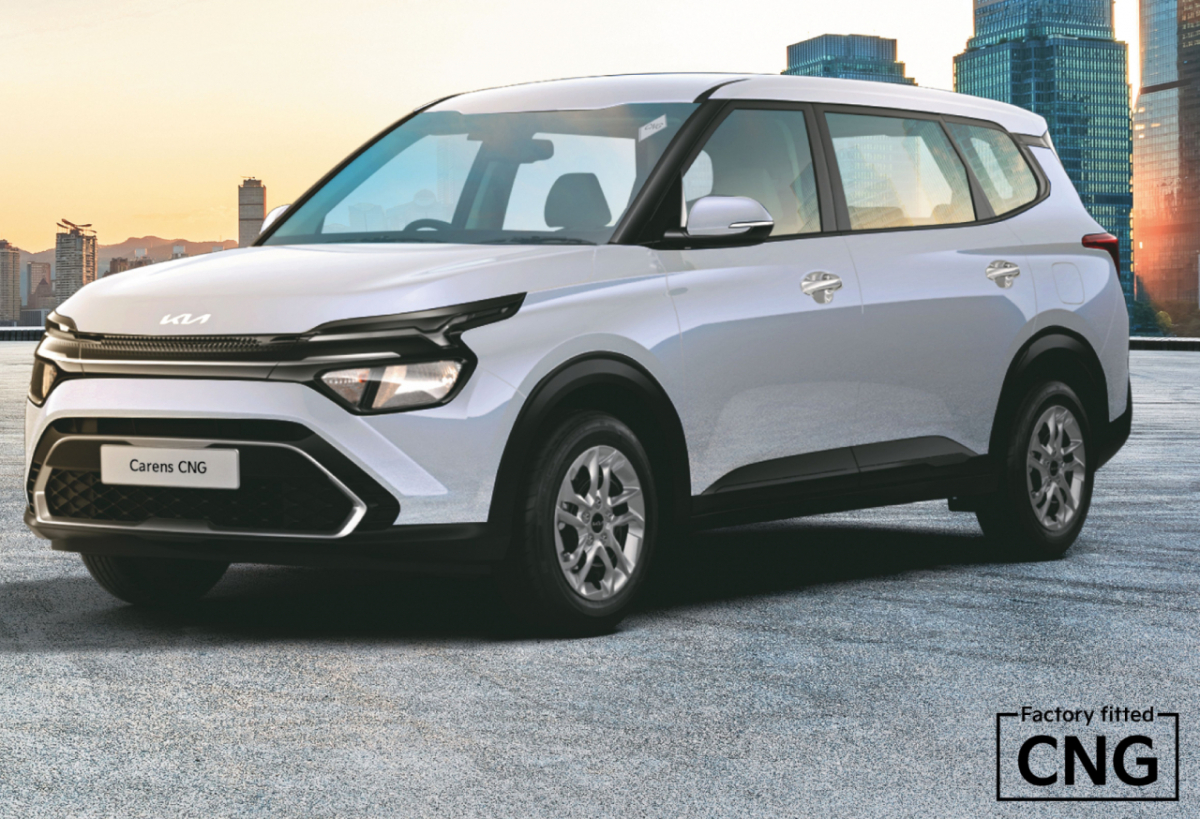
Kia has secured approximately 10% of local delivery volumes in India just over a month after launching its factory-installed compressed natural gas (CNG) models. The diversification of powertrains, aimed at responding to the growing CNG market in India driven by low operating costs, is showing early results. Hyundai Motor also plans to add a CNG model to the Bayon, which is expected to accelerate both companies’ localized product strategies in the region.
According to local Indian media on the 4th, among Kia’s 33,462 wholesale sales in India last month, the share occupied by the Carens and Carens Clavis CNG models was approximately 10%. Wholesale sales refer to the volume shipped from factories to dealerships. This is distinct from retail sales, which are actual sales to consumers.
Kia launched factory-installed CNG versions of these two vehicle models on September 19. Unlike the previous method where dealerships added CNG kits to existing Carens vehicles, these new models apply CNG specifications from the factory production stage.
Both models combine a 1.5L engine with a 6-speed manual transmission. The launch prices are 1,212,000 rupees (approximately 17 million won) for the Carens CNG and 1,239,000 rupees (approximately 17.5 million won) for the Carens Clavis CNG. Although they are 100,000 rupees (approximately 1.4 million won) more expensive than their corresponding gasoline manual transmission counterparts, they have secured an initial share of deliveries.
The background behind Kia’s expansion of CNG models lies in Indian consumers’ fuel cost burdens and changes in local demand. Even if the purchase price is higher than gasoline models, CNG vehicles offer relatively lower operating costs, making them a viable alternative for consumers with high mileage.
According to local reports citing data from the Federation of Automobile Dealers Associations (FADA), the share of CNG vehicles in India’s passenger car retail sales was 21.98% in the 2025-2026 fiscal year. This made it the second largest segment after gasoline, surpassing diesel (18.08%). The share rose to 25.28% in August this year and recorded 23.11% in September. This means that one out of every four or five passenger cars sold in India is a CNG vehicle.
The early success of the CNG models is also contributing to Kia’s expanded sales in India. Kia’s wholesale sales in India last month increased by 13.2% year-on-year, setting a record for the highest monthly figure ever. Cumulative sales from January to October reached 286,470 units, already surpassing the total annual sales of 280,286 units last year. While the Seltos and Sonet support main sales, the CNG models are securing new demand.
Hyundai Motor also plans to broaden its CNG options. According to local industry sources, Hyundai is scheduled to launch a Bayon CNG model in January next year. This move is interpreted as an effort to expand purchase demand by adding a CNG version to the Bayon, which was first launched in India last month.

 in INDUSTRY
