

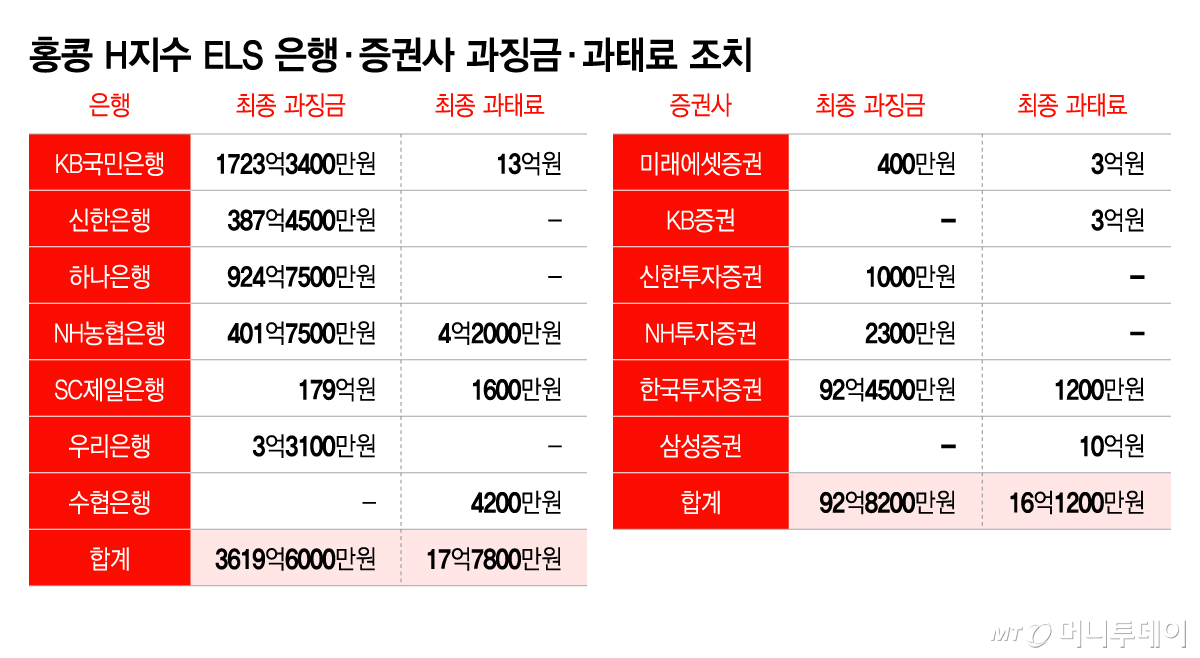
The penalty for the improper sale of equity-linked notes (ELN) tied to the Hong Kong H-Index has been significantly reduced from initial expectations, complicating banks' calculations over whether to file administrative lawsuits.
While accepting a substantial penalty could raise issues of breach of fiduciary duty, the severity of the sanctions has been drastically lowered, and banks must also consider the capital regulation burden associated with prolonged litigation. Banks are expected to decide on litigation after reviewing the financial authorities' final sanction results and deliberating through their boards of directors.
The Financial Services Commission decided at its regular meeting on the 4th to impose a total penalty of 361.96 billion won on six banks related to the improper sale of Hong Kong ELNs.
The Financial Supervisory Service had pre-notified approximately 2 trillion won last November, then reduced it to 1.4 trillion won in February this year. Following a request for supplementation from the Financial Services Commission, it was lowered to 600 billion won in June, and further reductions were made this time.
Banks are expected to review whether to file lawsuits after receiving the final sanction results from the Financial Services Commission. They are anticipated to go through a process of reviewing the appropriateness of the penalty calculation, legal issues, and the likelihood of winning, among other factors, in compliance monitoring departments, before reporting to management.
Given the gravity of the matter, there is a high possibility that related content will also be discussed at the board level. In particular, Standard Chartered Bank Korea, a foreign-affiliated bank, may go through a process of consulting with group executives in addition to domestic board discussions.
A bank official stated, "Administrative litigation is legally possible, but we are currently reviewing it." Another bank official explained, "We must comprehensively examine how much the banks' defenses were reflected in the sanction results and the scale of the penalty."
Initially, the possibility of administrative litigation was raised within the banking sector on the grounds that accepting a large penalty could lead to allegations of breach of fiduciary duty against management.
This is because banks have already voluntarily compensated investors approximately 1.3 trillion won, covering about 99% of the losses, and would additionally have to bear the penalty. Banks accounted for this by establishing provisions during the voluntary compensation process, recognizing costs, and deducting them according to actual payments.
However, with the penalty reduced more significantly than expected, the atmosphere suggests a lower likelihood of litigation. In particular, the capital regulation relaxation measures announced by financial authorities at the 5th Productive Finance Transformation Meeting in April are also cited as a variable.
The Financial Services Commission allowed large-scale loss incidents that meet certain criteria to be excluded from the calculation of risk-weighted assets (RWA) for operational risk. Previously, these were reflected for 10 years in principle, but a path has been opened to exclude them if they are reflected for a minimum of three years.
To qualify for loss exclusion, banks must go through an examination by the Financial Supervisory Service, including preparing and demonstrating the effectiveness of measures to prevent recurrence. In particular, whether residual legal risks, such as the conclusion of legal disputes, have been resolved is included in the examination criteria. Even during litigation, if sufficient provisions are accumulated, legal risks may be considered resolved; however, if disputes are prolonged, it could become a burden for the loss exclusion review aimed at capital regulation relaxation.
A financial industry official said, "If a large penalty were accepted as is, issues of breach of fiduciary duty could arise at the board level, but this time the penalty has been significantly reduced from initial expectations, and the increasing RWA burden if litigation drags on can also be considered," adding, "This means there are sufficient business reasons not to file a lawsuit."

 in FINANCE
