

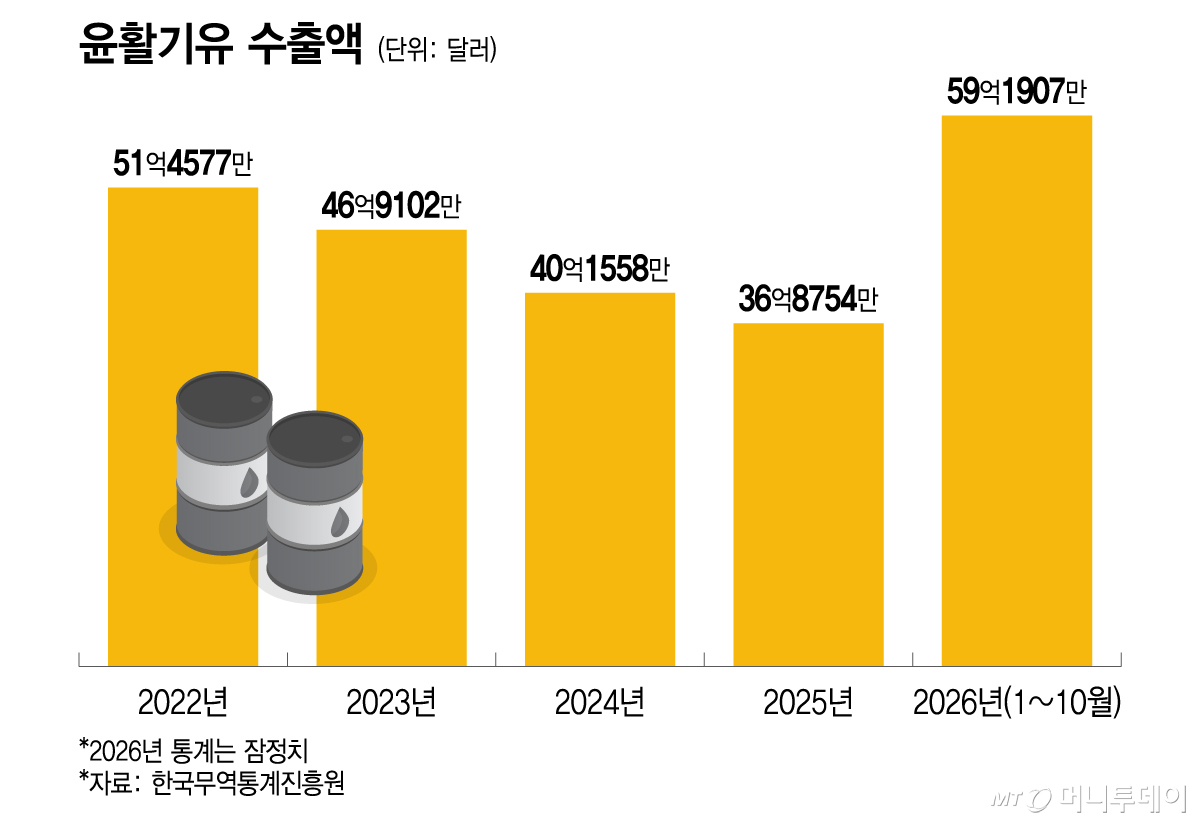
South Korea’s exports of lubricant base oil (the raw material for lubricants) have hit a new annual record. As the prolonged Middle East war deepens global supply shortages, domestic refiners are reaping spillover benefits. In addition, signs indicate that customers who previously used Middle Eastern lubricant base oil, including finished vehicle manufacturers, are shifting their supply sources to Korean products.
According to the Korea Trade-Statistics Service on the 5th, lubricant base oil exports from January to October this year reached $5.91907 billion (approximately 7.936 trillion won) on a preliminary basis. This surpassed the all-time high export value of $5.11457 billion achieved in 2022 within just 10 months. Given that recent export values have shown an upward trend, with September at $796.53 million and October at $897.06 million, there is also speculation that this year’s lubricant base oil exports could exceed $7 billion (approximately 9.38 trillion won).
Supply chain disruptions originating from the Middle East are cited as a key factor behind the export boom. The prolonged war has caused operational difficulties at major Middle Eastern lubricant base oil production bases, such as Qatar’s Pearl GTL and Saudi Arabia’s Sadara, leading to supply shortages. In particular, with severe shortages of high-performance (Group III) lubricant base oil—a key raw material for automotive lubricants—demand for Korean products is surging in the European and U.S. markets, which have Middle East dependency levels of 70% and 40%, respectively, for this product.
While supply has decreased, demand is expanding around new industries. This is because new demand sources for high-performance lubricant base oil are rapidly increasing due to expanded investment in artificial intelligence (AI) infrastructure and the growth of advanced manufacturing. In AI data centers, immersion cooling technology is spreading to reduce heat generated by graphics processing units (GPUs), drawing attention to immersion coolants based on lubricant base oil as a candidate cooling material. In the industrial robotics sector, the use of high-performance lubricant base oil capable of withstanding high friction and torque in reducers and drive systems is also increasing.
This market environment is acting as a tailwind for Korean refiners. South Korea holds the world’s largest Group III lubricant base oil production capacity on a single-country basis. In particular, SK Enmouve and S-OIL, which account for approximately 40% of global Group III lubricant base oil production, are highlighted as key beneficiaries. In the third quarter of this year, SK Enmouve recorded revenue of 2.3671 trillion won and an operating profit of 1.0906 trillion won, achieving an operating profit margin of 46%. S-OIL also recorded revenue of 11.9687 trillion won and an operating profit of 1.4067 trillion won over the same period. Notably, in the lubricants segment alone, it generated revenue of 1.5424 trillion won and an operating profit of 742.7 billion won, resulting in an operating profit margin of 48%.
The industry forecasts that the export boom for Korean lubricant base oil will continue for the time being. Even if the war ends, it will take considerable time to restore and normalize halted production facilities, and quality certification procedures by major global automakers are stringent, making it difficult to replace existing supply sources in the short term. In other words, customers who have newly adopted Korean lubricant base oil will not easily return to their previous suppliers in the short term. An industry official said, “Inquiries regarding new supply contracts are coming in steadily, and existing customers are also trending toward long-term contracts.”

 in INDUSTRY
