

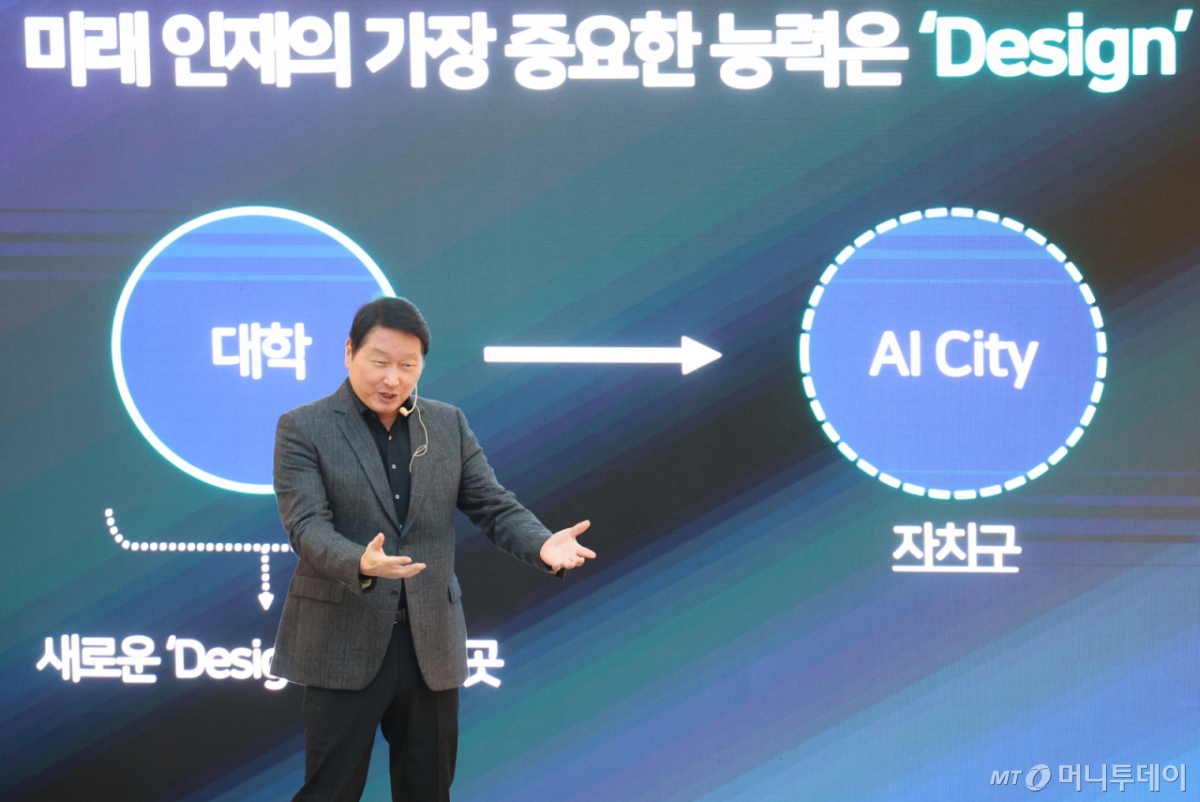
SK Group Chairman Chey Tae-won stated, "At this geopolitically risky and difficult time, how quickly we can adapt our growth model to AI (artificial intelligence) will determine the fate of our country."
Chairman Chey made these remarks during a lecture held on the 5th at the Central Hall of the College of Social Sciences at Seoul National University, saying, "Our growth is ultimately dependent on AI." The lecture was conducted as part of the 'Freedom and Market Special Lecture' series by the Department of Economics at Seoul National University. On this day, approximately 500 students gathered in the lecture hall, showing intense interest. Students who could not secure seats in the first-floor auditorium sat on the stairs taking notes or crowded around the railings on the second and third floors to listen attentively to Chairman Chey's remarks.
This is an argument that South Korea must accelerate its AI transition amid changes in the existing economic order due to the US-China hegemony competition, the rapid growth of the AI industry, and other factors. Chairman Chey mentioned SK Group's announcement to invest 2100 trillion won related to the three mega-projects being promoted by the government, stating, "Samsung has talked about an even larger number, and with two companies saying they will spend nearly 5000 trillion won, people are asking if this is a normal plan."
He then explained, "We have no way to catch up unless we make such a bet here as well. In the past, spending just 200 trillion won was considered an enormous investment, but now it has gone more than 10 times that. The nature of the game, and the scale and concept of money, have completely changed."
Chairman Chey's problem awareness is that South Korea, which must go 'all-in' on AI in this way, is held back by internal and external variables. And as solutions for the Korean economy to break through these challenges, he presented four items: △New Capitalism △AI Native Nation △Expansion of Economic Scale (Expansion Option) △Growth Incentive System (Incentive System).
'New Capitalism' means moving away from the existing method where the government solves social problems with taxes paid by corporations and the private sector, and instead providing incentives to individuals and companies that create social value. The argument for an 'AI Native Nation' is that it should not stop at simply expanding AI infrastructure, but must transform the entire social system, including labor and education, to fit AI.
For the keyword of 'Expansion of Economic Scale,' he advocated his core belief in 'Korea-Japan economic cooperation.' Regarding the timeline for Korea-Japan economic integration, Chairman Chey said, "It is not a matter of doing it next year, but a journey that will take about 30 years." He analyzed, "South Korea's current GDP (gross domestic product) is on the scale of 2 trillion dollars. If you think of the economy operating combined with Japan's, it becomes 6 trillion dollars. The return from succeeding in a 2-trillion-dollar economy and the return from a 6-trillion-dollar economy will not be simply three times, but about 10 times."
He also called for reforming the incentive system that induces corporate growth. This means changing the structure where support decreases and regulations increase as SMEs (small and medium-sized enterprises) grow into mid-sized companies or large corporations. Chairman Chey diagnosed, "The numerous SMEs in South Korea face the application of about 200 new regulations the moment they move beyond being an SME, and almost all the support they received is cut off." He added, "We must move in a direction where we provide support commensurate with their growth and continue to support them even as they rise to become large corporations."

 in INDUSTRY
