

Behind Big Tech’s purchase of clean power lies not only carbon reduction but also calculations regarding cost and supply. While securing the electricity needed for AI data center expansion, companies must also mitigate price volatility risks. Procurement strategies are now expanding beyond simply increasing purchase volumes to ensuring power availability at required times and locations.
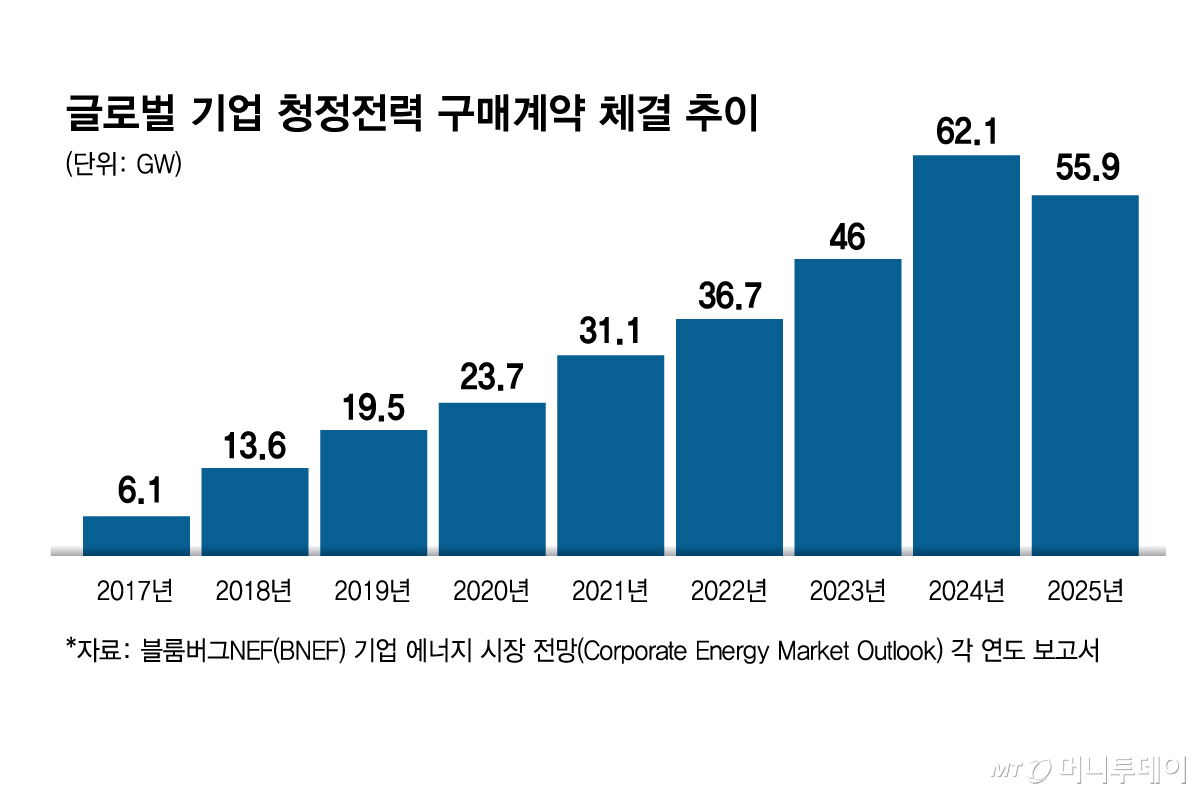
According to BloombergNEF, clean power purchase contracts announced by global companies last year totaled 55.9 gigawatts (GW) in generation capacity. While the total contract volume decreased by 10% from the previous year, four Big Tech firms—Microsoft, Amazon, Google, and Meta—accounted for 49% of the total.
The core instrument is the long-term power purchase agreement (PPA). When a company commits to buying electricity for typically 10 to 20 years, developers use projected future sales revenue as collateral to raise construction funds. This structure allows purchasing companies to reduce power price volatility risks through fixed-price contracts, enhancing cost predictability, while developers secure stable buyers.
The role of battery energy storage systems (BESS), which enable the use of clean power at required times, is also becoming increasingly important. One driver of this change is carbon accounting standards. The GHG Protocol, the international standard for greenhouse gas emissions calculation, is discussing the introduction of time-matching in its Scope 2 revision. If clean power must match not only annual totals but also hourly usage, the integration of renewable energy and storage facilities becomes even more critical.
A more direct driver of change is the pace of business expansion. As grid connection delays have emerged as a factor slowing AI data center operations, attempts are being made to develop data centers alongside generation and storage facilities. The goal is to regulate power drawn from the grid to reduce grid burden and accelerate data center startup times.
The range of energy sources targeted for procurement is also broadening. A representative example is the PPA announced last September by geothermal developer Fervo Energy, which will supply 396 megawatts (MW) of geothermal power under development in Utah, U.S., to Google. The contract aims to secure base load power needed for data centers under consideration by Google.
However, expanding power supply through sources like geothermal requires considering site conditions and construction timelines. This is why the combination of solar, wind, and BESS is gaining attention as a fast and realistic option in the face of surging AI power demand immediately. It leverages the relatively short construction periods of solar and wind while using storage devices to compensate for generation fluctuations. Gale Miller, Head of Strategic Investor Relations at Brookfield, said, "Current energy demand clearly increases renewable energy demand," adding, "Because it can be operationalized faster."
Growing resident backlash due to concerns over grid overload and electricity rate hikes from data center expansion is also a factor Big Tech must consider. In this process, companies bearing the costs of expanding new renewable energy and storage facilities to increase clean power supply can help reduce residents’ electricity bill burdens and environmental concerns, thereby enhancing community acceptance.
Melanie Nakagawa, Microsoft’s Chief Sustainability Officer (CSO), stated that she takes "very seriously" the moratorium on data center expansion and related concerns in some U.S. regions. Introducing Microsoft’s "Community-First AI Principles" announced this January, she said, "Data centers must add power to the grid, and new facility costs should be borne by companies, in this case Microsoft," adding, "They should not be passed on to customers or consumers."
※This special reporting was supported by the Korea Journalists Association and Climate Media Hub.

 in INDUSTRY

