

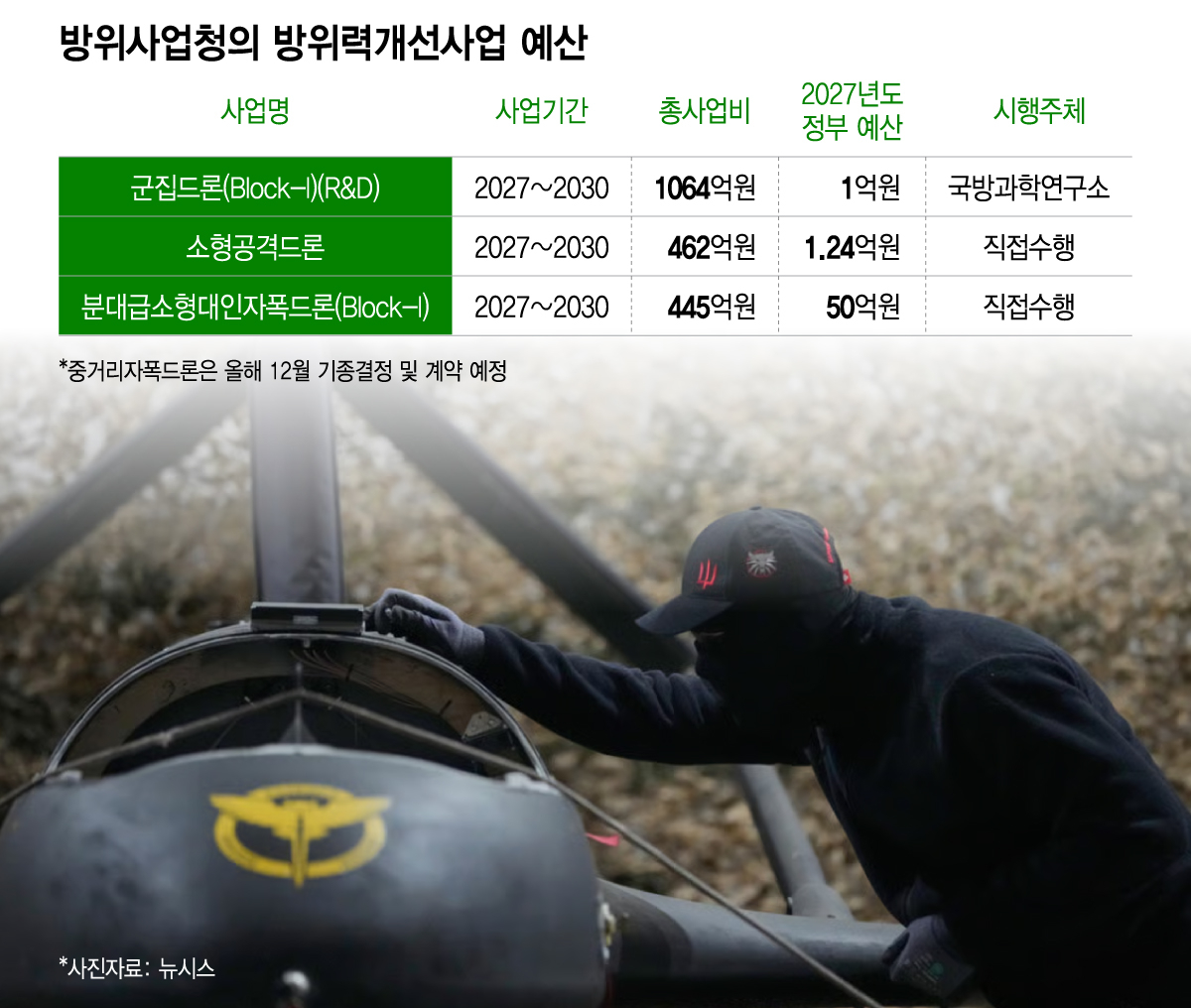
Although the government has positioned attack drones as a key force for future warfare, it was confirmed that the new project budget for next year amounts to only 5.2 billion won. Domestic companies that entered related technology development following the Russia-Ukraine war are facing management difficulties due to insufficient military procurement demand, or seeking breakthroughs in overseas exports.
According to the defense industry on the 11th, the total budget for three new attack drone projects planned by the Defense Acquisition Program Administration for 2027 was 5.224 billion won. One hundred million won was allocated for swarm drone (Block-I) research and development, 124 million won for small attack drones, and 5 billion won for squad-level small anti-personnel suicide drones (Block-I). While the total project cost for the three projects reaches 197.102 billion won, next year's budget is at a level of only 2.7% of the total. Attack drones are a general term referring to attack drones that carry missiles or bombs to strike enemies, and suicide drones where the aircraft directly collides with the target to explode.
The issue is that while approximately 90 domestic companies have entered the development of attack drones, actual new military procurement projects are limited. These companies entered related technology development as the military use of drones expanded following the Russia-Ukraine war. They invested in development personnel and production facilities for about three to four years, expecting expansion of the military market and overseas exports, but they are currently facing difficulties because domestic military purchases have fallen short of expectations.
Above all, this is directly linked to the survival of domestic small drone manufacturing SMEs (small and medium-sized enterprises). Small attack drones and squad-level small anti-personnel suicide drones are fields in which SMEs (small and medium-sized enterprises) participate in development and manufacturing, with a structure where military procurement translates into sales and production volumes for these companies. Both projects plan to proceed with purchase test evaluations and contracts next year, so it will inevitably take time until actual mass production and delivery. Until military purchases are fully underway, drone companies must bear development costs, labor costs, and production facility maintenance costs without stable orders.
A defense industry official stated, "There are too many companies that have entered the domestic market, but there are few projects coming out, making it difficult for companies to survive," adding, "Even if they participate in military projects, losses of 3 billion to 4 billion won per company are expected. They are participating to build track records in a situation where they cannot even properly recover product costs."
It is pointed out that limited military demand is also the background for domestic drone companies turning their eyes to overseas markets. Another official explained, "We are importing major weapon systems from abroad that could be developed domestically, and it is difficult to meet high required performance and development schedules, so in effect, each domestic company is striving to enter overseas markets."
In contrast, North Korea is promoting mass production of attack drones. Kim Jong-un, Chairman of the State Affairs Commission of North Korea, observed a test of suicide-type attack drones in November 2024 and instructed the rapid establishment of a continuous production system and full-scale mass production. In March last year, performance tests of suicide drones applying AI technology were conducted, and on the 30th of last month, the superiority of drone technology was emphasized at an unmanned aircraft technology exhibition.
Kim Young-soo, Director of the National Defense Rights Research Institute, stated, "Even considering that these are multi-year projects, 5.2 billion won is a level where one can secure only about 1,000 attack drones at most," adding, "North Korea produces tens of thousands of attack drones per year; North Korea's speed and scale themselves differ too greatly from ours." He continued, "In the era of the manpower cliff, if artificial intelligence (AI) and swarm drones are utilized, one person can operate up to 100 or 1,000 units, yet there is no sense of urgency or desperation regarding security."

 in INDUSTRY
