

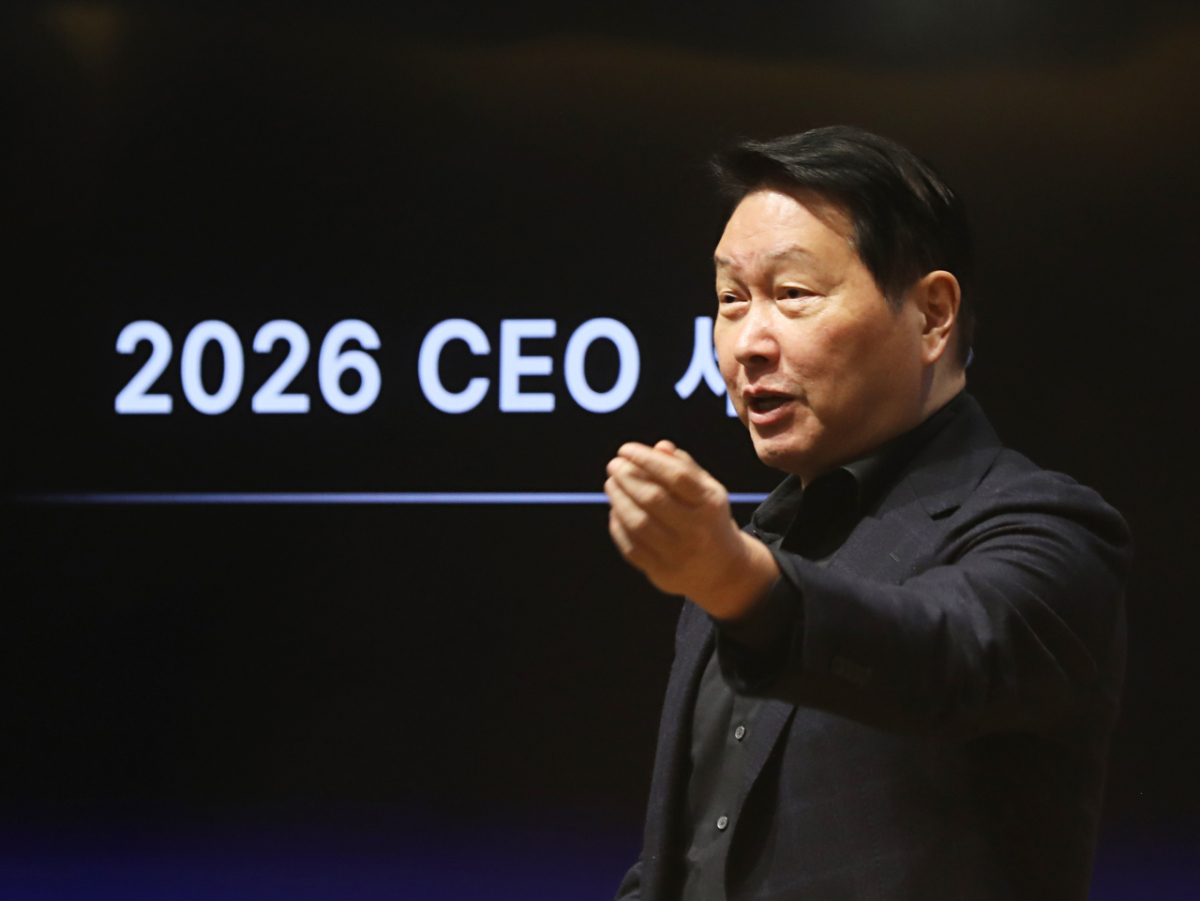
SK Group Chairman Chey Tae-won urged chief executives to build an "AI flywheel" in which growth in one business drives further growth across the group amid rapid changes in the artificial intelligence era.
Chey made the remarks at SK Group's 2026 CEO Seminar, held from Nov. 12 to 14 at the SKMS Research Institute in Icheon, Gyeonggi Province.
His vision is to expand beyond semiconductors, infrastructure and energy into AI models and applications, ultimately positioning the group as a key player in the "token economy," where AI computing power and services are traded as core resources.
The flywheel concept refers to a virtuous cycle in which growth in one area fuels expansion in another. Competitiveness in AI semiconductors can drive growth in AI factories, whose expansion creates demand for power, energy and AI services.
More competitive energy supplies and wider adoption of AI services, in turn, accelerate innovation in AI factories and advanced semiconductors while opening up new business and partnership opportunities.
"We must break out of the framework of our existing businesses and redefine ourselves as an AI company," Chey said. "Each member company should find new roles beyond its existing business areas and build an AI flywheel that connects everything from AI services to the token economy."
He also stressed the importance of cooperation with global partners.
"No company can do everything alone in the AI era," he said. "Open collaboration with global partners is essential to strengthen our capabilities and accelerate progress."
Executives focused on discussing Chey's AI flywheel strategy and exchanged views on how to become leading players in the token economy. They agreed that each group company should proactively identify and pursue new roles in emerging business areas.
The executives also outlined measures to strengthen the foundations supporting the AI flywheel. They agreed to continue "Portfolio Rebalancing 2.0," which involves streamlining underperforming businesses and strengthening core operations, while balancing financial stability and future investment based on capital allocation criteria centered on cash generation.
They also agreed to expand practical AI transformation (AX) across the group by combining operational expertise with data to generate revenue and improve work processes.
Changes are already underway across the group. SK hynix is improving production efficiency by upgrading its smart fabs through the integration of AI and digital twins. SK Innovation has improved yields at its Ulsan Complex by using an operational process map, or ontology, that connects equipment and operating data.
SK Telecom is using AI-based network and service automation to improve productivity and customer experience, while SK Gas is applying AI to market analysis and internal knowledge management to speed up decision-making.
The CEO seminar was attended by Chey, SK Group Vice Chairman Chey Jae-won, SK Supex Council Chairman Chey Chang-won and more than 50 senior executives from major group companies.
"The seminar provided an opportunity to review the group's restructuring efforts and examine each member company's role and action plans under the AI flywheel strategy," an SK official said. "We will continue to strengthen our core competitiveness and execution based on frontline operations."

 in INDUSTRY
