

"I should've bought DRAM instead of Samsung Electronics or SK hynix stock..."
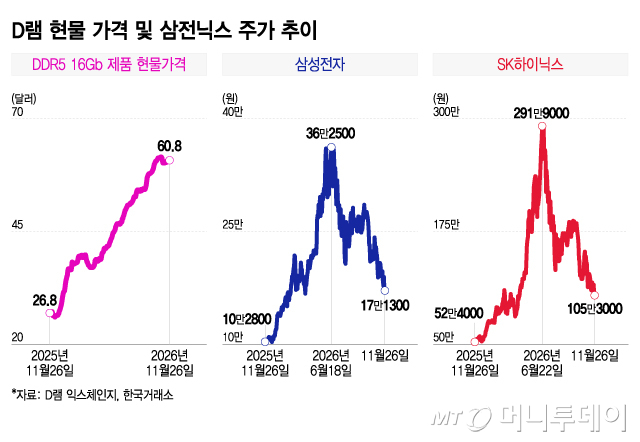
While shares of Samsung Electronics and SK hynix have plunged by more than half from their peaks, spot prices for DRAM have climbed more than 30 percent, prompting investors to lament that they would have been better off buying memory chips instead. A PC DRAM product that cost around 500,000 won a year ago now sells for nearly 2 million won.
According to market research firm DRAMeXchange on Nov. 28, the spot price of 16-gigabit (Gb) DDR5 (double data rate 5), a mainstream DRAM product, reached $60.8 as of Nov. 26, up 126.9 percent from a year earlier.
Over the same period, shares of Samsung Electronics and SK hynix gained 66.6 percent and 101 percent, respectively. The increase in DRAM spot prices outpaced the stock gains of both companies.
Contract prices, which serve as benchmarks for bulk transactions between memory chipmakers and their customers, have risen even more sharply. The contract price of 16Gb DDR5 climbed from $8.7 in October last year to $50 at the end of last month, a 5.7-fold increase in one year.
The trends in stock prices and DRAM prices have diverged particularly sharply since June. Shares of Samsung Electronics and SK hynix have fallen 52.7 percent and 63.9 percent, respectively, from their peaks that month.
In contrast, DDR5 spot prices have risen approximately 32 percent over the same period. While the two stocks have experienced sharp swings and an overall decline, DRAM prices have continued to climb.
Consumers are feeling the impact of the memory price surge. A PC DDR5 kit consisting of two 32GB modules, which cost around 500,000 won a year ago, is now selling for nearly 2 million won.
Prices of some 2-terabyte solid-state drives (SSDs) have also more than doubled over the past year. This explains the growing refrain that investors should have bought memory chips instead of Samsung Electronics or SK hynix shares.
Memory prices approach gold levels as DRAM export unit prices quadruple
The surge in memory prices is also reflected in trade statistics. According to Korea Customs Service data, the export unit price of DRAM reached $79,901 per kilogram in October, 3.9 times higher than in the same month last year.
The export unit price of multi-chip packages (MCPs), which include high-value products such as high-bandwidth memory (HBM), exceeded $100,000 per kilogram in September, reaching $101,542.
Although MCPs also include other products such as mobile memory packages, the industry uses the figure as an indicator of HBM export trends. The price was equivalent to nearly 87 percent of gold's market price of $117,138 per kilogram on Nov. 25 on the New York Mercantile Exchange.
DRAM prices reflect supply and demand conditions in the memory market. Supply has struggled to keep pace with surging demand, particularly from AI data centers.
Major memory manufacturers have also prioritized production capacity for HBM and server DRAM, further tightening supplies of conventional DRAM. Global technology giants are paying advance deposits and signing long-term supply agreements of five years or more to secure chip supplies.
Stock prices, however, tend to reflect expectations for future earnings ahead of time. Growing concerns that investment in AI data centers could lose momentum have shifted investors' attention toward how long the memory industry's boom cycle can last.
While immediate supply shortages are supporting DRAM prices, concerns about a potential slowdown in future demand are weighing on chipmakers' shares.
Recently, price gains have also begun to lose momentum in the spot market. Spot prices for older-generation DDR4 DRAM have declined, while DDR5 spot prices have remained largely flat this month.
The trend appears to reflect concerns over slowing AI investment as well as the possibility that surging memory prices could dampen demand for consumer IT products such as PCs.
Some market research firms have lowered their forecasts for DRAM price increases next year. TrendForce recently said it expects supply shortages to persist in the DRAM market, but quarterly price increases to moderate.
Even so, the DRAM market is expected to maintain strong growth, although the pace of price increases may slow. TrendForce forecasts that the global DRAM market will reach $1.153 trillion in revenue next year, up 69 percent from this year.
Industry estimates also suggest that the average selling price of HBM could nearly double next year from this year. Samsung Electronics and SK hynix have already effectively sold out their HBM production capacity for next year.

 in INDUSTRY
