

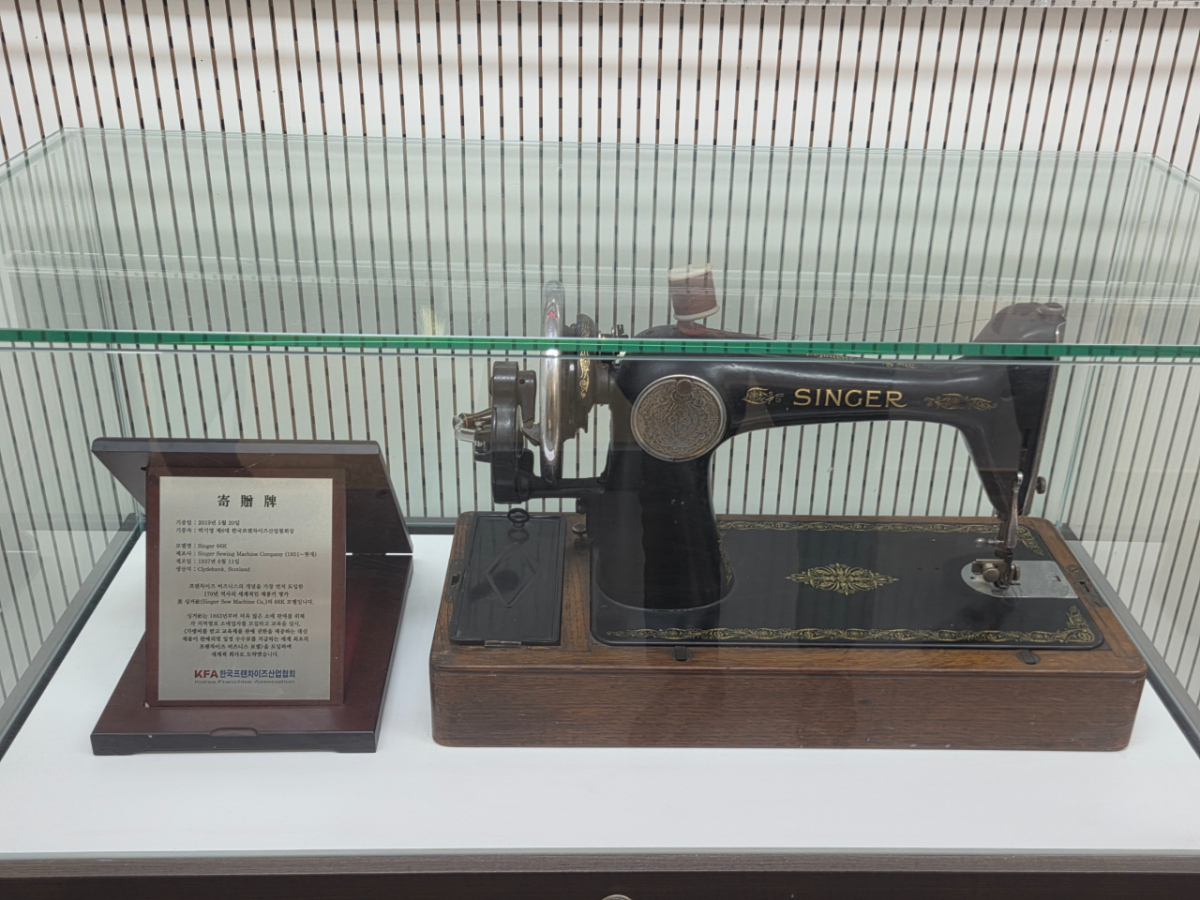
The office of the Korea Franchise Industry Association in Seoul Yeouido, visited on the afternoon of the 28th. Upon entering the entrance, an old sewing machine caught the eye first. It is a sewing machine from Singer, a U.S. company recognized as the world's first franchise. Donated to the association by Park Ki-young, the sixth president, on May 20, 2019, it was recently placed at the office entrance when the headquarters moved to Yeouido. The sewing machine that marked the beginning of franchising now stands as a symbol for the association, which envisions the future of the industry.
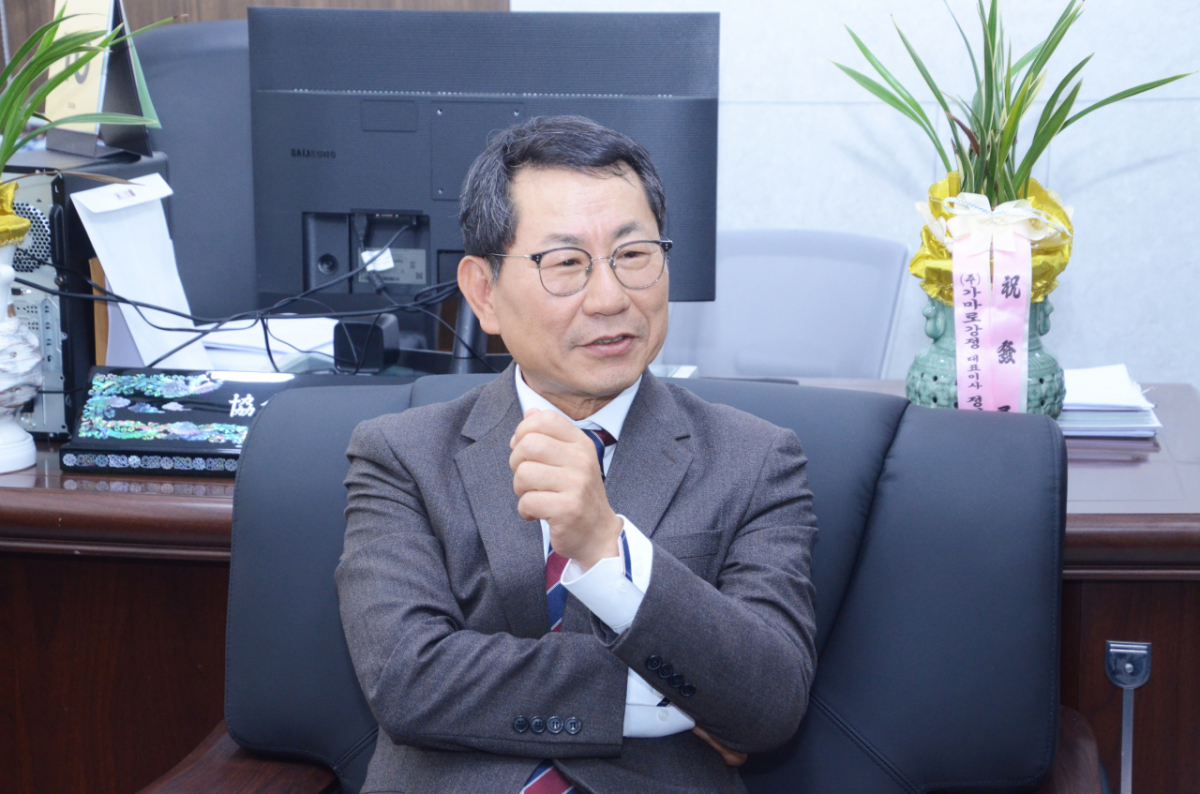
Na Myung-seok, President of the Korea Franchise Industry Association, is in his tenth month of term. When asked about his impressions after spending his first year in office, President Na could not hide his regret, stating, "The entire year was spent responding to regulations." He said, "Overseas, we are receiving a flood of interest. They say, 'Why aren't real Korean franchises coming in, instead of products made by Chinese companies?'" and added, "At times like this, K-Franchises should move forward, but the situation is one where they are moving sideways or backward, merely defending against regulations."
President Na also emphasized that the industry must not stop its efforts toward mutual benefit regarding controversies over abusive practices by some franchises. Initiatives at the association level, such as an ethical management certification system scheduled for introduction next year, are part of these efforts. We heard from President Na about major issues and challenges facing the industry, including the revised Franchise Business Act and lawsuits over differential franchise fees.
-The revised Franchise Business Act takes effect on December 31. If a registered franchisee organization requests consultation, the franchisor must respond; refusal makes them subject to corrective orders. The enforcement decree announced for public comment in August allowed organizations to register if they represented more than 10% (minimum 30 people) or at least 1,000 franchisees of the same brand. A proposal to lower the minimum number to five is also being discussed.
▶Lowering it to five would diminish their weight as a consultation partner. It is not that franchisors refuse to talk. All that is required is consultation, but if registration requirements are relaxed, what happens to the voices of the remaining 70-80% that the organization cannot represent? The association has expressed its opinion to raise the registration ratio to 40% and maintain the minimum number criterion. However, recently, the Korea Fair Trade Commission indicated a direction to lower the minimum number from 30 to five, considering it difficult to raise the ratio and taking into account the burden of registration for franchisees of small brands. For a brand with 50 franchisees, just five gathering would meet the organization registration requirement. If multiple organizations request consultations on advertising costs, supply prices, and operating methods at different times, headquarters without dedicated personnel will find it difficult to cope.
-What is the most concerning aspect if implemented as per the public comment draft?
▶The biggest problem is the ambiguous scope of "lawfully authorized representatives" who can attend consultations. What we have consistently argued is that third parties will appear to stir up trouble by saying, "I'll give you a lower price, let's change your signboard." Ultimately, both the franchisor and the franchisees will fail. The cost of products distributed cannot differ for those receiving them, so how can they offer such low prices? It makes no sense. Yet, such people will definitely come in. The industry has requested limiting third-party participation to lawyers, but there are reports that it will instead be relaxed. It is difficult to understand if this truly helps protect franchisee rights and interests.
-How are you communicating with the Fair Trade Commission?
▶We have communicated through chairman meetings in June and September, practical consultations, and submission of opinion letters. The Korea Fair Trade Commission is in a position to create guidelines after observing the reality of consultations. However, the field must judge and respond immediately from the implementation date, which is about two months away. We will continue to request that specific cases and criteria be presented first when creating the final draft.
-The purpose of the law revision is that franchisees lack information and legal knowledge and need protection.
▶That is absolutely not the case. In fact, representatives of small brand headquarters may know even less. This applies to cases where a single store was doing well and suddenly expanded to 20-30 franchises. While the franchisor is unprepared, franchisees come having made all sorts of preparations to raise legal issues. It is said that while the franchisor brings in lawyers, the franchisee is weak, but it is rare for a franchisor to have a lawyer as an employee. A legal team exists only when a franchise reaches a scale of 100 billion won in sales.
-In January last year, the Supreme Court finalized a ruling ordering Pizza Hut Korea to return approximately 21.5 billion won in differential franchise fees.
▶Everyone is a loser. There are no winners at Pizza Hut. Franchisees did not receive money, and the franchisor lost it too. Everyone is a loser. The real losers are the surviving franchisees. Those who actually sued have all retired. Their lawsuit has made it impossible to do business. How can any franchisor pay such massive compensation? If they do not have the ability to pay, how can they be forced to pay? The franchisor has already provided all the goods, so it makes no sense to demand them to give back now just because one name was used incorrectly.
-Subsequently, lawsuits spread to bhc, Mega Coffee, and Mom's Touch. How do you view the prospects of each individual lawsuit?
▶It is difficult to predict the outcome of individual cases at this point. Future lawsuits must be judged based on brand-specific contracts, information disclosure documents, and actual supply structures. Even for the same brand, contents may differ depending on the timing of the contract. Applying the Pizza Hut result directly to all headquarters requires caution. What is concerning is that as disputes drag on, trust between headquarters and franchisees collapses, leading to a decline in investment and store support. The industry also does not think that existing practices are sufficient and is making improvements through measures such as the Korea Fair Trade Commission's mandatory items system improvement.
-Is the industry preparing for this?
▶Being constantly troubled, everyone is making their own preparations extensively. We have no choice but to respect court judgments, and it is not a structure where the franchisor always loses. Laws must be respected, and we must adapt to new laws and precedents. At the association level, we will push for amendments to the enforcement decree to change the term "differential franchise fees" to better reflect reality.
-When it comes to franchises, "abusive practices" still follow them.
▶They are accused of abusive practices more than what was actually done wrong. It is not that there were no abusive practices. However, we must prevent the entire industry from being condemned as abusive just because it happened in one place among nearly 10,000 brands. Still, improving abusive practices is important. The industry can only move correctly if it starts from there. We conducted our first ethics and mutual benefit training in May last year, and on the 15th of last month, we held a second public training that franchise headquarters not affiliated with the association could also participate in. We will conduct a third training this month. The ethical management certification system will be introduced in the first half of next year.
-K-Food is popular overseas.
▶Franchising started in the United States. Franchises went global in the 1970s, when Hollywood movies and American pop songs dominated the world. Now, K-Culture has spread worldwide. Everyone I meet abroad asks why Korean franchises do not come to their country. Even Morocco is making a fuss asking us to come.
-One of the tasks you set at the start of your term was the "K-Franchise Street." What is the concept?
▶If one or two companies go individually, they may face invisible risks. If we establish a headquarters and export 20-30 brands to cover the entire Myeong-dong street, it will become the cornerstone for creating 1 million global stores. One street would have BBQ, Olive Young, Daiso, and if opportunities arise, CGV as well. In the past, when coming to Korea, people went to Deoksugung Palace or Bulguksa Temple in Gyeongju. Now they go to Olive Young and Daiso to buy various things, visit a plastic surgery clinic in Apgujeong, and have chimaek (chicken and beer) for dinner. We just need to take all of these out to the world.
-What is the role of the government?
▶Japan is already doing it. When I visited a shopping mall in Indonesia, there was a "Ramen Village" set up in one space. It was all Japanese. They could not have done it without help from the Japanese government. The role of initiating the creation of a "K-Franchise Street" belongs to the government. The franchise industry also needs government support. If the government helps a little and we establish a foothold in South America or Europe, second and third Seoul streets can sprout all over the world. While it is said that exports of K-Food items like seaweed and kimchi are doing well, considering unit prices, China will catch up quickly. Brands are different. Once tastes are accustomed to them, they do not easily fail. McDonald's and KFC also took root globally decades ago.
-At the beginning of the year, you said you would create one K-Franchise Street by the end of this year.
▶It is regrettable that we could not seize that opportunity. Just like with differential franchise fee lawsuits, the industry situation is still unstable. If urgent fires are put out this year, we should try to push this forward again. We plan to start by looking into where it can be implemented.

 in LIVING


