

A wave of voluntary retirement programs and organizational restructuring is sweeping through South Korea’s food industry.
Companies are increasingly reorganizing their workforce and operations by accepting voluntary retirement applications from long-serving employees or merging departments with similar functions.
This trend is seen as an effort to cut fixed costs and improve business efficiency in search of a breakthrough, as profitability has become difficult to secure due to sluggish domestic demand and rising input costs.
According to the food industry on Saturday, HiteJinro is accepting voluntary retirement applications from employees with at least 15 years of service, from Nov. 11 to 15. In addition to statutory severance pay, the company will provide a consolation payment equivalent to 20 months’ salary for employees with 15 to less than 20 years of service, and 36 months’ salary for those with 20 or more years of service.
Final candidates will be selected through an internal review process among applicants. HiteJinro explained that this measure is aimed at securing a stable revenue base and future competitiveness in response to the stagnation of growth in the domestic alcoholic beverage market and changes in the consumption environment.
In particular, voluntary retirement initiatives are continuing across the broader alcoholic beverage industry. Lotte Chilsung Caltex also accepted voluntary retirement applications this year after conducting its first-ever program last year.
The program targets executives and employees born on or before December 31, 1981, with at least 10 years of service. Depending on their length of service, participants will receive up to 24 months’ base salary and a re-employment support fund of 10 million won.
OBS Brewery also accepted voluntary retirement applications from all employees with five or more years of service last month. However, OBS Brewery stated that it has accepted such applications every year in the past and that this round is not due to operational difficulties.
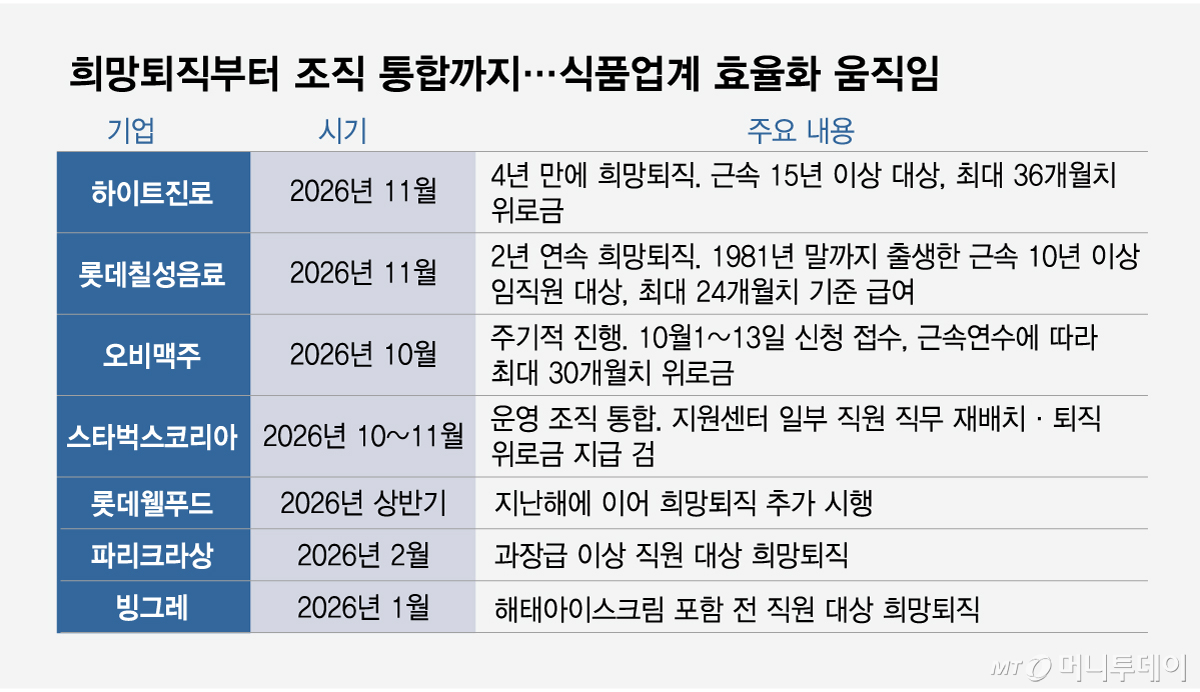
Starbucks Korea is pushing for workforce reallocation following organizational integration. On the 23rd of last month, it merged its operations division and operations support division, and reorganized them into a category management division by adding a merchandise planning (MD) function to its beverage and food development organization.
The company is also considering job reallocation and payment of retirement consolation money for some employees at its support center, based on their personal preferences. This move toward organizational renewal and efficiency is interpreted as a response to the company’s operating loss of 45.3 billion won in the third quarter of this year, marking its second consecutive quarter in the red.
Efforts to optimize workforce have continued since late last year. Coca-Cola Beverages implemented voluntary retirement at the end of last year, including not only sales and logistics but also management organizations such as human resources and strategic planning.
Binggrae conducted a voluntary retirement program for all employees, including those from Haitai Ice Cream, in January of this year.
Paris Baguette accepted voluntary retirement applications from managers and above in February, and Lotte Wellfood also received additional applications this year following its first voluntary retirement program last year.
With sluggish recovery in domestic consumption and rising costs due to an uncertain domestic and international environment, such industry moves are expected to continue for some time.
This is compounded by structural changes, including a shrinking consumer base for alcoholic beverages and processed foods due to low birth rates and an aging population.
In the Business Survey Index (BSI) forecast for this month released by the Korea Federation of Economic Communities, the food, beverage, and tobacco sector recorded 84.2, falling below the baseline of 100 for the second consecutive month.
This figure is even lower than the overall forecast across all industries (98.6). A BSI reading below 100 indicates that more companies expect economic conditions to worsen compared to the previous month.
An official in the food industry said, “While there are effects from the economic downturn, there is a trend of carrying out organizational restructuring for overall structural reform, including increasing the share of overseas exports to keep pace with market changes.”

 in LIVING

