

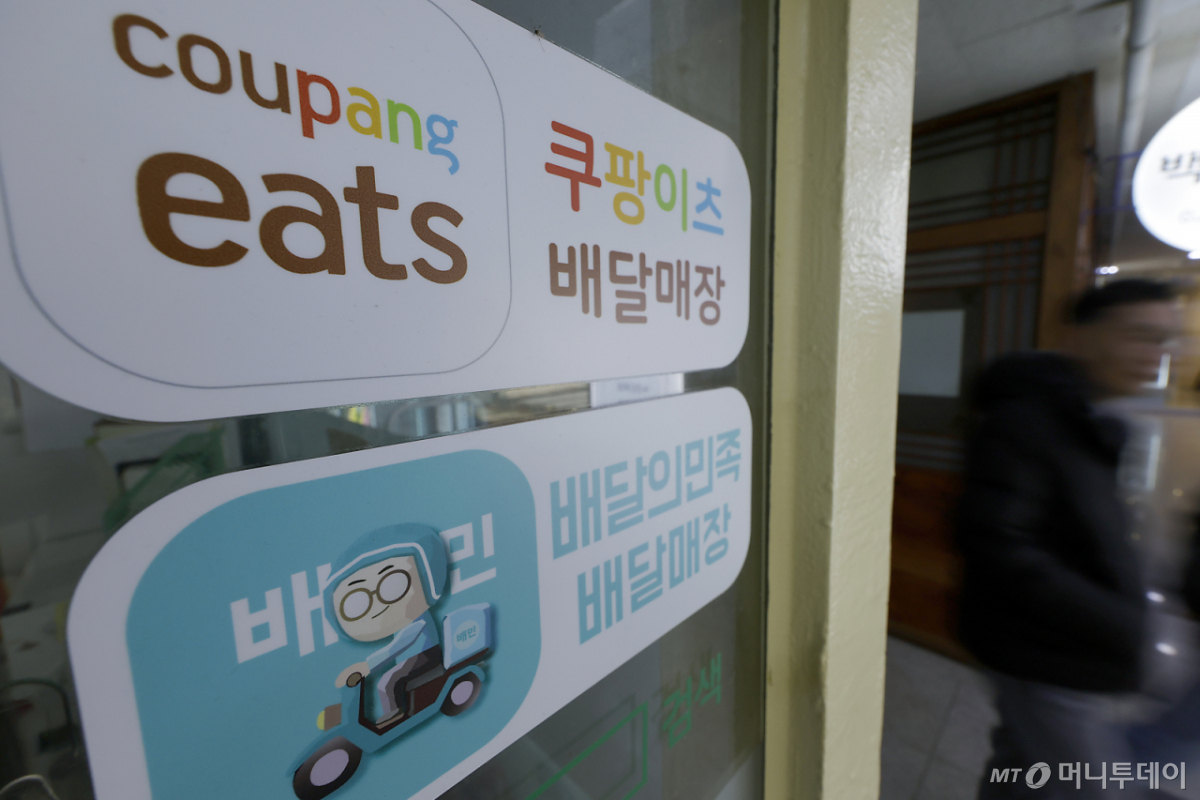
"It seems they imposed the maximum possible fine."
When the Fair Trade Commission (hereinafter Korea Fair Trade Commission) imposed a 300.8 billion won fine on the "Most Favored Nation" practices of the delivery app Coupang Eats on the 9th, reactions of shock emerged within Coupang. This is because it was a "punitive sanction" reaching ten times the estimated fine of 25 to 42 billion won based on the review report, which serves as an indictment, sent by the Korea Fair Trade Commission five months ago.
The sharp increase in the fine was due to the Korea Fair Trade Commission expanding the revenue related to Most Favored Nation practices from 710 billion won to 5.0149 trillion won, a more than sevenfold increase. The June review report only extracted the sales (transaction amounts) of merchants who received "direct" Most Favored Nation requests from Coupang. However, during the subsequent plenary session deliberation, the sales of all merchants on Coupang Eats who had not received separate contact were also added.
The Korea Fair Trade Commission views it as having forced Most Favored Nation treatment on all merchants linked to the platform during the period of alleged legal violations (July 2023 to January 2026). It effectively assumed that even the 4.29 trillion won in transactions from approximately 80% of platforms that did not receive direct Most Favored Nation demands and had partnered with multiple delivery apps other than Coupang Eats to set prices was entirely linked to unfair practices. Regarding this, Hwang Won-cheol, a Commissioner of the Korea Fair Trade Commission, explained at a press briefing, "Because the top two businesses simultaneously demanded Most Favored Nation treatment, menu prices and minimum order amounts became identical across platforms, resulting in significant competition-restricting effects."
However, Coupang interprets this decision as an "abuse of discretion." It argues that it is appropriate to consider only products where transactions were actually blocked or failed to materialize due to Coupang Eats' Most Favored Nation demands, or products where competing businesses or consumers suffered direct harm, as revenue related to legal violations. If the initial review report criteria were applied, the 300.8 billion won fine would amount to an unreasonable level of 42% of total sales, violating the principle of proportionality, according to Coupang's claims.
It is also difficult to estimate the scale of damage suffered by merchants due to Most Favored Nation demands. According to Coupang, after implementing free delivery for Wow members, the average sales per store for Coupang Eats merchants increased by 98% over one year, and the store-borne cost per order decreased by 5%. This is why Coupang has argued that the positive effect of reducing food and delivery costs, which led to increased customer orders, was instead judged as "illegal."

There is a precedent in past cases of abuse of dominant market position where fines were imposed based on "total sales" similar to this case, but the Korea Fair Trade Commission suffered a complete defeat in litigation. The 2023 Google Play Store case is representative. At that time, the Korea Fair Trade Commission included non-game app revenue from Google Play in the related sales for sanctions; however, the court ruled that the scope should be narrowed to revenue related to five game companies that received concentrated support to induce exclusive releases, and decided to cancel the entire 42.1 billion won fine.
There is no precedent, either among other companies or in past Coupang sanction cases, where changing the related sales amount caused the fine to surge by up to ten times. Prior to this decision, it is known that for the 2024 case involving allegations of search algorithm manipulation, where the Korea Fair Trade Commission imposed its maximum fine on Coupang (162.8 billion won), the review report applied a level of 2.4% to 4%, while the final resolution document applied 2%.
In particular, Coupang claims that applying the "up to 6% of revenue" fine rule with the same standard as the top monopoly business against Coupang Eats, which had a 7% market share at the time of the incident, constitutes "discriminatory treatment."
In fact, the Korea Fair Trade Commission applied a 5.6% fine rate to the unfair Most Favored Nation practices out of the 5.0149 trillion won in related sales. Additionally, considering the 2024 algorithm manipulation allegations and violations of the Large-Scale Retail Business Act in 2021, it increased the fine by 20%. According to an official from the Korea Fair Trade Commission, the fine size reflecting these criteria was 336.9 billion won, but since the current law sets a cap at 6% of related sales, the resulting fine calculated was 300.8 billion won.
The two sides are expected to engage in fierce legal battles in the future. The Korea Fair Trade Commission will focus on proving Coupang's illegal acts and their market impact, while Coupang is expected to respond firmly by focusing on the argument that the Korea Fair Trade Commission's decision constitutes an unreasonable discriminatory treatment.

 in LIVING

