

Korean cosmetics companies are continuing to expand on the back of surging global demand for K-beauty, but their profitability is diverging. While growing overseas demand is boosting sales, the extent to which companies translate that growth into actual profits varies depending on exchange rates, labor costs and production expenses.
As a result, controlling costs and securing profits are becoming just as important as expanding revenue.
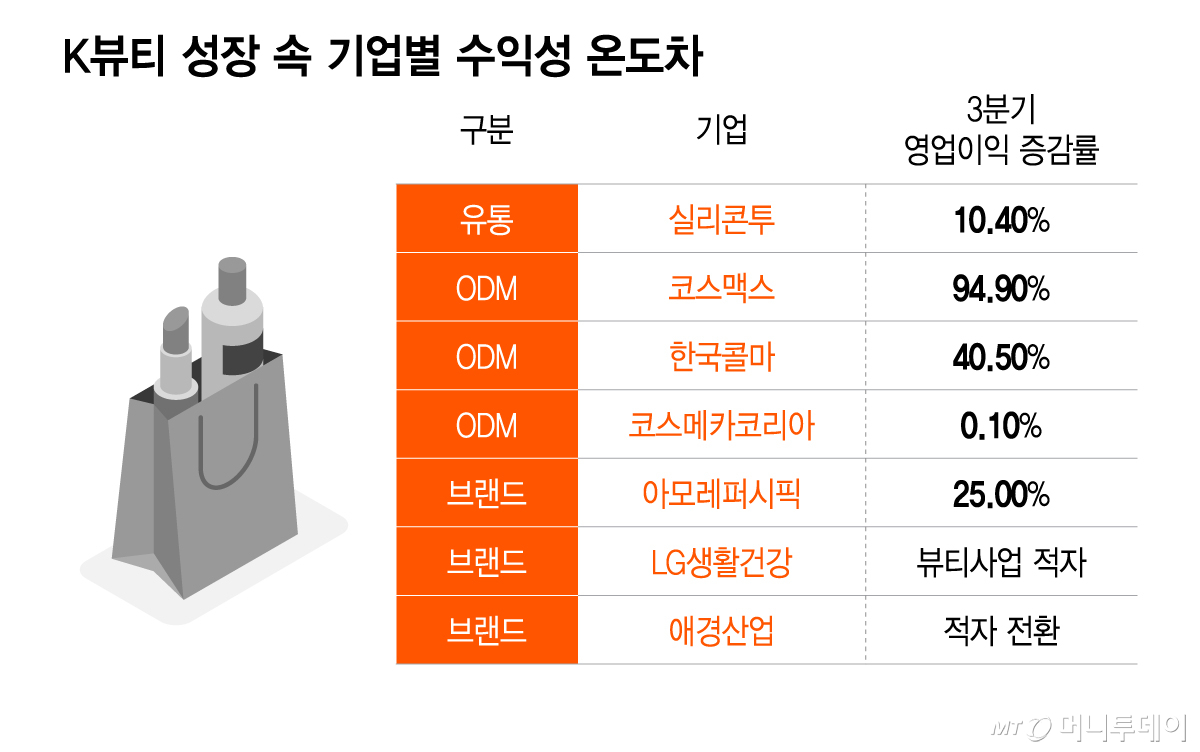
According to industry sources on Sunday, Silicontwo, which handles overseas distribution for Korean cosmetics brands, posted third-quarter revenue of 424.4 billion won, up 41.7 percent from a year earlier.
Operating profit, however, rose just 10.4 percent to 69.6 billion won. The increase in profit lagged far behind revenue growth, falling 14.8 percent short of market expectations.
Currency movements and investment in new businesses weighed on profitability. Given its export-heavy business structure, the company is particularly sensitive to a stronger Korean won. Its gross profit margin fell 3.3 percentage points from the previous quarter to 28.7 percent in the third quarter.
Salary-related expenses also jumped 70.7 percent from a year earlier as the company hired additional staff in advance to support its Japanese operations and new businesses. Labor costs rising faster than revenue growth limited the increase in operating profit.
Kim Myung-joo, an analyst at Korea Investment & Securities, lowered her target price for Silicontwo to 46,000 won from 65,000 won, saying improvements in margins and stabilization in the growth of selling and administrative expenses would need to be confirmed.
Cosmetics manufacturers also reported diverging profitability. Cosmax and Kolmar Korea posted operating profit increases of 94.9 percent and 40.5 percent, respectively, from a year earlier in the third quarter.
Cosmecca Korea, by contrast, saw operating profit rise just 0.1 percent. Despite growing production orders from K-beauty brands, differences in production efficiency and cost structures resulted in varying levels of profit growth.
For original design manufacturers (ODMs), the key is how efficiently they utilize production capacity as orders increase. Higher factory utilization can reduce the burden of fixed costs, while insufficient production facilities and reliance on outsourced manufacturing can drive up expenses.
Profitability also depends on product margins and the performance of overseas subsidiaries. This explains why companies benefiting from the same K-beauty boom can report vastly different results depending on their production infrastructure and cost competitiveness.
Brand owners are also experiencing mixed fortunes. Amorepacific increased its third-quarter operating profit by 25 percent from a year earlier, achieving growth in both revenue and profitability.
LG Household & Health Care, however, continued to post operating losses in its beauty business, while Aekyung Industrial swung to a loss. Although global interest in K-beauty is growing, individual companies' results vary depending on brand competitiveness and sales performance.
Against this backdrop, the industry is increasingly recognizing the importance of profitability management alongside revenue growth.
"As overseas demand for K-beauty expands, companies continue to grow in scale, but profitability inevitably varies depending on their business structures and cost burdens," an industry official said. "The ability to turn sales growth into profits is becoming just as important as how much revenue companies generate."as important as how much sales are increased."

 in LIVING
