

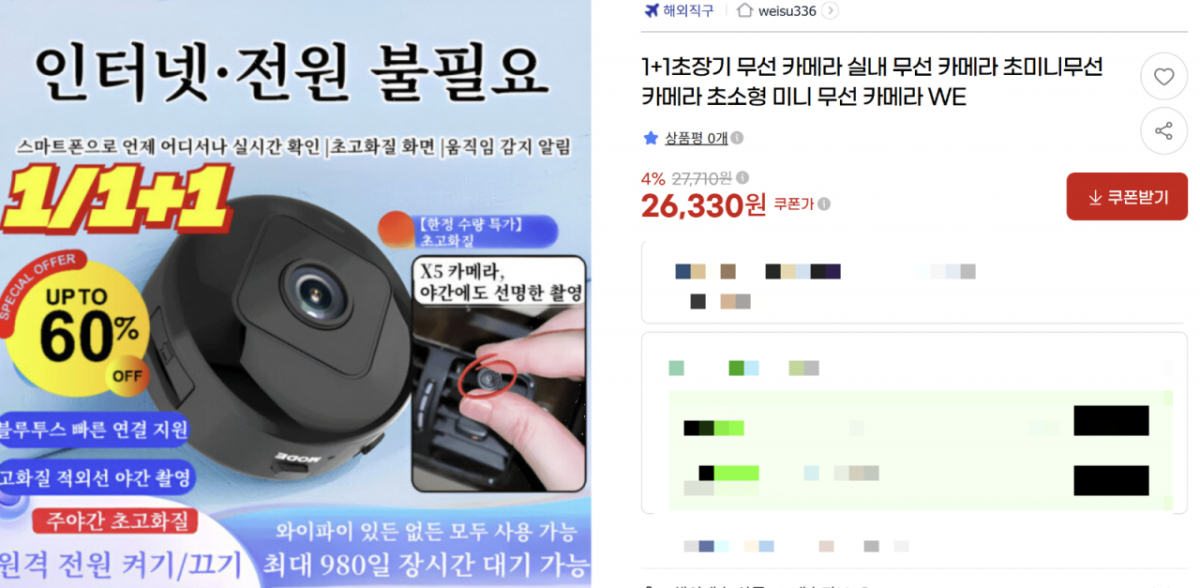
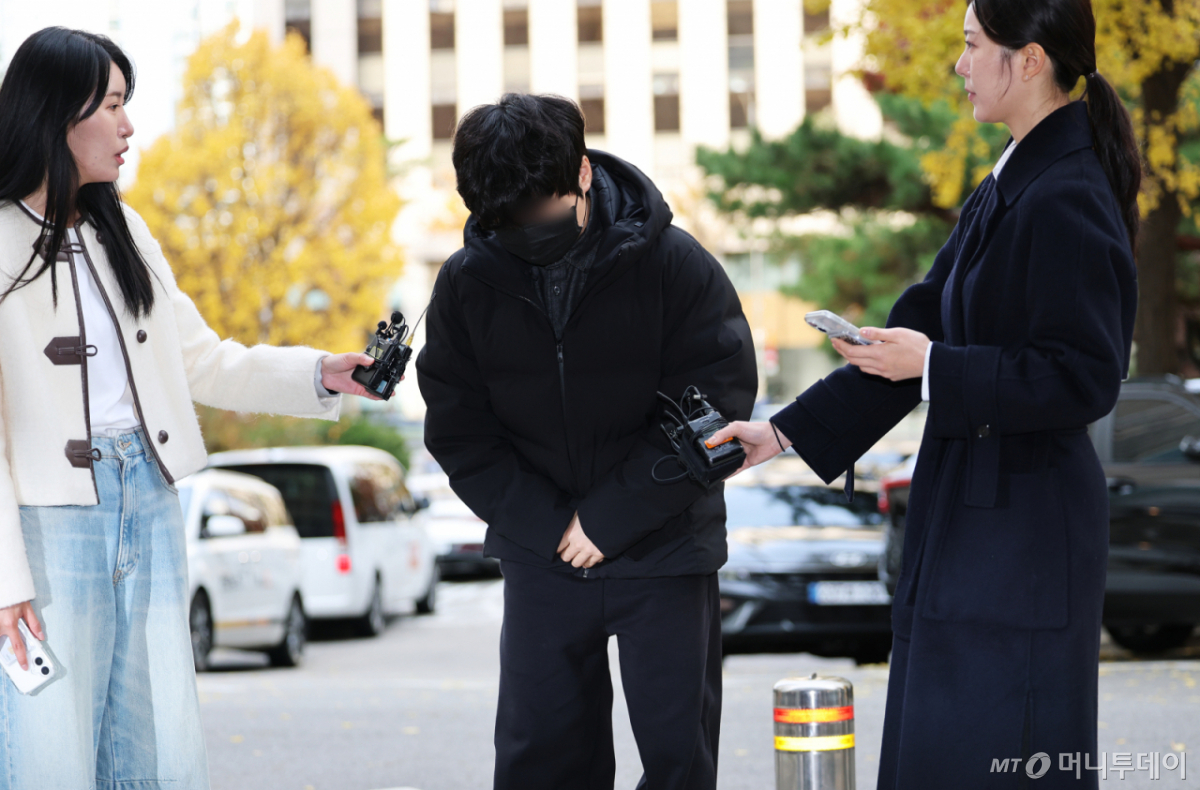
As the controversy has spread following the top scorer on this year's Certified Tax Accountant exam confessing to cheating using an ultra-miniature camera and artificial intelligence, e-commerce companies selling related products are also deliberating on countermeasures.
According to industry sources on Tuesday, major domestic e-commerce platforms are blocking keyword searches for related products, such as disguised hidden cameras that could be used in criminal activities, or prohibiting sales by overseas sellers on open marketplaces.
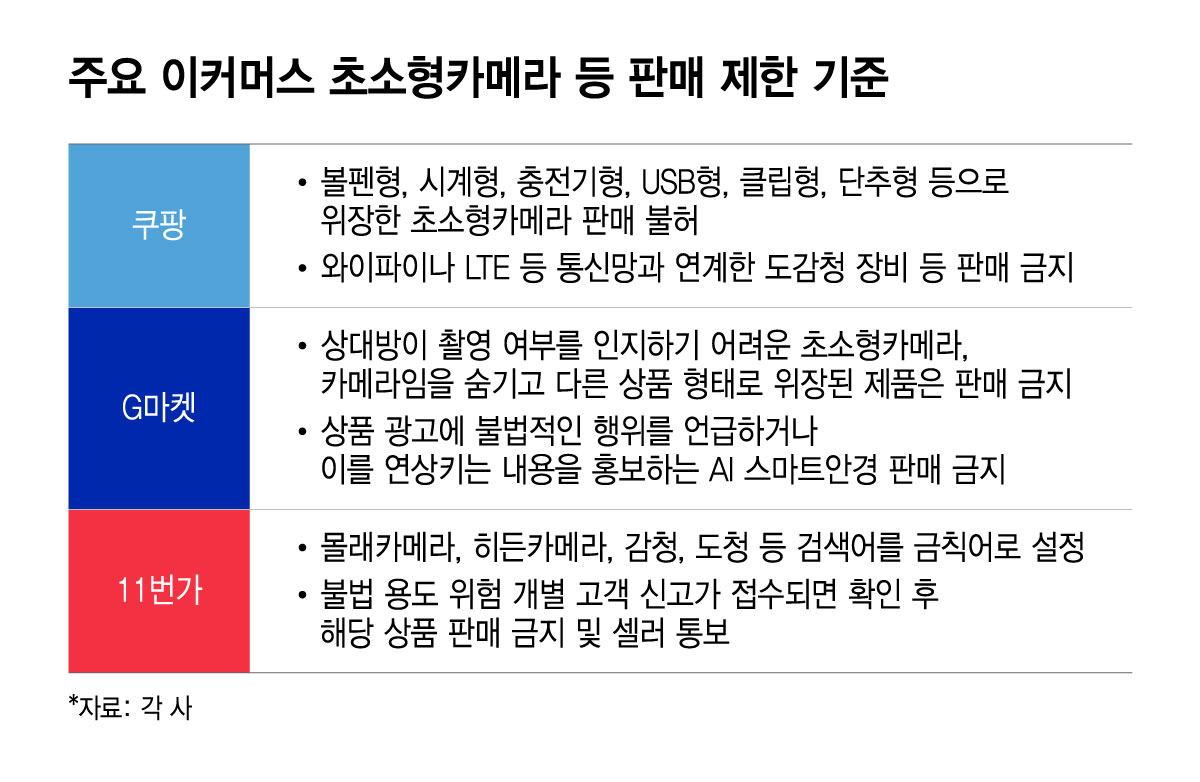
Coupang has listed cameras and ultra-miniature cameras disguised as pens, watches, chargers, USB drives, clips, power banks, and buttons, as well as glasses-type hidden cameras that are not recognized as cameras and whose recording status cannot be detected, as prohibited items under its marketplace terms of service policy, citing a high likelihood of use in crimes such as privacy violations.
It has also stipulated that equipment allowing third parties to secretly eavesdrop on conversations without consent from outside, or to transmit them in real time externally using communication networks such as Wi-Fi or LTE, and products for secretly tracking another person's location without their consent, are not permitted for sale.
A Coupang official explained, "We have registered keywords such as pen cameras, glasses cameras, power bank cameras (ultra-miniature), sunglasses cameras, eyeglass cameras, and car key cameras—items that cannot be recognized as cameras—as sales-blocking keywords on the open marketplace, and we continuously update and manage them."
Gmarket also prohibits the sale of products in the ultra-miniature camera category that are so small that it is difficult for the other party to recognize they are being recorded, or that are disguised in the form of other products making it hard to identify them as cameras.
Additionally, sales of AI smart glasses are restricted if product advertisements directly mention illegal activities or contain content evoking such activities.
On 11th Street, search terms such as "hidden camera," "spy camera," "eavesdropping," and "wiretapping" have been set as banned words, so no search results are provided. Other search terms are also monitored in real time, and if inappropriate content is found, it is blocked.
When individual customer reports are received, follow-up measures such as verifying the issue, prohibiting the sale of the relevant product, and notifying the seller are taken.
In particular, for products with a high risk of being linked to illegal activities, such as the ultra-miniature cameras and disguised cameras that have recently become an issue, the company plans to actively cooperate by prohibiting sales or blocking searches if recommendations or requests are made by relevant authorities.
However, industry experts point out that there are limits to completely blocking the distribution of related products. This is because current law lacks a basis for prohibiting the sale of ultra-miniature cameras and AI smart glasses.
The prevailing view is that it is not possible to fundamentally block the sale of all related products solely due to the possibility of them being misused for exam cheating. The decision to limit sales prohibition items to "disguised devices" that cannot be recognized as cameras was also made for this reason.
Furthermore, it is cited as a limitation that most related products, such as ultra-miniature cameras, are sold in the form of overseas direct purchases on open marketplaces, meaning platforms have limited authority to directly sanction sellers (vendors).
Even companies sanctioned for illegal sales can continue selling by changing their corporate name, which cannot be prevented. Currently, searching for "ultra-miniature camera" on some e-commerce platforms allows users to purchase overseas direct purchase products priced between 20,000 and 40,000 won.
Given the limitations of individual company responses, opinions are emerging that institutional reinforcement is necessary.
An industry official said, "Current law does not prohibit the sale of ultra-miniature cameras or AI smart glasses themselves; it punishes them only when the devices are used as means for crime."
The official added, "While each platform is making self-regulatory efforts by blocking searches for products with potential for criminal misuse, the environment is such that loopholes can arise at any time."
In the National Assembly, bills to manage modified cameras have been introduced multiple times since 2015, but each time they failed to pass the threshold of the National Assembly's standing committees and were discarded due to the expiration of their terms.
Concerns about industry contraction, limits in controlling overseas direct purchases, privacy violations (management of purchaser history), and difficulties in coordinating with the competent ministry are cited as background factors.

 in LIVING


