

As the delivery platform market grows year by year, the burden borne by franchise owners using delivery apps (applications) is also increasing. With rising fees, delivery costs, and in-app advertising expenses, owners are raising menu prices to offset these costs, a situation where that cost is passed on to consumers.
According to the Korea Food Service Industry Association on the 22nd, stores applying Baemin's (hereinafter Baemin) mutual benefit fee plan (within the top 35% of transaction volume) pay 6,235 won per order of a 21,000-won food item, including an intermediary fee of 1,802 won, a PG (payment gateway) fee of 693 won, and a delivery fee of 3,740 won. This amount corresponds to approximately 30% of the selling price.
The association explained that while the intermediary fee decreased by 462 won compared to Baemin 1 Plus fees (9.8% intermediary fee) before the introduction of the mutual benefit fee plan, the delivery fee increased by 550 won, resulting in an 88-won increase in the burden on the owner.
As the delivery market expands, nearly half of franchise store sales also come from delivery apps. According to the "December 2025 and Annual Online Shopping Trends" released by the National Data Agency in February last year, online transaction volume for food services was 36.9891 trillion won last year, a 12.2% increase from the previous year. In a survey of 186 franchise stores including chicken, coffee, and hamburgers released by Seoul City in June last year, 48.8% of franchise store sales came from delivery apps.
The burden of fees has also grown accordingly. In the same Seoul City survey, the proportion of delivery app sales accounted for by fees rose by 6.9 percentage points in one year, from 17.1% in October 2023 to 24% in October 2024. The average operating profit margin of franchise stores was 8.7%, among which the chicken industry had the lowest at 6.5% due to high fee burdens. In particular, in the chicken industry, the fee proportion (17.5%) was larger than labor costs (15.2%).
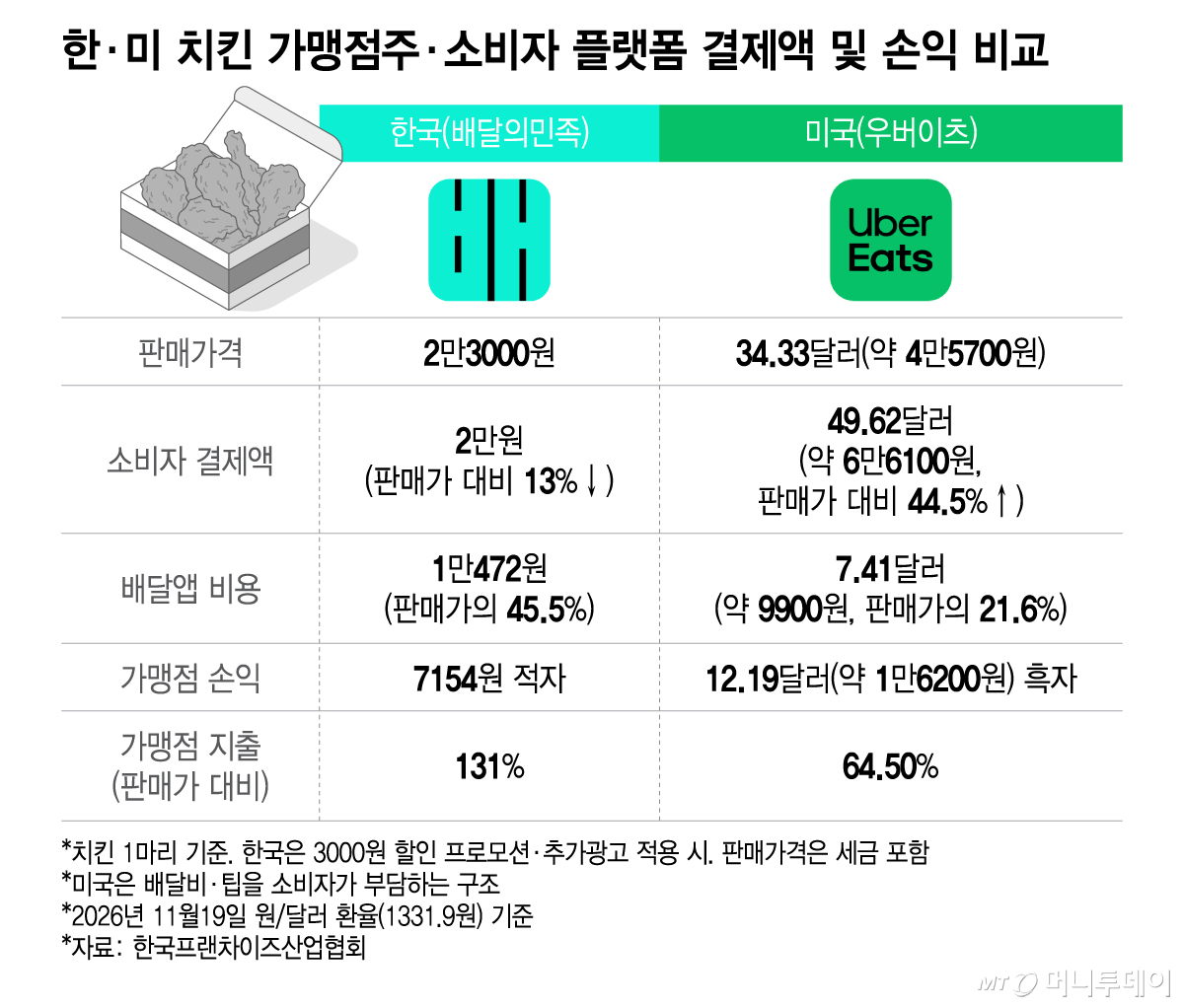
The difference in cost structures is even more distinct when compared with overseas. According to a comparison by the Korea Franchise Industry Association between Baemin in Korea and Uber Eats in the United States, consumers pay delivery fees and rider tips in the U.S., whereas owners bear the burden of discounts and delivery fees in Korea. Additionally, if both platforms apply a 3,000-won discount promotion to a 23,000-won chicken and attach advertising, Korean owners incur a loss of 7,154 won per bird, while American owners make a profit of $12.19 (approximately 16,200 won).
Industry analysis suggests that the burden on owners ultimately results in reduced benefits for consumers. According to the industry, discount amounts for delivery app promotional events are shared between the delivery app and the franchise, with headquarters and franchise stores typically covering more than half. A franchise official said, "When spending on promotional costs for delivery apps, marketing funds available for direct consumer benefits, such as accumulating membership points on our own app, decrease accordingly."
There are also voices stating that the burden on consumers is greater for single-person meal menus. Another franchise official said, "Since single-person meal brands have only one menu item, the delivery app fee relative to the order amount is inevitably large," adding, "To make a profit through delivery apps, we have no choice but to structure the menu as a set priced at 14,000 to 15,000 won, which is an expensive price for a single-person meal." He continued, "This will be the burden consumers feel when using delivery apps."

 in LIVING

