

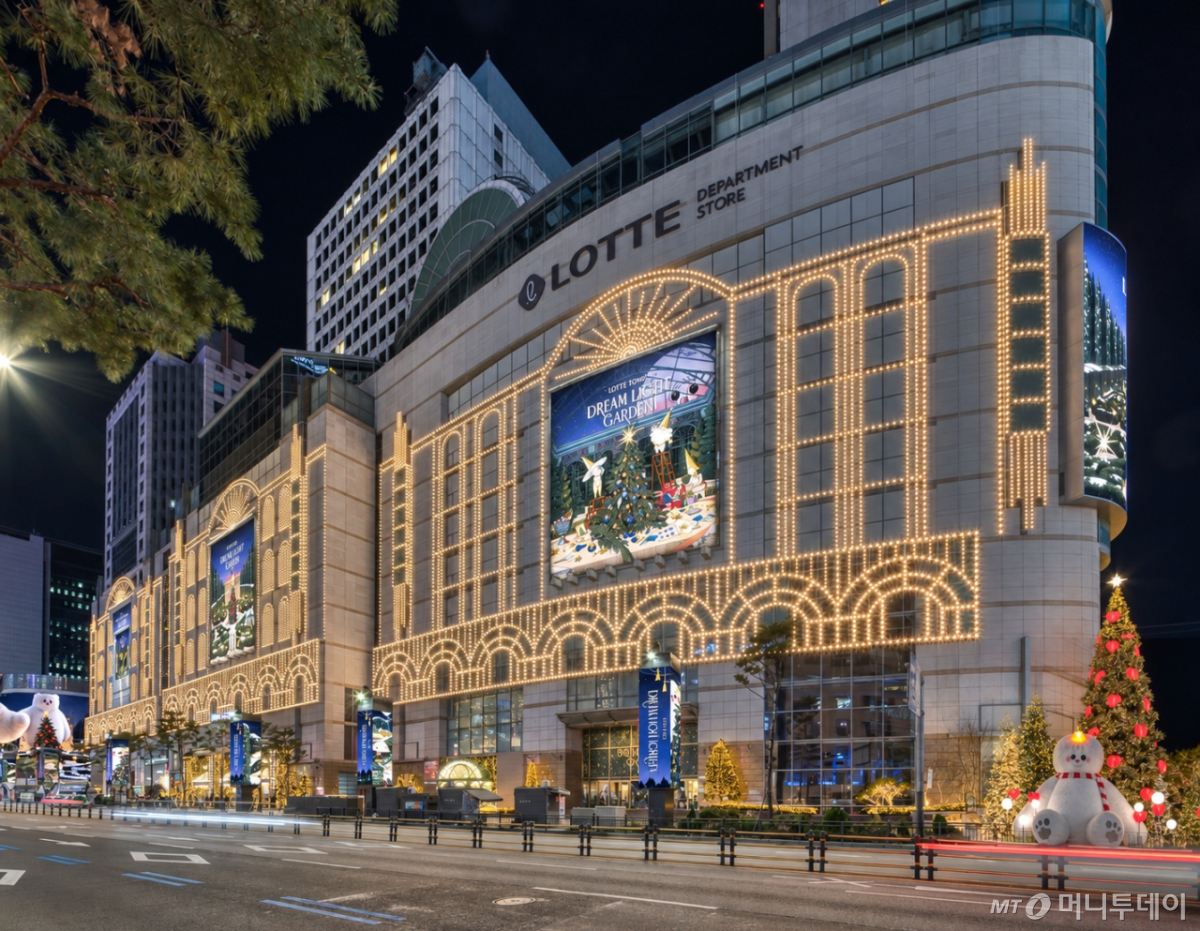
The department store industry, which had been on a high by setting new quarterly sales records through the third quarter of this year, appears to be slowing down in the fourth quarter. Analysts suggest that this is due to a combination of factors: reduced consumer spending power caused by the sharp decline in domestic and foreign stock markets since October, and an increase in foreign customers choosing duty-free shops over department stores due to the strong won (falling won-dollar exchange rate).
According to industry sources on the 24th, sales at the three major department store operators—Lotte, Shinsegae, and Hyundai—have shown slight year-on-year increases or near-flat performance since October this year. Lotte Department Store's same-store sales growth rate in the third quarter of this year was 11%, while large stores such as the Jamsil Store and Main Store recorded a sales growth rate of 15%. However, investment industry analysts note that the sales growth rate has slowed to the 1-2% range in the fourth quarter.
Shinsegae Co., Ltd. disclosed that its October sales were 671.6 billion won, a 2.0% decrease from the same period last year. Cumulative sales for the first three quarters of this year were 9.2592 trillion won, a 7.8% increase from the same period last year, but the sales growth trend reversed in the fourth quarter.
Hyundai Department Store is known to have seen its major store sales growth rate turn near-flat since October. Cumulative net sales for the first three quarters were 1.8908 trillion won, a 7.7% increase from the same period last year, but forecasts suggest fourth-quarter sales will decrease slightly compared to the previous year (681.8 billion won).
Industry observers interpret this trend as linked to stock market movements. An industry official stated, "Domestic luxury consumption began growing from the fourth quarter of last year when the stock market was on an upward trend, continuing through the first half of this year," adding that it has shown a slowing trend since the second half when the stock market turned downward.
In fact, the KOSPI index, which hit a record high of 9,114 points on June 22 last month, turned weak in July and showed a sharp decline from October. The KOSPI closing price on the 23rd was 4,708 points, down approximately 50% from its June peak.

It is interpreted that consumers who had surplus funds due to the stock market boom from late last year through the first half of this year increased their spending on luxury goods and high-end clothing at department stores, but this demand has significantly contracted as losses have widened with the recent stock market plunge.
Analysts also suggest that the exchange rate, which exceeded 1,550 won per dollar in the first half of this year but recently dropped to the 1,300-won range, has impacted the decline in department store demand. An industry official explained, "With the trend of a strong won emerging from the second half, foreign tourists have been given greater incentive to purchase goods at duty-free shops rather than department stores."
Consequently, the timing for record-breaking achievements at ultra-large department stores that had expected to surpass 4 trillion won in annual revenue (transaction volume) for the first time this year has also been delayed. Shinsegae Department Store's Gangnam Store, ranked first in domestic sales, originally expected to break the 4th trillion won annual revenue mark around the third week of November. However, with recent sales performance slowing, the forecast timing has been adjusted to mid-December, about a month later. Lotte Department Store's Jamsil Store was also likely to surpass 4 trillion won in annual revenue through the first half, but the atmosphere is currently less optimistic. It is viewed that achieving the target will require an all-out effort until year-end.
There are also predictions that this decline in department store sales will not be prolonged. Researcher Cho Sang-hoon of Shinhan Investment Corp stated, "We expect department store performance to overcome recent asset market adjustments through expanded spending power among high-income earners due to semiconductor bonus payments, renovations of major stores, and differentiated MD (merchandising) competitiveness."

 in LIVING

