

Until two days before the measure to raise the basic deposit requirement for single-stock leverage ETFs (exchange-traded funds) to 30 million won, only six of the top ten brokerages had posted related notices on their websites as of last month's 29th. The remaining four brokerages faced criticism for a "last-minute" response that failed to even inform customers until just before implementation.
As financial authorities urgently announced supplementary measures for single-stock leverage ETFs, swift responses from brokerages are now required. This is because brokerages, being closest to investors, must promptly notify them of changes such as the basic deposit requirement standards.
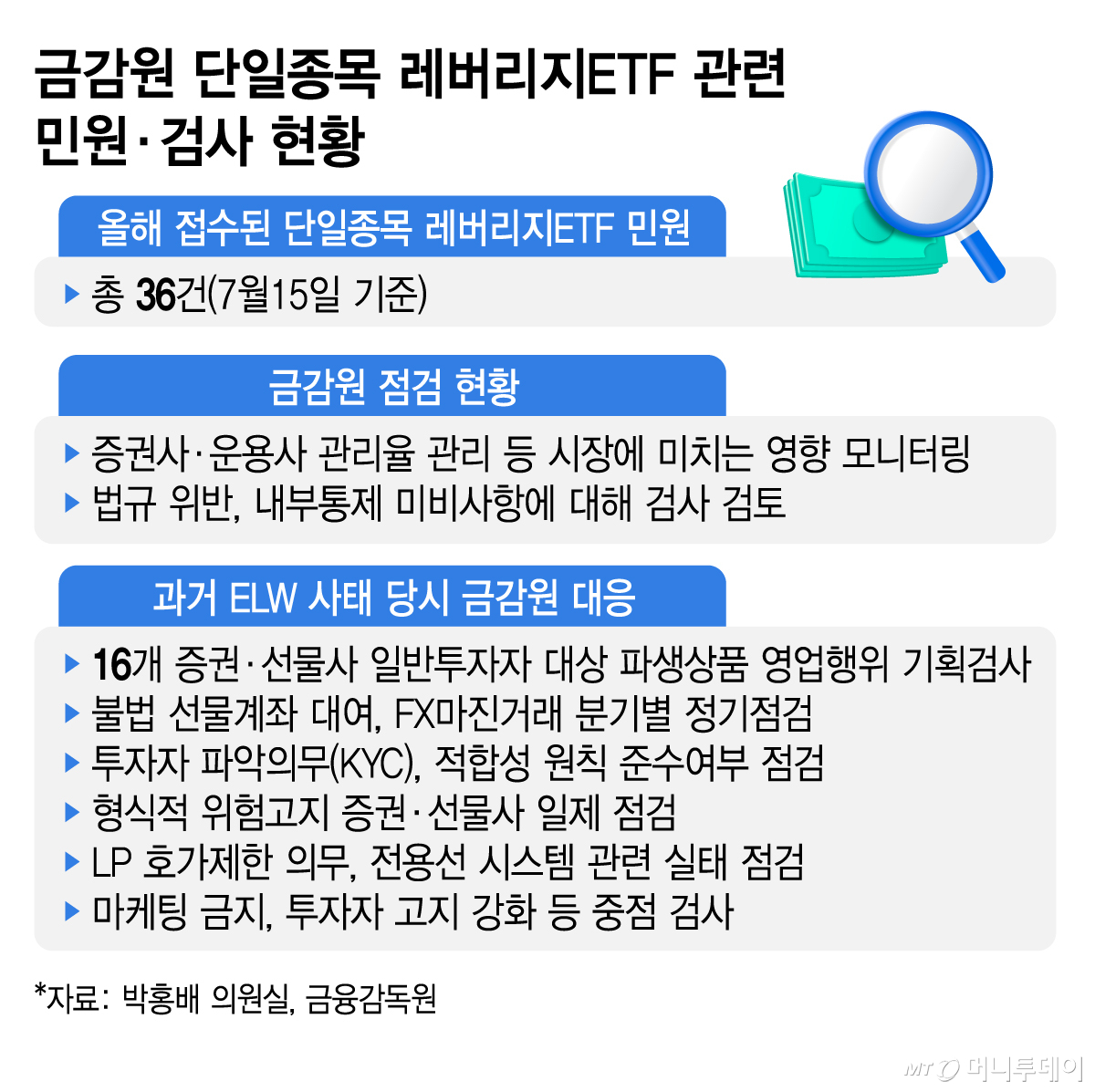
In this regard, the Financial Supervisory Service has stated it is also considering inspections targeting brokerages and asset management companies. If there are deficiencies in investor protection or internal controls, inspections could be conducted for verification. During the ELW (equity warrant) crisis, the Financial Supervisory Service had already carried out high-intensity planned inspections on securities and futures firms, leading to speculation that it may launch comprehensive supervisory oversight this time as well.
According to an inspection of the websites of the top ten brokerages by Money Today at 9 a.m. on the 3rd, NH Investment & Securities was the first to post specific details one week after financial authorities announced their first supplementary package containing the deposit increase on the 16th. Kiwoom Securities also began providing guidance relatively early. In contrast, other brokerages took no significant action until two days before implementation.
With opposition parties even discussing a national assembly investigation into single-stock leverage ETFs and questioning "who is responsible," there is growing speculation that regulatory authorities will impose high-intensity oversight similar to the ELW crisis. During the 2010–2011 ELW and FX (foreign exchange) crises, the Financial Supervisory Service conducted planned inspections on 16 securities and futures firms to verify whether there were issues in their derivatives trading practices. It also simultaneously checked whether they had faithfully fulfilled obligations such as investor identification (KYC), disclosure duties, and whether risk warnings were merely formalities.
For single-stock leverage ETFs, brokerages face strengthened responsibilities including prohibitions on marketing and mandatory enhanced investor disclosures, leading to expectations that the Financial Supervisory Service will meticulously examine cases of inadequate internal controls. However, the Financial Supervisory Service clarified on July 30 that it had not launched an investigation regarding allegations concerning some brokerages' dedicated lines for foreign HFT (high-frequency trading) firms.
According to materials submitted by the Financial Supervisory Service to National Assembly Member Park Hong-bae of the Democratic Party of Korea, a member of the Political Affairs Committee, on this day, the Financial Supervisory Service stated that it would "closely monitor the impact of supplementary measures on the market while considering whether inspections are necessary for legal violations or internal control deficiencies related to single-stock leverage ETFs."
Specifically, the Financial Supervisory Service indicated it will examine brokerages' (LPs/liquidity providers) and asset management companies' business practices and progress in managing deviation rates, including prohibitions on new listings and advertising of single-stock leverage ETFs until market stability is achieved, as well as enhanced responsibility for deviation rate management by brokerages and asset management companies.
With dozens of complaints already filed, the Financial Supervisory Service is highly likely to conduct focused inspections on single-stock leverage ETF business practices through regular, unscheduled, or planned inspections. According to materials submitted by the Financial Supervisory Service to Park Hong-bae (Rep.), a total of 36 complaints related to single-stock leverage ETFs were recorded this year. These complaints surged within just one and a half months from the ETF's listing on May 27 until July 15.
Dispute mediation complaints handled by the Financial Supervisory Service are typically resolved within 30 days, while other complaints are processed within 14 days. While responses may be issued by referring to existing dispute mediation and complaint resolution cases from the relevant department, new complaints of similar types may also be reviewed by respective industry departments. Major incidents such as large-scale incomplete sales often emerge from individual complaints (reports) that lead to unscheduled or planned inspections.
Amid continued criticism from retail investors and opposition parties for late supplementary measures, there are also calls for brokerages on the front lines of sales to fulfill their responsibilities. Park Hong-bae (Rep.) emphasized, "Given that the government has introduced additional supplementary measures, brokerages must promptly implement related actions." He added, "They must strengthen guidance to ensure investors fully understand the changed systems and take every precaution to protect investors."

 in STOCK
