

Financial authorities have announced plans to introduce an "Excessive Trading Fee" as a stabilization supplement for single-stock leverage ETFs (Exchange-Traded Funds) of Samsung Electronics and SK Hynix. The industry is raising concerns, warning that this could be like "burning down a thatched cottage while trying to catch a louse."
The Excessive Order Load Fee, which serves as the basis for the Excessive Trading Fee, is currently applied only in the derivatives market. Critics argue that imposing fees based on trading frequency could become a factor contributing to the "Korea discount." The industry, which had already expressed concerns regarding the introduction of an Excessive Order Load Fee in the securities market, maintains a cautious stance, stating that it should be operated temporarily and only for single-stock leverage ETFs.
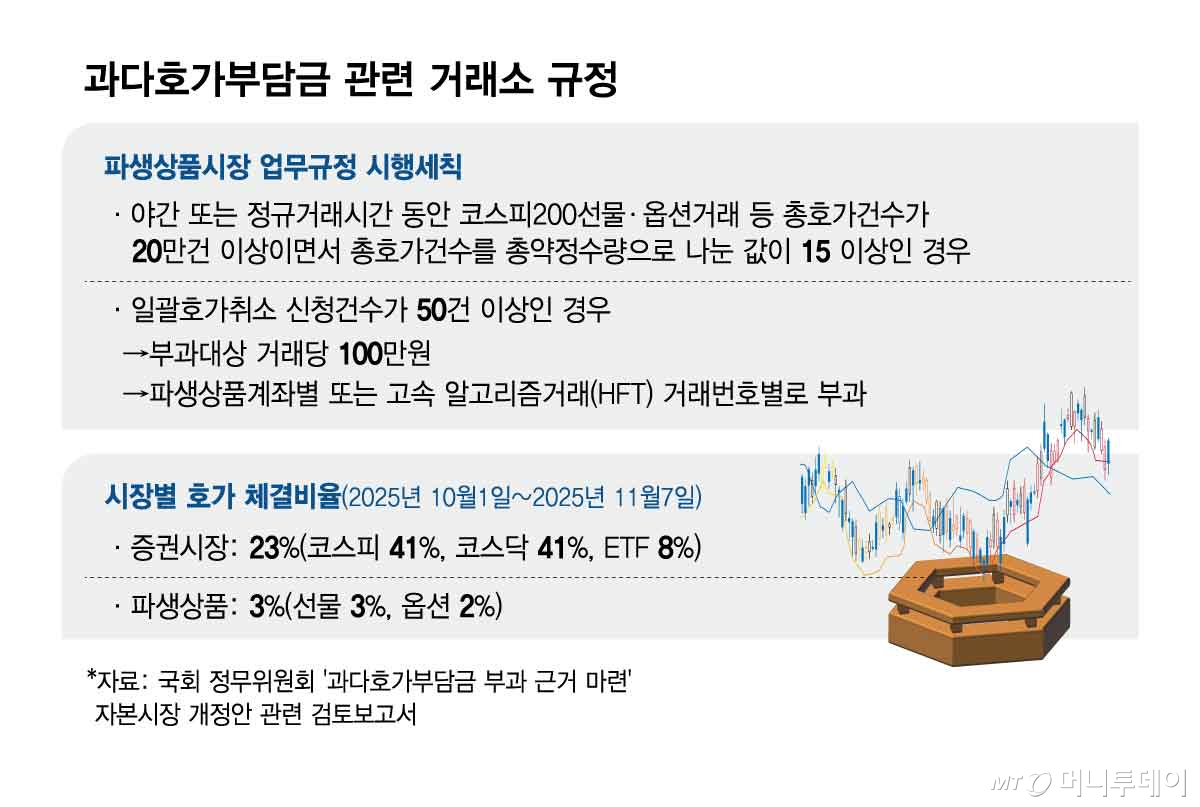
According to a MoneyToday investigation on the 4th, the exchange plans to design the scope and method of the Excessive Trading Fee for single-stock leverage ETFs by benchmarking the implementation rules of the Korea Exchange Derivatives Market Business Regulations. Under these regulations, an Excessive Order Load Fee of 1 million won per transaction is imposed if: (1) the total number of orders during regular or overnight trading hours for instruments such as KOSPI 200 futures reaches 200,000 or more and the ratio against total contracted volume exceeds a certain level; or (2) there are 50 or more bulk order cancellation requests. Fees would be levied per product account or per high-speed algorithm (HFT·high-frequency trading) transaction number, requiring investors to pay amounts directly to the exchange.
The issue lies in the industry's significant concern over extending the Excessive Load Fee system, currently applied only in the derivatives market, to the securities market. The industry has already expressed a "cautious" stance regarding the Capital Market Act amendment bill (sponsored by Kim Seung-won (Rep.)) that includes provisions for expanding the Excessive Order Load Fee to the securities market.
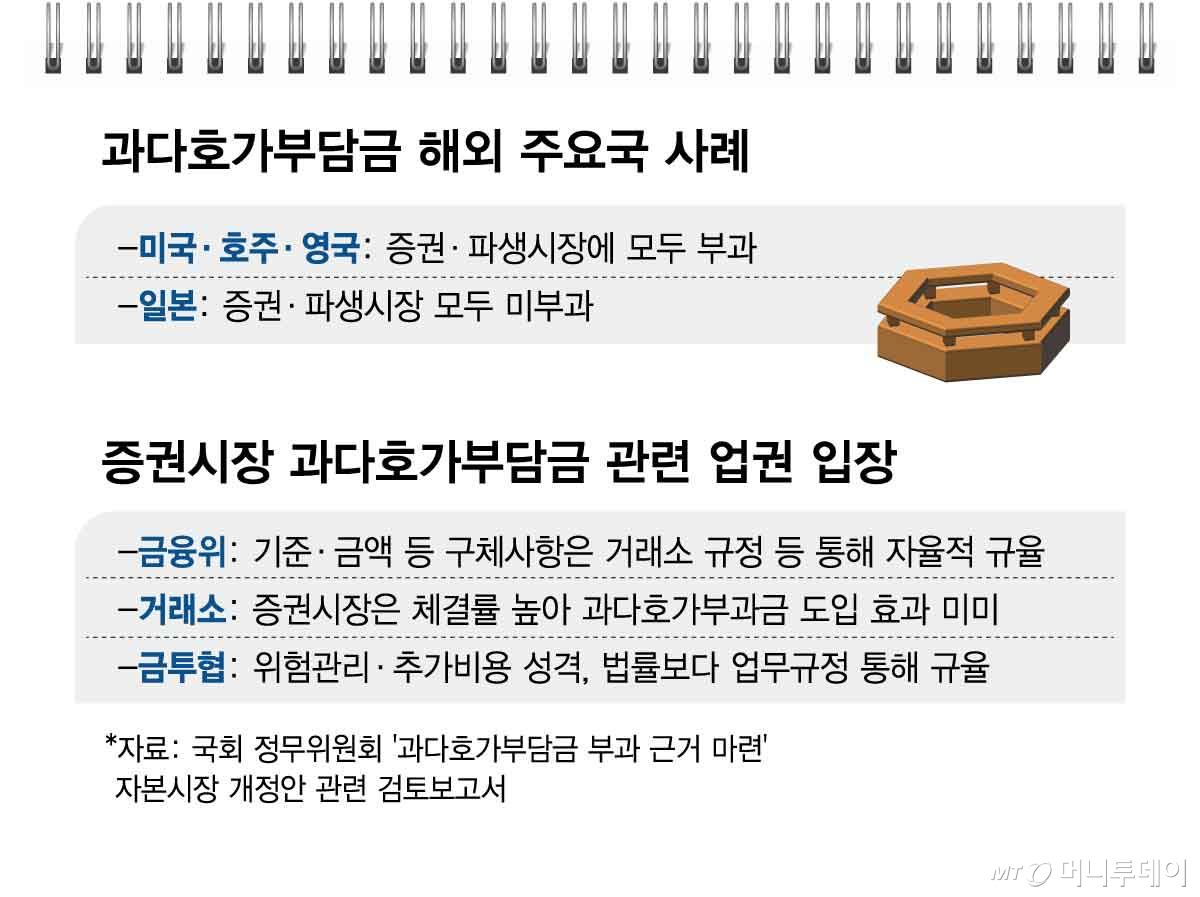
According to the review report on the Capital Market Act amendment bill by the National Assembly's Political Affairs Committee, as of October 2025, the order-to-trade execution ratio in Korea's securities market stood at approximately 23%, which is eight times higher than that of derivatives (3%). In response, the Financial Services Commission stated that "specific details such as criteria and amounts should be regulated autonomously through exchange rules," while exchanges clarified their position that "the securities market has a high execution ratio, so the introduction effect would not be significant."
The Excessive Trading Fee proposed by authorities for single-stock leverage ETFs imposes a form of penalty even on executed orders, leading to heightened industry concerns. An industry official stated, "Although details have not yet been released, if some retail investors are also required to pay the fee, transaction costs would become too high, resulting in 'the tail wagging the dog.'" The official added, "While there is a perception that foreigners or institutional investors disrupt the single-stock leverage ETF market through high-speed algorithmic trading (HFT), there is no precedent for imposing fees based on trading frequency."
Determining the criteria for 'excessive trading behavior,' as well as defining the scope and ratio of fee imposition, is also expected to face difficulties in detailed discussions. While the Excessive Order Load Fee in the derivatives market can set standards based on accumulated statistics, single-stock leverage ETFs have been on the market for only two months, resulting in a short time series.
Especially if the measure targets foreigners or institutional investors who primarily use HFT, it could lead to a decline in external credibility regarding the Korean stock market. A senior industry official noted, "While various countries including the U.S., UK, and Australia have introduced order load fees, there are no overseas cases of an 'Excessive Trading Fee.' Even HFT plays a role in supplying significant liquidity to the stock market." The official pointed out, "Imposing fees based on trading frequency is like burning down a thatched cottage just to catch a louse."
Some interpret the Excessive Trading Fee as targeting HFT transactions primarily used by foreigners and institutional investors. Another industry official remarked, "If raising the basic deposit requirement to 30 million won was a measure for 94% of retail investors, then the Excessive Trading Fee appears to be an attempt to reduce trading by some professional investors, foreigners, and institutional investors." The official further explained, "Higher transaction costs inevitably lower net returns, which means trading volumes by foreigners and institutional investors will also have to decrease."
The industry has also voiced opinions that the Excessive Trading Fee should be implemented temporarily and only for single-stock leverage ETFs. An industry official emphasized, "Even news about investigating foreign HFT activity alone has caused foreign investors to worry about penalty (regulatory) risks. Given the growing scale and attention of the KOSPI market, supplement measures for single-stock leverage ETFs must be operated very temporarily while considering international consistency."

 in STOCK

