

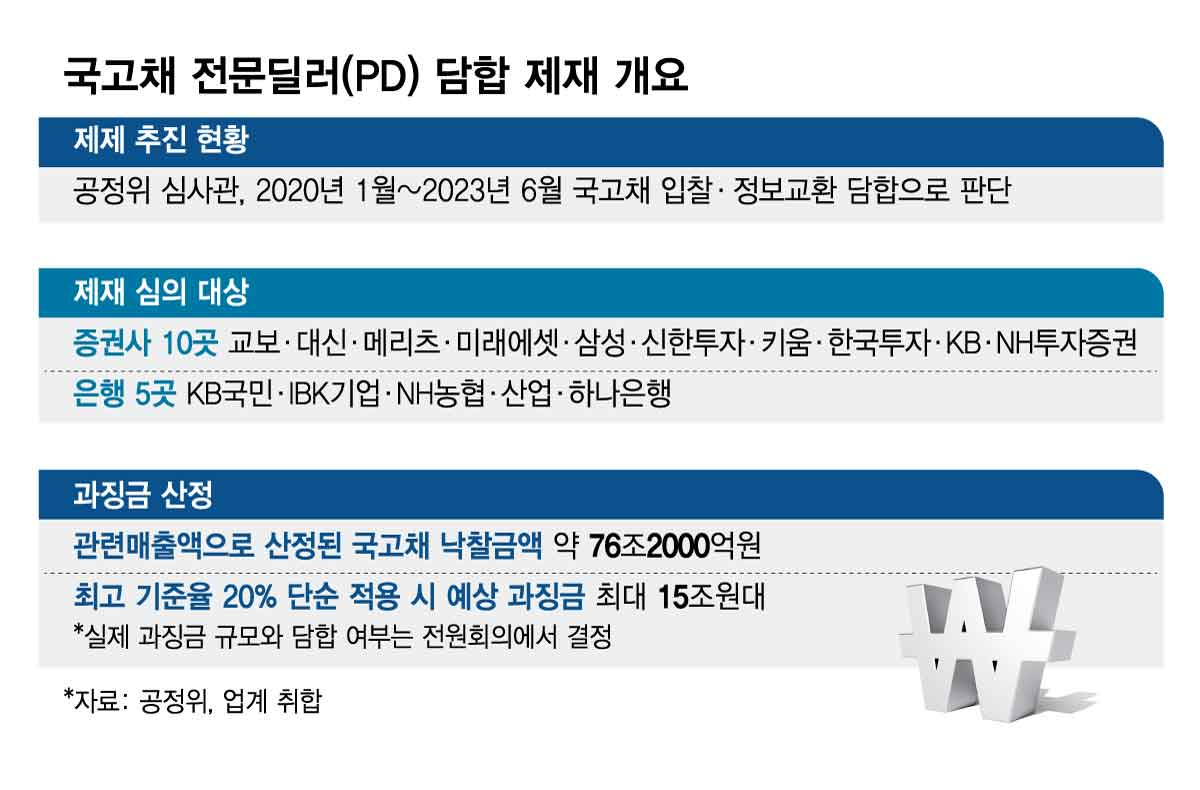
On the 6th, it was reported that the financial investment industry conveyed its opposition to the Fair Trade Commission's proposed penalties for Treasury bond Primary Dealer (PD) collusion, denying allegations of collusion and arguing that the fine calculation system is illegal. However, these views were not accepted. The financial investment industry expressed strong opposition, warning that the investigation results, which could result in fines reaching 15 trillion won—the largest in history—could burden the financial sector's financial soundness and Korea's external creditworthiness in capital markets.
Despite "Collusion Impossible" Opposition from Financial Sector... Korea Fair Trade Commission: "10 Securities Firms and 5 Banks Colluded"
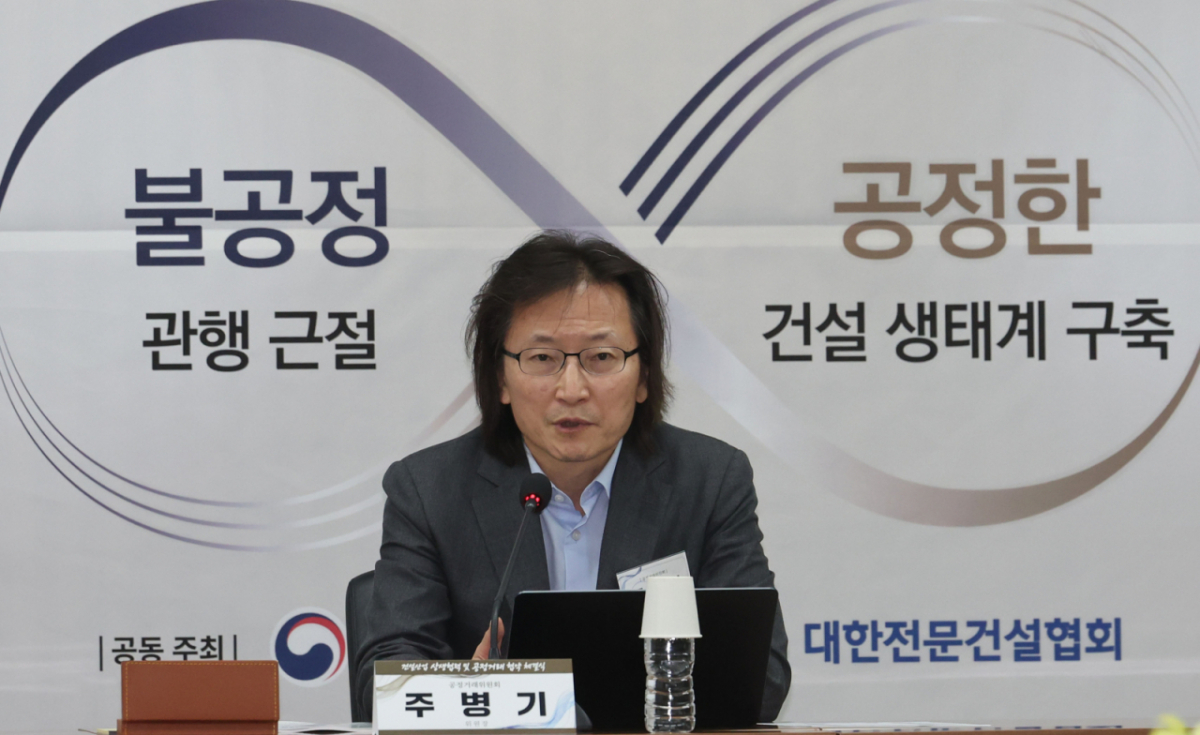
According to the financial investment industry on the 6th, the industry conveyed its opposition opinions regarding the Korea Fair Trade Commission's investigation into Treasury bond PD penalties, covering issues such as whether collusion occurred, the method of calculating fines, and the impact on the national economy. It is understood that the Korea Fair Trade Commission did not conduct separate hearings with relevant financial investment associations or organizations but directly heard opinions from the respondents, securities firms, and banks.
However, a Korea Fair Trade Commission examiner determined that 10 securities firms and 5 banks engaged in Treasury bond bidding collusion and information exchange collusion from January 2020 to June 2023. The examiner estimated the scale of bids affected by the collusion at approximately 76.2 trillion won and proposed corrective measures, imposition of fines, and filing criminal complaints against the corporations and current and former executives. Among PDs, the 10th securities firms subject to penalties include Kyobo, Daishin, Meritz, Mirae Asset, Samsung, Shinhan Investment, Kiwoom, Korea Investment, KB, and NH Investment & Securities. The 5 banks are Kookmin, Hana Bank, Industrial Bank of Korea (IBK), Agricultural Cooperative Federation (Nonghyup), and Woori Bank.
The financial investment industry argued that it is difficult for individual companies to agree on bidding conditions because PDs not only conduct their own bids but also act as agents for various institutional investors' orders. An industry official stated, "PDs participate in bids by acting as agents for numerous institutional investors such as insurance companies and pension funds in addition to their own bids, making collusion agreements between PD firms practically impossible." They further claimed, "Information exchange was merely for basic market information gathering, and according to the industry's economic analysis, it did not produce anti-competitive effects; in fact, information exchange sometimes led to lower winning bid rates."
Application of 'Extremely Serious Violation' Standard... Financial Sector Claims Illegal Calculation Formula; Korea Fair Trade Commission Effectively Refutes

This case is classified as an "Extremely Serious Violation" under the Korea Fair Trade Commission's detailed criteria for imposing fines, meaning fines can be calculated using the formula: "Relevant Sales Amount × Standard Rate (between 10.5% and 20%)." It is understood that if the Korea Fair Trade Commission applies the maximum standard rate of 20% to the known Treasury bond winning bid amount of approximately 76.2 trillion won designated as relevant sales, the calculated fine could reach up to 15.24 trillion won.
The industry argues that applying the winning bid amount to the fine calculation formula violates higher-level laws. This is because, under the Fair Trade Act, a financial institution's relevant sales should be calculated based on operating revenue. Another industry official stated, "If calculating operating revenue is difficult, a fixed fine of up to 4 billion won prescribed by law should be applied; interpreting the winning bid amount as relevant sales is an administrative convenience measure."
According to the industry, in capital markets, PDs act as de facto intermediaries who purchase Treasury bonds and then distribute them within a short period rather than holding them for their own portfolios. They also bear the market-making obligation to continuously provide buy and sell quotes in the distribution market. The industry argued that even if transactions resulting in losses occur, treating the entire winning bid amount as relevant sales could disrupt the balance between actual profits and the scale of penalties, violating the principle of proportionality.
In contrast, a Korea Fair Trade Commission official firmly refuted this, stating, "In this case, since the collusion occurred during the process where respondents purchased and bid for Treasury bonds, it is reasonable to consider both the purchase amount and the winning bid amount as relevant sales under the law."
Will Financial Sector Be Shaken by Trillion-Won Penalties?... Financial Authorities: "We Will Examine from Aspects of Soundness and Business Conduct"
Some segments of the industry predict that even if the Korea Fair Trade Commission takes the financial sector's circumstances into account, a standard rate in the high 15% range will likely be applied to this case. Although lower than the maximum standard rate on paper, there is a possibility that fines in the trillions of won could be imposed. In such a scenario, fines are expected to reach between approximately 8 trillion won and 11.4 trillion won.
Furthermore, the industry expressed concern that if PD qualifications were suspended or revoked due to penalties, it could disrupt Treasury bond issuance and national budget financing. They argued that with Korea's inclusion in the Global Bond Index (WGBI) starting last April, any issues with Treasury bond issuance and distribution could negatively impact South Korea's external creditworthiness in financial markets.
Some market observers also raised concerns that securities firms and banks subject to penalties would suffer massive financial damage if the penalties are finalized. A Financial Supervisory Service official stated, "We are taking this matter seriously," adding, "We will examine it heavily from aspects of soundness and business conduct."

 in STOCK


