

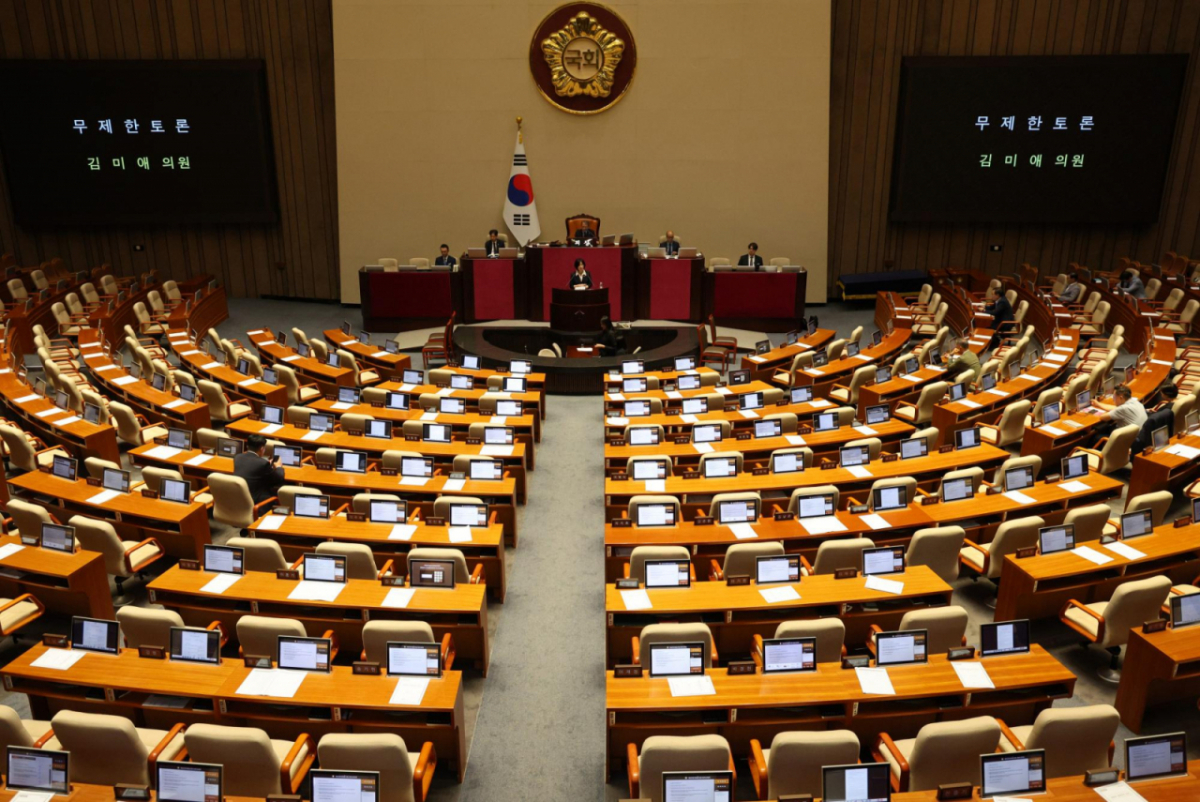
A revision to the Capital Markets Act, which stipulates that merger valuation should be determined based on fair value rather than benchmark price when companies merge, has recently passed the National Assembly Legislation and Judiciary Committee, leaving only the final step of passing the plenary session this month. Discussions on protecting minority shareholders triggered by the 2024 Doosan Bobcat case are expected to yield legislative results after two years.
According to political circles and others on the 6th, a revision to the Capital Markets Act that determines merger valuation based on fair value instead of benchmark price (stock price) when companies merge has passed the National Assembly Legislation and Judiciary Committee. With only the final hurdle—the plenary session deliberation at the National Assembly—remaining, it is widely expected to be finally approved.
The National Assembly, which has entered its extraordinary session this month, plans to accelerate legislative efforts. Among the major bills under consideration is the revision to the Capital Markets Act related to abolishing the benchmark price for merger valuation. Considering that a related bill was introduced in 2024, this would mark its passage after two years.
The revised bill, which passed the Legislation and Judiciary Committee as an alternative proposal, stipulates that when a publicly listed company undergoes mergers or similar actions, its valuation shall be determined based on fair value calculated by comprehensively considering factors such as stock price, asset value, and earnings value. The board of directors of the listed company must prepare and disclose an opinion letter regarding the purpose and expected effects of the merger, the appropriateness of the valuation, and other related matters.
In cases of mergers between affiliated companies, external evaluators shall be selected by the auditor or audit committee, and any conflicts of interest with the merging counterpart company must be disclosed. Matters such as criteria and methods for mergers, content and methods of disclosure, scope of external evaluators, and restrictions on evaluation work shall be prescribed by Presidential Decree. Violations may result in corrective orders, recommendations to dismiss executives, or restrictions on securities issuance by the Financial Services Commission.
Originally, the bill introduced by lawmakers also proposed provisions for compensation liability in case of investor losses and priority allocation opportunities for initial public offering shares to parent company shareholders, but these were not included in the alternative proposal.
Throughout the process of corporate mergers, growing dissatisfaction among minority shareholders regarding merger valuation has led to consistent calls for measures to protect them. When a disappearing company (target company) merges, its shareholders receive shares of the surviving company (acquiring company) as compensation. If the merger valuation of the disappearing company is not properly calculated, the number of shares received will vary. However, under current law, the method for calculating merger valuation is uniformly applied based on benchmark price, leading to claims that minority shareholders' interests are not adequately reflected.
Academic circles have also pointed out that using market price as a standard can lead to adverse effects. While theoretically, market price reflects the value of a company evaluated by the market and could serve as a standard, it is argued that intrinsic corporate value includes intangible assets such as synergy effects after mergers and the qualities of the company and management team, which are important factors. Major countries including the United States, the United Kingdom, and Japan leave the determination of merger valuation and exchange ratios to the autonomous judgment of merging companies.
The 2024 restructuring case of Doosan Group served as a catalyst, leading to the introduction of several revision bills commonly referred to as the "Doosan Bobcat Prevention Law." At that time, minority shareholders expressed strong dissatisfaction over the failure to properly recognize the corporate valuation of Doosan Bobcat, which was the disappearing company, bringing attention to the need for fair merger valuation and protection of shareholder rights.

 in STOCK
