

Following the New York Stock Exchange (NYSE), companies listed on NASDAQ and the Toronto Stock Exchange have shown interest in pursuing a second listing on KOSDAQ. They are discussing listing possibilities with domestic supporters and have submitted inquiries to Korea Exchange regarding review procedures. If North American companies successfully achieve a second listing on KOSDAQ, it is expected to help improve market credibility.
According to the financial investment industry and securities firms on the 11th, recently, an electric vehicle-related business listed on NASDAQ and a mining-related business listed on the Toronto Stock Exchange are considering a second listing on KOSDAQ.
These companies are reportedly exchanging communications with domestic law firms or securities firms to review the KOSDAQ listing review process and demand from domestic investors.
Shinhan Investment Corp is actively engaging with these companies and discussing plans to list Wonju in the KOSDAQ market through DR (depositary receipt) issuance. This concept is similar to how SK Hynix enabled domestic Wonju to be traded in the U.S. market via ADRs (American depositary receipts).
Earlier this year, an ESS (energy storage system) company listed on NYSE with a market capitalization of around 1 trillion won inquired about a second listing on KOSDAQ. The entity responsible for attracting this company's domestic second listing is also Shinhan Investment Corp.
As a result, a total of three North American-listed companies are currently reviewing a listing on the domestic KOSDAQ market. If realized in the future, it would become the first case of a North American company at the center of capital markets achieving a second listing on KOSDAQ.
Domestic stock market second listings have occurred twice before when Asian companies listed on KOSPI through DR issuance. However, issues such as accounting fraud and insufficient market capitalization arose respectively, ultimately leading to delisting.
The securities industry expects that if North American companies' second listings in the domestic market continue to materialize, the issue of market credibility—one of the objectives of policies aimed at activating the KOSDAQ market—will naturally improve.
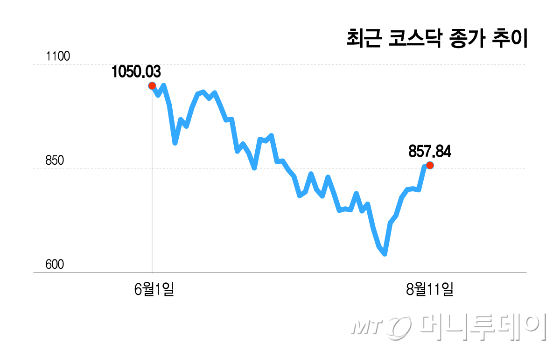
Since the beginning of this year, the KOSDAQ index has fallen by about 10% compared to the start of the year. By the end of July, the closing price dropped to 644.78, showing a decline of over 30% at one point. The liquidity freeze was largely influenced by the launch of single-stock leverage ETFs (exchange-traded funds), which caused supply and demand to concentrate only on certain KOSPI large-cap stocks and related products.
Thanks to market stabilization measures taken by authorities at the end of last month, the recent KOSDAQ index has been tracing an upward curve. Industry insiders believe that supply and demand issues have stabilized to some extent. Furthermore, if the credibility issue, which had long been identified as a chronic problem in the KOSDAQ market, is improved through successful second listings, it is expected that the KOSDAQ's upward trend will gain further momentum.
A securities industry official stated, "A second listing of North American companies does not simply mean adding one more listed company to KOSDAQ; it can be seen as recognition that our market is a valuable source of capital." He added, "Hong Kong and Singapore have recently taken active steps to support second listings by foreign companies, which are measures aimed at enhancing the credibility of their own markets."

 in STOCK
