

As the exodus of U.S. public pension funds from China becomes a reality, it has emerged that South Korea's National Pension Service (NPS) expanded its ties with China by investing in Hong Kong-listed companies banned from participating in U.S. Department of Defense procurement projects. The NPS invested in Zhongji Innolight, which listed on the Hong Kong Stock Exchange on July 30 and has emerged as a leading Chinese supplier of AI components amid the U.S.-China artificial intelligence (AI) dominance race. Zhongji Innolight manufactures optical transceivers, devices that convert electrical signals into optical signals and vice versa. Although the U.S. government plans to intensify regulatory pressure on Chinese AI-related companies in the coming months, it is understood that the NPS will be unable to retrieve its funds before January of next year due to lock-up restrictions.
National Pension Service Invests in Chinese Military Enterprise IPO; U.S. Pension Funds Accelerate Capital Withdrawal
According to pension funds and others on the 12th, the National Pension Service participated in Zhongji Innolight's IPO on the 20th through a cornerstone investment (a method of securing pre-IPO allocations) totaling $250 million alongside BlackRock-managed funds and others. This move came after the U.S. Department of Defense added 65 companies, including Zhongji Innolight, to its list of Chinese Military Companies (CMC) in June, bringing the total number of designated entities to 188. This marks the first confirmed case of the NPS making a new investment in a CMC-designated company. As of June 30, companies on the CMC list are prohibited from participating in U.S. Department of Defense procurement projects, and indirect procurement will be banned starting in June 2027.
The CMC list is a system established under the U.S. National Defense Authorization Act, whereby the Department of Defense designates entities based on ownership, control, or ties with the Chinese government or military, or contributions to civil-military integration. Previously, designation alone did not trigger direct U.S. sanctions, but this time, effective sanctions have been activated.
This stands in stark contrast to the trend of U.S. public pension funds withdrawing investments from China. In November 2024, state treasurers and auditors from multiple U.S. states, including Alabama and Pennsylvania, sent a joint letter urging public pension trustees to withdraw their Chinese investments. That same month, the Texas governor directed institutional investors in the state to divest from China.
Florida and Kansas have legally mandated disposal deadlines, while Indiana has restricted public pension investments related to China through state law. Considering these actions by U.S. public pension funds, the National Pension Service appears to be operating more like private capital than a public pension fund. BlackRock faced criticism during a 2023 House Select Committee on China investigation for allowing Americans' retirement funds to flow into companies developing weapons for the People's Liberation Army.
U.S. Moves Toward Legal Ban on Chinese Investments; National Pension Service Faces Few Economic Security Constraints
The withdrawal of funds from China by U.S. public pension funds resulted from a series of state laws and executive orders. Some U.S. public pension funds have begun enforcing regulations that prohibit Chinese investments amid escalating U.S.-China tensions. As the rivalry for global dominance intensifies, not only supply chains but also capital allocation methods are being restructured.
South Korea lacks legal mechanisms mandating restrictions or divestments from specific countries for pension funds. When asked whether it had recognized and reviewed its inclusion on the U.S. Department of Defense list, the National Pension Service responded that it could not disclose details of individual investments.
Some observers suggest that the NPS's recent Hong Kong IPO bet reflects the unique tendency of domestic pension funds to prioritize returns over geopolitical concerns. Indeed, Zhongji Innolight has been recognized as a company riding the wave of the AI infrastructure investment boom.
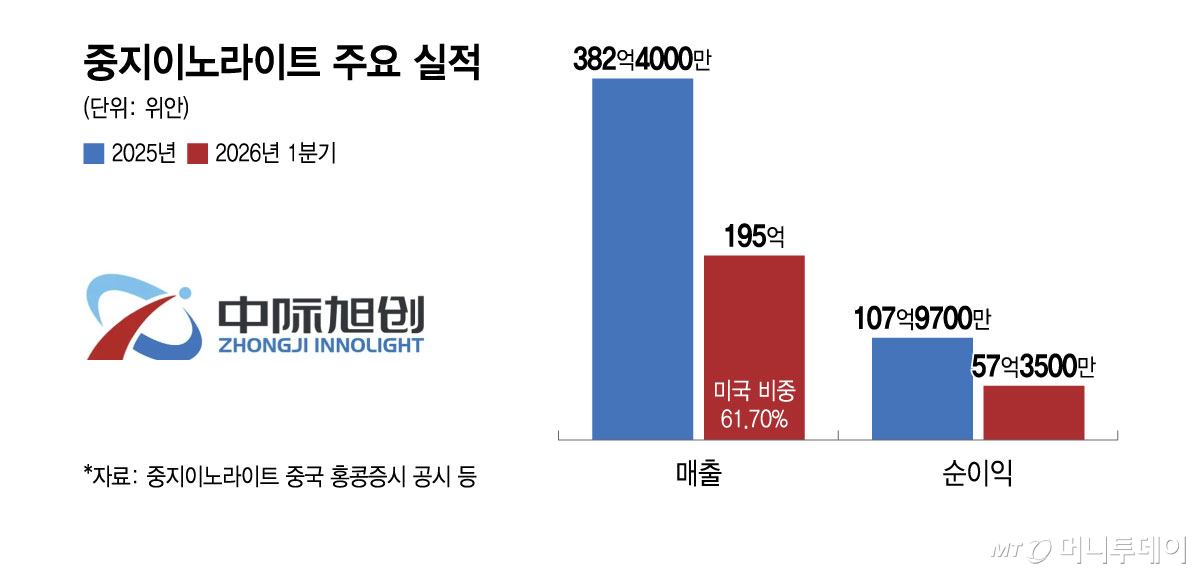
First-quarter revenue surged 192.1% year-on-year to 19.496 billion yuan, with 61.7% coming from the United States. However, the company is now considered directly vulnerable as the U.S. Federal Communications Commission (FCC) reviews a draft regulation to restrict imports of Chinese-made optical transceivers, aiming to announce it within the year.
Accumulating U.S.-Origin Regulations and Uncertain Fate of Retirement Assets; Locked-Up Investment Funds Cannot Be Withdrawn

However, even if regulations are fully implemented, the funds cannot be withdrawn. The portion of assets pre-allocated by the National Pension Service through cornerstone investment remains locked under lock-up restrictions until January 29, 2027.
Despite reports that China's "Hanhanryeong" (restrictions on Hallyu within China) remain in place in the cultural and arts performance sector, the NPS has contributed to capital raising for CMC-designated companies. While there is potential to reap profits from China's AI industry growth, some analysts argue that risks have been shared.
Some voices suggest that while managing returns and risks across the entire portfolio should remain a priority, the National Pension Service should distance itself from the approach of U.S. public pension funds withdrawing capital from Chinese markets. Considering the growth potential of China's market, there is an argument that betting on China remains necessary even if some losses or unrecoverable investments occur.
Im Chae-woon, a professor emeritus at Sogang University's Department of Business Administration and former ESG committee member at the Korea Minting, Printing and Security Printing Corporation, stated, "We must consider overall risk, investment losses, or bad debt ratios." He added, "In the worst-case scenario, delisting could occur, but this does not indicate corporate insolvency or lack of technological capability. Rather, it is a risk arising from U.S.-China regulations, which may eventually be resolved."

 in STOCK


