

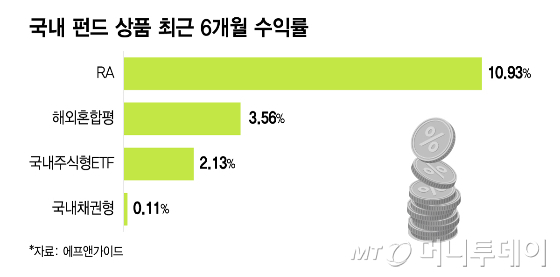
Robo-advisory (RA) funds based on artificial intelligence (AI) were the only category to post double-digit average returns over the past six months. This strong performance came amid significant market volatility since the second quarter of this year. However, despite their robust investment techniques for handling volatility, analysts note that activation remains sluggish due to insufficient growth in the number of products and net asset values falling short of expectations.
According to financial information platform FNGuide on the 12th, as of the 10th, the six-month average return for RA fund products stood at 10.93%. This significantly outperformed similar fund types managed by human fund managers—overseas mixed funds—which recorded an average return of just 3.56% over the same period, roughly one-third of RA’s performance.
RA is a portmanteau of “Robot” and “Advisor,” representing an investment approach where AI robots manage assets tailored to individual investor profiles. It was first introduced in Korea in 2017. Many overseas mixed funds (funds investing in foreign stocks and bonds) have adopted RA, making them a common benchmark for comparison. As data-driven investments, RAs are widely regarded as advantageous for achieving relatively stable returns in highly volatile environments.
Indeed, even during the past six months—a period marked by extreme volatility with the KOSPI 200 Volatility Index (VKOSPI), considered Korea’s version of the VIX (Fear Index), soaring to the high 90s—RA funds were the only major product category to deliver double-digit returns compared to other key investment groups.
Specifically, average returns over the same period were as follows: domestic equity funds at 5.69%, domestic equity ETFs (exchange-traded funds) at 2.13%, domestic mixed funds at 4.98%, domestic bond funds at 0.11%, overseas equity funds at 9.34%, overseas equity ETFs at 9.84%, and overseas bond funds at -2.88%.
By product, Mirae Asset TIGER AI Korea Growth Active Securities Exchange-Traded Fund (Equity) posted the highest return of 23.15% over six months, followed by E-Global AI Plus Securities Investment Trust (H)[Equity] Class C-F at 15.23%, and E-Global AI Plus Securities Investment Trust (H)[Equity] Class C-I at 15.03%, all achieving double-digit average returns.
Despite demonstrating such stability in volatile markets after approximately a decade of introduction, RA investment activation remains distant within Korea’s capital market.
Only 13 products have exceeded the initial establishment amount of 1 billion won, and total net assets reached just 210.9 billion won as of the 10th of this month. Notably, the number of products with establishment amounts exceeding 1 billion won has decreased from 18 last year to just 13—a drop of five. In particular, compared to domestic ETFs totaling approximately 316 trillion won in net assets, RA’s scale remains negligible.
Meanwhile, the global RA investment market is steadily expanding. According to data from the Korea Capital Market Institute, the global RA market size is projected to grow from $97.5 billion (approximately 138 trillion won) in 2020 to 2.4 trillion won (approximately 340 trillion won) by 2029.
A securities industry official stated, “It is difficult to ignore the domestic investor preference for personally executing buy and sell orders.” The official added, “To ensure investment stability, securities firms and asset management companies must design more sophisticated algorithms and actively promote that RA investments can minimize variables in highly volatile markets.”

 in STOCK
