

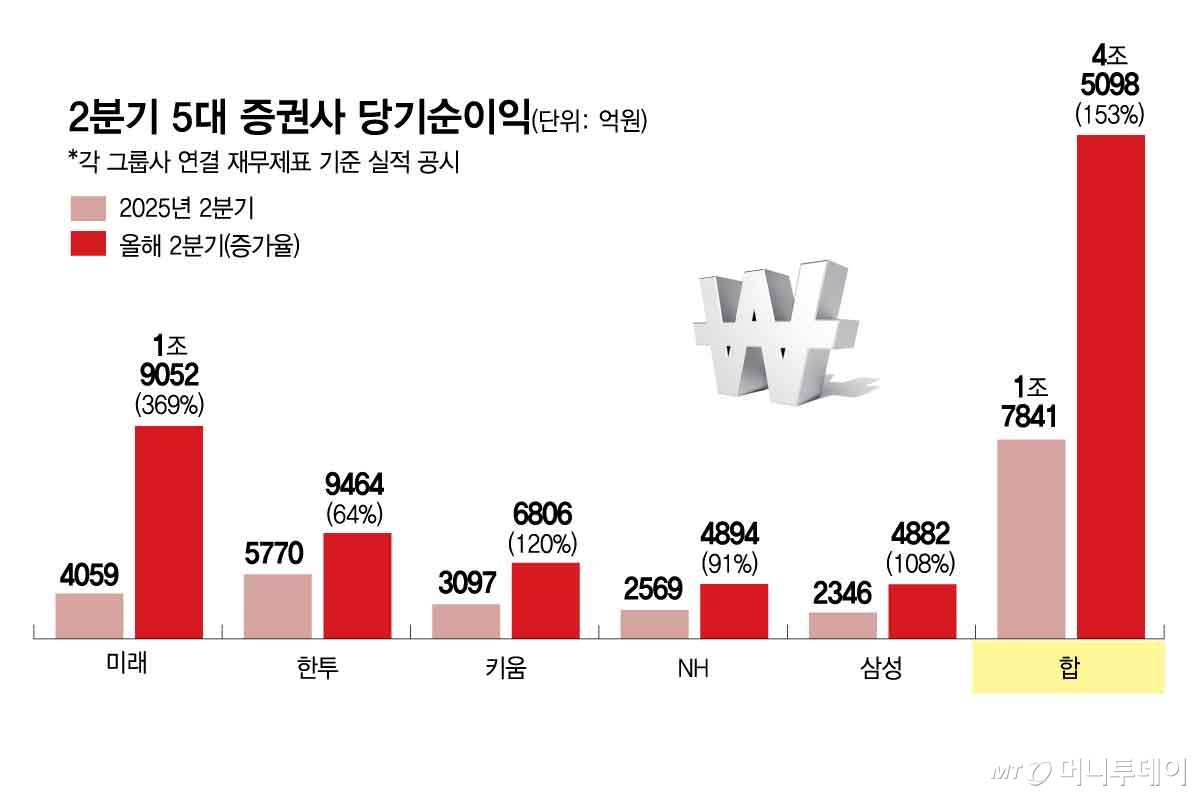
The top five brokerages recorded their highest-ever performance this year, posting a combined net profit of 7.8 trillion won. As the KOSPI index climbed to 9,110 in June, trading volumes for stocks and ETFs (exchange-traded funds) surged, boosting fee income, interest income, and investment income. A defining feature was that they generated record-breaking profits in the retail and WM (wealth management) sectors rather than in IB (investment banking), with net profit jumping 153% in the second quarter alone.
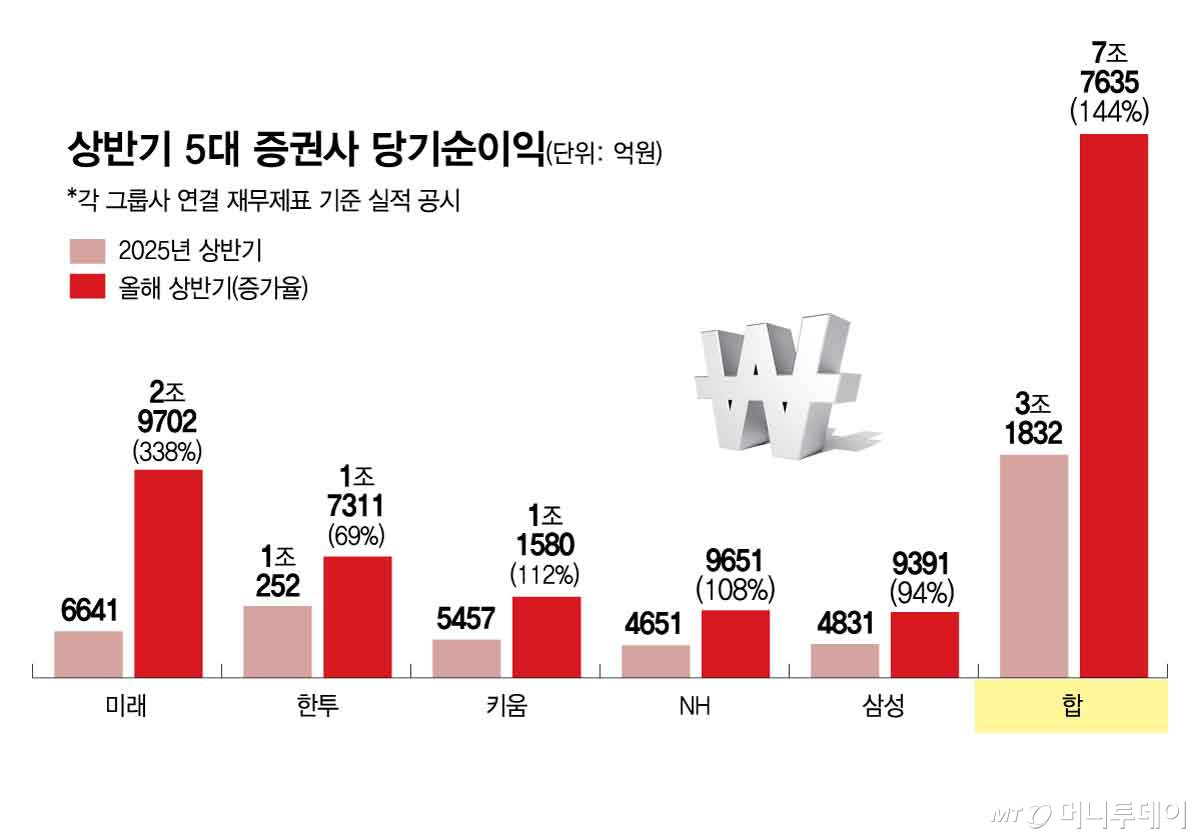
According to the financial investment industry on the 12th, the combined net profit of the top five brokerages this year (Mirae Asset Securities, Korea Investment & Securities, Samsung Securities, NH Investment & Securities, and Kiwoom Securities) totaled 7.7635 trillion won. This represents a 2.4-fold increase compared to the first half of last year (3.1832 trillion won), marking a 144% rise over one year.
Notably, Mirae Asset Securities posted a net profit of 2.9072 trillion won in the first half of this year, surpassing Korea Investment & Securities, which had held the top spot in the first half of last year, to claim the title of 'Leading Brokerage.' Mirae Asset Securities' net profit growth rate reached 338%, vastly outpacing its peers. Korea Investment & Securities recorded a net profit exceeding 1 trillion won again this year (1.7311 trillion won), following its performance in the first half of last year (1.2502 trillion won). Retail powerhouse Kiwoom Securities posted 1.158 trillion won, surpassing the 1st-trillion-won mark for the half-year period, while NH Investment & Securities (965.1 billion won) and Samsung Securities (939.1 billion won) are on the verge of joining the '1 Trillion Won Club.'
In the second quarter, the brokerages set a new record, surpassing their previous all-time high. The top five generated a combined net profit of 4.5098 trillion won: Mirae Asset Securities (1.9052 trillion won), Korea Investment & Securities (946.4 billion won), Kiwoom Securities (680.6 billion won), NH Investment & Securities (489.4 billion won), and Samsung Securities (488.2 billion won). This represents a 2.5-fold increase compared to the second quarter of last year (1.7841 trillion won), marking a 153% rise over one year.
The surge in stock and ETF trading volumes driven by the KOSPI rally directly led to these record-breaking results for brokerages. Brokerages earn brokerage (intermediary) fees as compensation for connecting investors with the Korea Exchange when they trade securities such as stocks and ETFs. According to the Korea Exchange, the monthly average KOSPI trading volume jumped from approximately 27 trillion won in January this year to 50 trillion won each in May and June.
As the monthly average trading volume rose to 50 trillion won, brokerage profits also increased accordingly. Mirae Asset Securities, which holds a 12% share of the domestic stock commitment market, saw its brokerage fee income rise by 36%, from 459.4 billion won in the first quarter to 625.6 billion won in the second quarter. Brokerage profits alone for Mirae Asset Securities exceeded 1 trillion won in the first half of the year. Hanwha Investment & Securities' brokerage profit also surged by 41%, from 248.6 billion won (based on separate financial statements) in the first quarter to 349.7 billion won in the second quarter.
Kiwoom Securities, with a 25% share of the individual stock trading market, recorded stock fee income of 311.5 billion won in the first quarter and 451.9 billion won in the second quarter.
In addition to intermediary fees from direct investor trading, WM (wealth management) fee income from financial product sales and advisory services also increased. Samsung Securities, which has a high proportion of high-net-worth individuals, saw the number of customers with assets exceeding 0.1 billion won jump by 88% year-on-year in the second quarter to 572,000 (from 305,000 one year prior). Individual customer assets grew from 356 trillion won to 652 trillion won during the same period, while financial product sales revenue increased by 225% to 115.4 billion won. This was driven by increased sales of products such as structured notes, wrap accounts, and funds.
Interest income, once considered the exclusive domain of banks, has become an indispensable 'star performer' in brokerage results. As individual stock trading grew, margin lending transactions also surged, expanding brokerages' interest income. In the second quarter this year, Kiwoom Securities' net interest income from credit extension reached 138 billion won, a 63% increase over one year. NH Investment & Securities reported net interest income of 265.5 billion won in the first quarter and 252.4 billion won in the second quarter, generating a net profit exceeding 500 trillion won in the first half alone.
While performance in the IB sector, including rights offerings (paid-in capital increases) and M&A (mergers and acquisitions), varied among brokerages, investment income increased across the board. In particular, with ETF net assets surpassing 500 trillion won and ETF trading becoming active in the second quarter, it is analyzed that investment income for brokerages acting as LPs (liquidity providers) also rose alongside this trend. NH Investment & Securities' product management profit and loss reached 289.2 billion won in the second quarter, a 156% increase over one year, while Mirae Asset Securities' trading and other financial profit and loss hit a record high of 1.2419 trillion won for the first half of the year.
Stock trading volume, the top contributor to the record-breaking performance in the first half, is not a positive factor for the second half. The average trading volume in July was approximately 37 trillion won, a 26% decrease compared to June. Industry observers also anticipate that brokerage and WM fee income will inevitably decline given the drop in stock trading volume this month. Additionally, increased sales and administrative expenses due to performance-based bonuses following rapid profit growth, as well as expanded education tax burdens resulting from changes in the education tax rate, are cited as further challenges.

 in STOCK

