

Brokerages, previously overshadowed by banks, are now challenging the banking sector’s stronghold with record-breaking profits. Riding a bull market in the first half of this year, major brokerages have posted quarterly net profits ranging from hundreds of billions to over 1 trillion won, with some already surpassing the performance of large banks. Even within financial holding companies dominated by banks, the profit contribution from brokerage subsidiaries is growing rapidly. While banks continue to serve as the stable profit foundation of the financial sector, brokerages are emerging as a new core profit driver alongside capital market growth.
Hana Securities and Kiwoom Securities Overtake Some Large Banks…Brokerage Firms Gain Prominence Within Financial Holding Companies
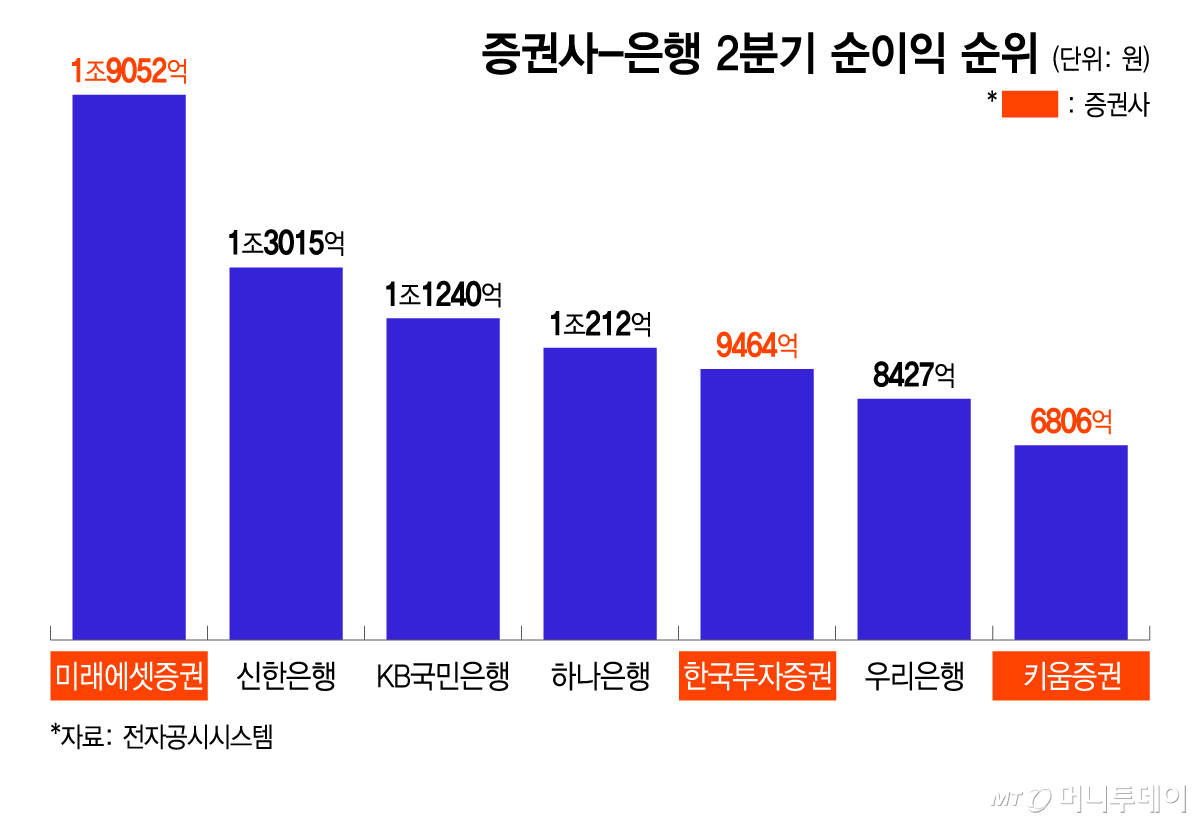
A comparison of second-quarter net profits between major banks and brokerages clearly reveals the shifting status of brokerage firms. According to the financial investment industry on the 12th, Mirae Asset Securities posted a second-quarter net profit of 1.9052 trillion won, surpassing all five major banks. It exceeded Shinhan Bank (1.3015 trillion won), KB Kookmin Bank (1.1240 trillion won), and Hana Bank (1.2120 trillion won). Korea Investment & Securities (946.4 billion won) surpassed Woori Bank (842.7 billion won), while Kiwoom Securities (680.6 billion won) also posted higher net profits than NH NongHyup Bank (605.2 billion won). The quarterly profits of major brokerages have grown to a scale comparable with those of key banks.
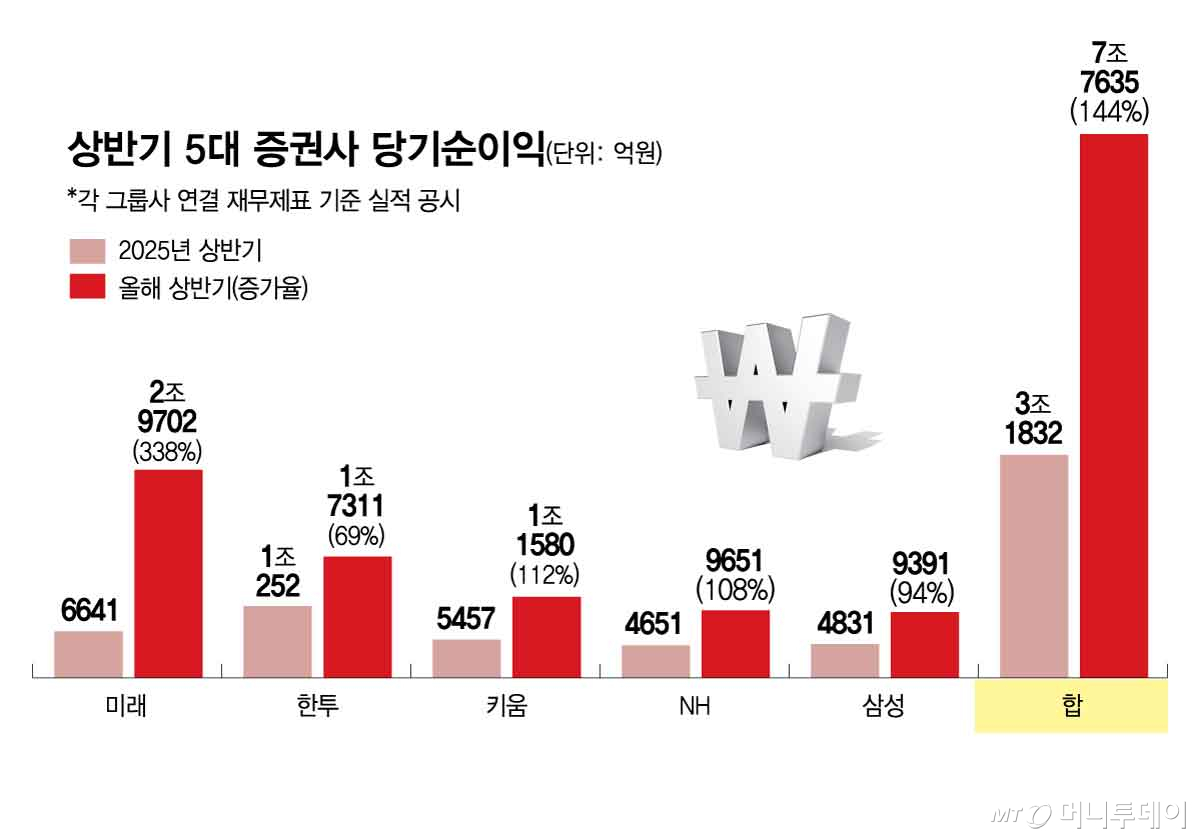
The rise of brokerages is also evident within financial holding companies. The combined second-quarter net profit of the five major financial holding company-affiliated brokerages—NH Investment & Securities, KB Securities, Shinhan Investment Corp., Hana Securities, and Woori Investment & Securities—reached approximately 2.6370 trillion won this year, more than doubling compared to the same period last year. In the first half of this year at NH NongHyup Financial Group, NH Investment & Securities’ net profit (965.1 billion won) rose to 83% of NH NongHyup Bank’s net profit (1.1629 trillion won).
KB Securities and Shinhan Investment Corp. also strengthened their presence in terms of performance share within the holding company. KB Securities recorded a net profit of 796.3 billion won in the first half, a 135% increase year-on-year, while Shinhan Investment Corp. posted 577.7 billion won, up 123%. Although banks remain at the center of total profits for financial holding companies, brokerage subsidiaries strongly supported additional profit growth for these groups this year.
The fact that financial holding companies are bolstering brokerages’ capital strength also reflects their changing status. KB Financial Group invested 700 billion won in KB Securities last February and added another 1 trillion won in July. NH NongHyup Financial Group also expanded capital for NH Investment & Securities by 400 billion won in June. Woori Financial Group injected 1 trillion won into Woori Investment & Securities this year, raising its own capital to the 2nd trillion won level. This demonstrates how financial holding companies are expanding the scale of their brokerage subsidiaries to secure growth drivers beyond banking.
Capital is flowing into brokerages because own capital directly affects operational competitiveness. As own capital increases, firms gain greater capacity to execute large-scale transactions in corporate finance, M&A financing, and venture capital supply. The size of own capital is also a key requirement for designation as a comprehensive financial investment firm and for entering new businesses such as issued bills and IMA (Integrated Investment Accounts).
“Clear Signal That Financial Sector’s Profit Landscape Is Shifting Away from Bank-Centric Model”
Recent expansion in brokerage profits has also been influenced by the movement of funds into capital markets. A bull market has increased trading volumes in stocks and ETFs (exchange-traded funds), boosting brokerage commissions. Rising credit lending has also expanded interest income. Additionally, as rising stock prices increase client assets, fees from financial product sales and wealth management (WM) have grown. The inflow of long-term assets such as retirement pensions and pension savings into brokerages has also broadened their revenue base.
Banks generate relatively stable profits based on loans and interest rate spreads but face growth constraints due to household loan management and capital regulations. In contrast, while brokerages are vulnerable to market volatility, they can simultaneously expand multiple revenue streams—including brokerage services, WM, investment banking (IB), and trading—if the capital market grows.
There are also limitations in simply comparing the profit scales of banks and brokerages. Bank profits tend to be more repeatable, whereas brokerage performance fluctuates significantly depending on stock market conditions, transaction volumes, interest rates, and valuation gains or losses on held assets. In fact, Mirae Asset Securities’ second-quarter net profit surpassing all major banks was decisively influenced by gains from the valuation of SpaceX.
In the financial investment industry, there is a view that brokerages are not replacing banks but rather growing as the second core profit pillar of the financial industry alongside capital market expansion. Additionally, given that recent brokerage profit volatility is greater than that of banks, some experts caution against concluding a structural reversal between banks and brokerages based on just one or two quarters of performance.
A financial investment industry official stated, “The signal that the financial sector’s profit landscape is shifting away from being bank-centric is becoming clearer,” adding, “It remains to be seen how much further the status of brokerage firms will grow within Korea’s traditionally bank-centered financial industry.”

 in STOCK

