

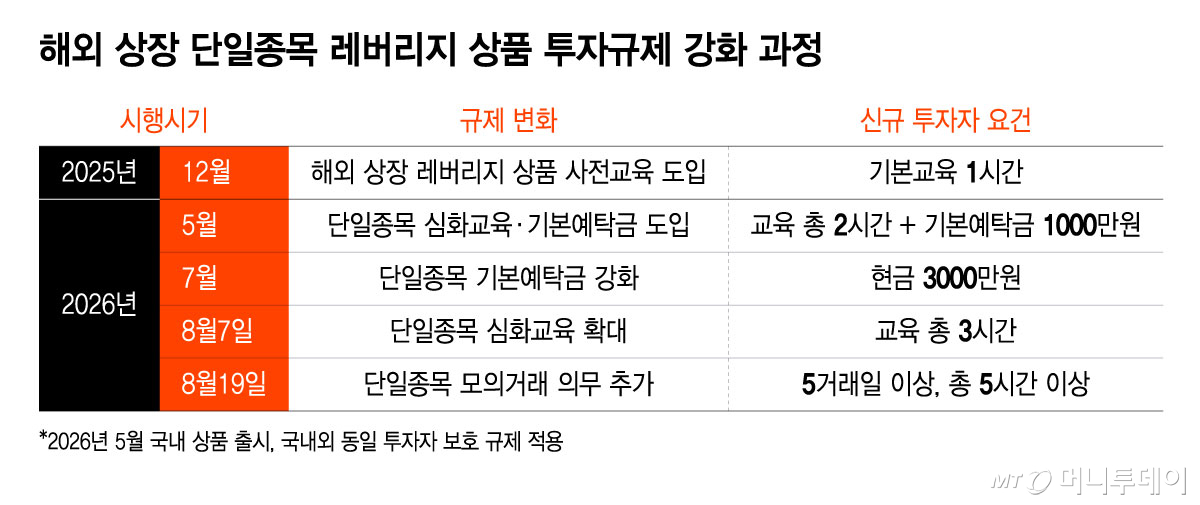
As restrictions on single-stock leverage products have been tightened, investments in overseas products that retail investors in overseas stocks have traded are also becoming more difficult. Government policies launched to resolve the "asymmetric regulation" between domestic and foreign markets are ironically adding new constraints to existing investment methods rather than expanding investors' choice options.
Even before single-stock leverage products listed domestically were introduced, retail investors in overseas stocks had been trading U.S.-listed products such as Tesla and NVIDIA in significant volumes. However, following the launch of domestic products, concerns over investment overheating and expanded market volatility led to strengthened regulations, raising the entry threshold for overseas products as well.
The authorities maintain that since the structure and risks of domestic and foreign products are identical, the same protective measures are necessary. However, some retail investors in overseas stocks have expressed dissatisfaction, arguing that a policy launched to expand domestic investment choices has ultimately made new investment procedures for overseas products more cumbersome.
Investment barriers for single-stock leverage products listed overseas rise alongside regulatory hurdles
According to the financial investment industry on the 13th, new investors in single-stock leverage products (ETFs and ETNs) will face an additional procedure of simulated trading starting from the 19th, beyond the already implemented requirements of a basic deposit of 30 million won in cash and three hours of pre-instruction training.
Those seeking to invest in newly listed overseas products are not exempt either. Instead of using separate programs based on overseas market data such as those in the U.S., investors must complete simulated trading using Korea Exchange data based on domestic information. To make new investments in single-stock leverage products listed overseas, a minimum of five days and over five hours of simulated trading is required.
Single-stock leverage products listed overseas constitute a separate market where domestic investors have invested significant funds even before the introduction of domestic products. According to Korea Securities Depository's Save-Ro, as of May 26, one day before the launch of domestic single-stock leverage products, the amount held by domestic investors in "Direxion Daily Tesla Bull 2X Shares" (TSLL), which tracks twice the daily return of Tesla, reached $2.43986 billion (approximately 3.46 trillion won).
However, whenever regulations have been strengthened amid controversies surrounding domestic Samsung Electronics and SK Hynix single-stock leverage products, the tightened investment requirements have also been applied to overseas products. One retail investor with experience in single-stock leverage product investments stated, "While we welcomed the introduction of domestic products as it expanded investment choices," adding, "Although I understand that risk education is necessary, requiring education and simulated trading procedures before investing in new overseas products creates a very cumbersome entry barrier." He further remarked, "From an investor's perspective, overall investment choices have narrowed."
"Is identical regulation for domestic and foreign markets the best investor protection?"
There is also room for debate regarding the requirement for investors in single-stock leverage products listed overseas to undergo simulated trading using domestic data. While both domestic and foreign products share the same basic structure of tracking daily returns of individual stocks by a multiple, their actual investment environments are not identical. The U.S. market differs from the domestic market in terms of trading hours and market conditions, and domestic investors are also exposed to exchange rate fluctuations.
Financial authorities explain that the purpose of simulated trading is not to experience risks across all overseas investments but to familiarize investors with the specific risks inherent in single-stock leverage products themselves. Core risks such as negative compounding effects and leverage effects remain identical regardless of whether the product is listed in domestic or foreign markets. A financial authority official stated, "It is difficult to incorporate exchange rate factors into these measures, as exchange rate risks exist equally not only for leverage products but also for general overseas products."
Financial authorities maintain that regulating overseas products is not a belated response to overheating in the domestic market. From the outset of promoting the introduction of single-stock leverage products domestically, the system was designed to apply identical investor protection principles to both domestic and foreign products. Consideration was also given to the possibility of a "balloon effect," where investment demand would shift to overseas products if only domestic products were subject to strengthened regulations. If the risks of domestic and foreign products are the same but investor protection levels differ, investment demand could migrate toward markets with relatively weaker regulations.
Nevertheless, the outcome produced by this policy is paradoxical. From the perspective of some investors, a policy aimed at eliminating differences between domestic and foreign markets to expand choice options has ultimately resulted in applying higher investment thresholds even to overseas investment markets that existed prior to the introduction of domestic products. This represents a paradox where the government's original policy objectives have partially faded.
An official from the financial investment industry remarked, "It is necessary to reconsider whether applying identical procedures for both domestic and foreign investments solely on the grounds that these are high-risk products constitutes the best investor protection." He added, "There is also a need to explore ways to design regulations more precisely based on investors' experience levels and understanding of risks."

 in STOCK
