

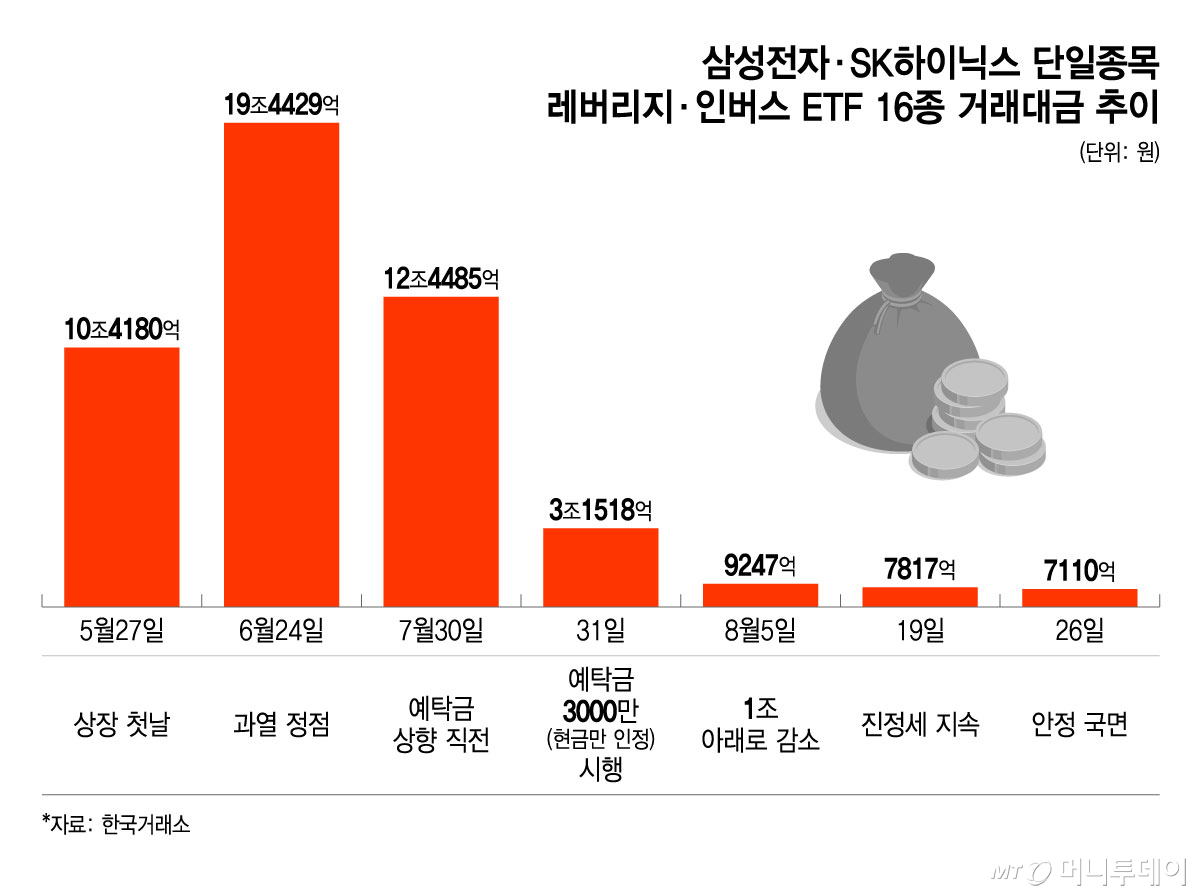
The "2x Betting" frenzy, which once saw daily trading volumes exceeding 12 trillion won, has subsided. Within less than a month of strengthened regulations, the trading volume for 16 single-stock leverage/inverse exchange-traded funds (ETFs) based on Samsung Electronics and SK Hynix, which had at one point soared well above 10 trillion won, dropped sharply to around 700 billion won. As financial authorities raised the entry threshold for investors, excessive short-term trading and concentration in specific products quickly calmed down.
According to data from Korea Exchange on the 26th, the total trading volume of 16 single-stock leverage/inverse ETFs based on Samsung Electronics and SK Hynix reached 711 billion won. This represents a 94% drop compared to 12 trillion 448.5 billion won on the 30th, just before the strengthening of basic deposit requirements.
Financial authorities have diagnosed that the market has entered a stable phase. A financial authority official stated, "The trading share of single-stock leverage products in the overall market has decreased, and the market capitalization representing the size of these products is maintaining a stable level." If the decline in trading volume indicates a cooling of trading enthusiasm, the reduction in trading share suggests that the concentration of trades on specific products has eased.
The market also evaluates that the single-stock leverage turmoil has subsided. An official from a securities firm said, "In fact, the concentration phenomenon placed a significant burden on securities firms' systems and raised considerable concerns for the entire securities market. With regulatory effects leading to a stable state, companies are also relieved."
Single-stock leverage products based on Samsung Electronics and SK Hynix first appeared in the domestic stock market on May 27. From the day of listing, trading volume for the 16th ETFs reached as high as 10 trillion 400 billion won, indicating intense investor concentration. Later, on June 24, daily trading volume surged to 19 trillion 442.9 billion won.
The issue was not limited to trading scale. Concerns were raised that the rebalancing process, where asset management companies buy and sell underlying stocks daily to meet target leverage ratios, could increase price volatility for Samsung Electronics and SK Hynix. With trades concentrated in products based on a few large-cap stocks, there were fears of exacerbating concentration in specific stocks. Additionally, it was pointed out that investors holding these products over the long term face risks of losses due to "volatility drag," where cumulative returns fail to reach simply twice the return of the underlying stock as prices fluctuate repeatedly.
As overheating continued, financial authorities introduced measures from mid-last month to significantly raise the entry threshold for investors. The core measure involved basic deposit requirements. Previously, individual investors purchasing single-stock leverage products were required to post a basic deposit of 10 million won; this was tripled to 30 million won. Additional conditions were strengthened, such as recognizing only cash (excluding substitute securities) as eligible for the basic deposit.
Immediately after the announcement of these measures, trading enthusiasm did not subside. On the 20th, trading volume stood at 12 trillion 326.4 billion won, showing little difference from pre-announcement levels. However, once the strengthened deposit regulations were actually implemented, the situation changed rapidly. Trading volume fell below 1 trillion won in early this month and has not returned to previous levels since. The National Assembly Legislative Research Service evaluated that strengthening deposit requirements could significantly limit investors' participation in trading.
While overheating has subsided, the challenges posed by this incident remain. A decline in trading volume does not necessarily signify a successful effort in investor protection. Entry regulations such as raising basic deposits had an immediate effect in curbing overheating. However, concerns have been raised that these measures could restrict investors' product choices or divert investment demand toward overseas products. The future task is to establish a regulatory framework that keeps the door open for innovative investment products while effectively controlling overheating and preventing investor harm.

 in STOCK
