

Analysis suggests that the Bank of Korea’s hawkish monetary policy stance has widened the decline in the Korean stock market during sharp sell-offs. The argument is that a rate-hiking trend increases corporate interest burdens and drags down equity valuations. While the domestic stock market has exhibited a ‘RollerKOSPI’ (roller coaster + KOSPI) pattern this year, the KOSPI index’s gain has been only half that of the Taiwan Weighted Index, the representative benchmark for the Taiwanese stock market.
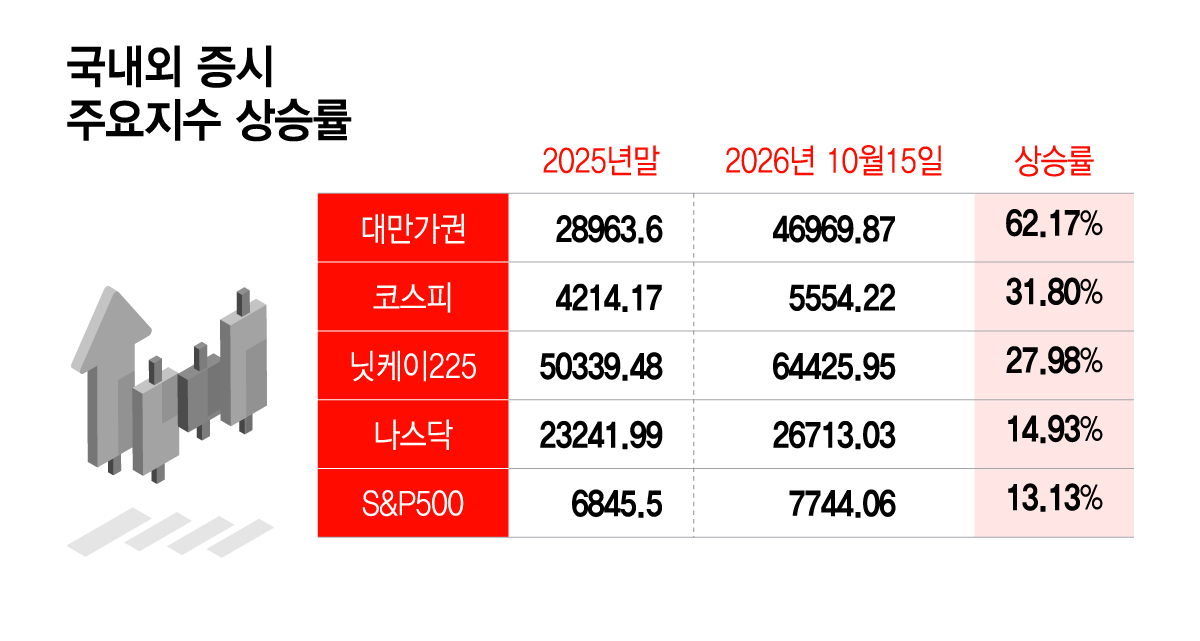
According to financial investment industry sources on the 17th, the KOSPI index closed at 5,554.22 on the 15th, up 31.80% from the end of last year. Over the same period, the Taiwan Weighted Index rose 62.17% to 46,969.87. The U.S. S&P 500 index stood at 7,744.06 on the 15th (local time), up 13.13% from the end of last year, while the NASDAQ index climbed 14.93% to 26,713.03. Japan’s Nikkei 225 index rose 27.98% from the end of last year to 64,425.95 on the same day.
The KOSPI fell by as much as 7.57% on the 15th. On the same day, the Taiwan Weighted Index dropped 3.41%, meaning the KOSPI’s decline was more than double that of the Taiwan Weighted Index.
The backdrop for the sharp drop in the KOSPI index was the outflow of foreign capital. Foreign investors made net sales worth 3.7659 trillion won on the KOSPI that day. Retail investors and institutional investors made net purchases worth 1.4381 trillion won and 1.6747 trillion won, respectively. The reasons cited for the foreign investor exodus include rising global long-term interest rates and concerns over a slowdown in artificial intelligence (AI) investment.
Market observers predict that as the Bank of Korea intensifies its tightening moves, the Korean stock market faces an increased likelihood of stronger downward pressure compared to major economies. High interest rates increase corporate interest burdens and weigh on equity valuations, which are calculated by discounting future earnings to present value.
In fact, NH Investment & Securities diagnosed that the reason the Korean stock market has been hit harder than Taiwan is “because the Bank of Korea is particularly hawkish.” NH Investment & Securities expects the Bank of Korea to pursue additional rate hikes, given its forecast of 3.5% for next year’s Korean economic growth rate. However, it noted that there may be room to adjust the policy stance if fears regarding stock market and corporate debt repayment risks grow.
![[Seoul=NEWSIS] Reporter Cho Seong-woo = Bank of Korea Governor Shin Hyun-song answers questions from lawmakers during the National Assembly’s Fiscal, Economic and Planning Committee’s national audit at the Bank of Korea in Jung-gu, Seoul, on the 12th. October 12, 2026. xconfind@newsis.com / Photo by Cho Seong-woo](https://thumb.mt.co.kr/cdn-cgi/image/f=avif/21/2026/10/2026101615415672208_2.jpg)
Bank of Korea Governor Shin Hyun-song explained during the national audit on the 12th that he raised the base rate consecutively in July and August to preemptively curb the spread of inflation and respond to financial stability risks.
Taiwan’s monetary policy environment is different. The Central Bank of Taiwan froze its policy rate for the 10th consecutive time on the 17th of last month (local time). The consumer price inflation forecast presented by the Central Bank of Taiwan for this year is 2.03%.
Semiconductor stocks, a key sector in the stock market, also showed differing downside support during the sharp decline. On the 15th, TSMC fell only 2.01%, while Samsung Electronics and SK Hynix plunged 9.48% and 11.06%, respectively. It appears that the differing conditions each company faces in the semiconductor sector have been reflected in stock prices alongside industry outlooks.
TSMC is the world’s largest company in the foundry (semiconductor contract manufacturing) field, which involves producing semiconductors based on designs by clients. In contrast, memory semiconductors, the mainstay of Samsung Electronics and SK Hynix, are produced and sold by a few companies with similar products, causing prices to fluctuate significantly according to supply and demand; an increase in competitors leads to downward price pressure.
The Japanese and U.S. stock markets also carry concerns over AI investment returns and additional U.S. rate hikes. However, on the 15th (local time), the New York stock market saw government bond yields fall and buying concentrate in consumer stocks, pushing the Dow Jones Industrial Average up 1.08% from the previous day to 52,177.69. The NASDAQ index’s gain was limited to 0.08%. Weakness in AI-related stocks was partially offset by gains in other sectors.
NH Investment & Securities predicts that while the domestic stock market may need time to find direction due to regulatory concerns surrounding the U.S. midterm elections, it could rebound after confirming a bottom twice once supply and demand pressures ease.

 in STOCK

